Incredible!
- Still
The first volume of
this book has a chapter on "The Same Baba", where many facts that convince us about the identity and
continuity of the Sai Baba at Shirdi and the Sai Baba at
Puttaparthi were mentioned.
Baba refers to Himself always as Sai Baba; the
name Sathya Sai Baba is being used only to avoid legal and
administrative complications with institutions and organizations that
have grown round 'the previous body' and its admirers. When the
Chairman of the Shirdi Samsthan, charged with the duty of administering
the properties and the ceremonials of worship at Shirdi, where the
'previous body' is laid to rest, hesitated to swallow the 'Vibhuthi' materialized by the 'present body' (Sri
Sathya Sai Baba) because he feared it might be a sacrilege, Baba gave
him a sign, to convince him that the two are the same. His picture on
the wall of that room in Bombay gave forth a flash of brilliant light,
and the dark doubt in his heart was gone!
When Tidemann
Johanessen of Norway was before the Shirdi Shrine, an old man appeared
before him and giving him a small picture of Sathya Sai Baba and also a
small quantity of Udi,
directed him to see the present
Avatar in Bombay, on the
thirteenth day of March! No one had any inkling of the visit to Bombay
in March of Sathya Sai Baba at that time. Later, when on 13th March, he
met Baba at Bombay, Baba convinced him that he was informed at Shirdi
by Him alone.
Sathya Sai Baba is the
effulgence, the majesty, the compassion that animates every shrine in
which Shirdi Sai Baba is now adored. A nephew of Kakasaheb Dixit, one
of the inner circle of Sai devotees at Shirdi (if we can speak of inner
and outer, instead of stronger and weaker) had written a song of prayer
to Shirdi Sai Baba, where he yearned to be at least, 'your
gate-keeper'! This was years ago. Now, he is the gate-keeper at
Brindavan, Whitefield, living in a cottage near the gate and hurrying
with the keys when Baba drives in, from Prasanthi Nilayam
or Madras or Nilgiris.
Pray to Him, either as
Shirdi Baba or as 'Parthi' Baba; it is Baba that hears. Mrs. Batheja
and her daughter heard of Baba while at Bangalore; they had to proceed
to Bombay, after a visit to Shirdi. They decided to have the
Darsan of Baba on their way.
Since they could not get the 'interview', within a few days, they had
to leave. They called out to Baba when He was passing along the
verandah on the first floor for permission to leave. So, He called me
into His Presence and giving me some 'Udi' packets, said, "Go and give
these to the mother and daughter from Bombay, waiting below. He added,
"They have brought a piece of cloth for Me. Tell them they can take it
back and use it, stitched as items of dress, as My Prasad". When I
told them this, they were amazed! The piece of cloth they had brought
and kept carefully inside their box was for offering at the Shrine of
Shirdi; there, it would be spread on the 'tomb'! But, since Baba had
accepted it, "We shall not go to Shirdi; this is Shirdi. That offering
has been accepted and returned as Prasadam," they
exulted.
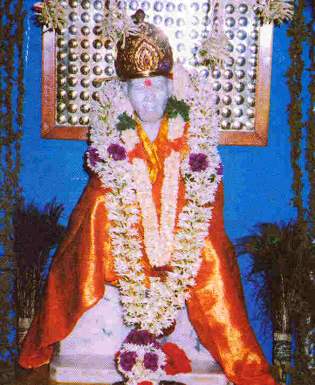
The
Shirdi Baba Statue at Sundaram (Shirdi Sai temple) in Madras
The Sai Sathcharitham(*), written while Sai was at Shirdi, with His
Blessings, by Govinda Raghunatha Dabholkar refers to Shirdi Sai Baba
Himself as "Sathya Sai"! It speaks of the story of Shirdi Sai Baba as
"Sathya Sai Katha"; it also describes a Sathya Sai Vratha, Sathya being
as has happened in the present incarnation the abridgement of the name,
Sathyanarayana! Bhimaji Patel, after a miraculous recovery from disease
through the Grace of Shirdi Sai, celebrated thanks-giving ceremonies.
Full of gratitude and reverence, instead of the usual Sathyanarayana
Vratha, he observed the Sathya Sai Vratha! Instead of Sathyanarayana
Katha which had to be read after the Vratha, he recited the Sathya Sai
Katha! Sai Baba at Shirdi must have, as the indweller of Bhimaji,
prompted him to name the Vratha and the Katha, in that manner, urged by
a Sankalpa to suggest coming events. For, has not Sai Baba said at
Shirdi, over and over again, "Blessed and fortunate is he who knows Me
as seated in the hearts of all beings." In fact, He knew the past,
present and future, as Dabholkar has declared, after many a proof had
been witnessed by him and recorded.
Ten years ago, a
Maharashtrian composed a poem on Baba at Shirdi in which he
characterized Sai as Sathya Sai! Last year, he came to know of Sathya
Sai, through the first volume of this book. He came to Prasanthi
Nilayam, drawn by the name which had come to his pen unawares. He told
me that the continuity of the two Sais was confirmed by the last
incident in the life of the first, and the first incident in the career
of the second! Sai Baba appeared before Das Ganu at dawn on the 16th
day of October, 1918 and said, "The masjid has collapsed; I am going
from there now; I have come to inform you; go there, quick. Fulfill
this wish of mine: place flowers on My Dabari". Dabari indicated the
'tomb'. Das Ganu did as he was told.
 In 1940, when Baba
announced Himself as having come again to resume His work and foster
His Bhakthas,
Peddavenkappa Raju asked his son who was making the announcement, "Show
us a sign and convince us that you are the same Baba." And, Baba asked
that 'flowers' be placed in His hands! Flowers that He had asked Das
Ganu to place on His Dabari, when He took leave of Shirdi! He threw the flowers on the
floor - and, the two words SAI and BABA were formed by those flowers, moving by
themselves into those shapes. [See for this story: The
Serpent Hill] For those who can read the tracks and trails
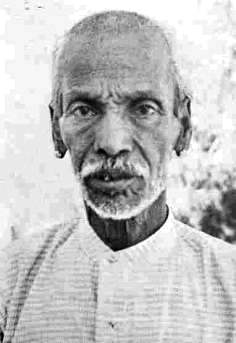
of the Godhead, this is a meaningful coincidence. [Picture: Peddavenkappa Raju]
In 1940, when Baba
announced Himself as having come again to resume His work and foster
His Bhakthas,
Peddavenkappa Raju asked his son who was making the announcement, "Show
us a sign and convince us that you are the same Baba." And, Baba asked
that 'flowers' be placed in His hands! Flowers that He had asked Das
Ganu to place on His Dabari, when He took leave of Shirdi! He threw the flowers on the
floor - and, the two words SAI and BABA were formed by those flowers, moving by
themselves into those shapes. [See for this story: The
Serpent Hill] For those who can read the tracks and trails
of the Godhead, this is a meaningful coincidence. [Picture: Peddavenkappa Raju]
On Vijayadasami, 1916,
when someone told Sai Baba at Shirdi, "Today is Seemollanghana Day",
Baba stunned every one by His announcement: "Yes; it is the day of My
Seemollanghanam too." Seemollanghanam means the act of crossing the
boundary, from one kingdom into another. Kings, in former days,
gathered their forces, equipped them with arms, worshipped and
propitiated on Ayudha Puja Day (the Day previous to Vijayadasami Day)
and, crossing their own state boundaries, they invaded the neighbouring
states, eager to achieve Vijaya or Victory. That was on the tenth Day
of Dasara, the tenth or Dasami day of the bright half of the Aswija
month.
What exactly did Sai
Baba mean, when He said, "Vijayadasami is the day of My
Seemollanghanam"? Which border was He crossing and into which State was
He proceeding? He left the body, as He had foretold, on Vijayadasami.
He told Das Ganu next morning, appearing before him, "I am going from
Shirdi now; oil mongers and grocers tease me a lot". So, He left Shirdi
and crossed from one state to another, from Maharashtra to Andhra! That
was the Seemollanghanam!
He had told Kaka Saheb
Dixit that 'He would appear as a child of 8'. Baba has said that in His
previous Body, He told Kakasaheb, that He would appear after 8 years,
and not as a child of 8. He appeared again at Puttaparthi, in 1926, 8
years after that Vijayadasami. He revealed Himself as a Divine Child,
with a miraculous career before Him, in His 8th year, when He willed at
school that the teacher should be struck to his chair, until He could
go down from the bench on which He was ordered by him to stand. [See
for this story: "The Rhythm of His Feet"] That was the first 'dramatic' announcement of the Advent
of Sai again! - 'as a child of 8'.
There are some who
limit the Almighty Will of the Godhead and say that Sai Baba cannot
enter into a human cage, once having flown out of it - as if they are
the lawgivers for that Eternal Absolute! One such wrote a letter to me
from Madras repeating this argument; when he received my reply, he was
so firmly convinced that he supported the identity and continuity and
advent by a new argument! "The Bhagavad Gîtâ tells us, the
Lord has announced that those who depart from the body during the
distressed smoky condition of the mind, or during the night, or the
dark half of the month, or during the six months when the Sun is in the
southern hemisphere, that is to say, during the six months that mark
the southern or the manes path, reach the region of the Moon, if they
are Yogins. After some time, they have to return thence to the earth
and human birth. (Chapter 8, Sloka 25) Sloka 28 says that if they
depart during the day and during the bright half of the moon and during
the six months of the Northward sun, the
yogis do not return at all.
Sai Baba of Shirdi departed during the Dakshinayana, the six months of
the southern sun, because, evidently, He courted the chance of
returning to earth." I can only say that such buttresses are not needed
to prove the obvious; here beckoning us in love and sweetness is the Avathar, the re-appearance of Sai, whom we call all
experience and benefit from. [See also: Bhagavad Gîtâ, Chapter 8, verses
24 to 28]
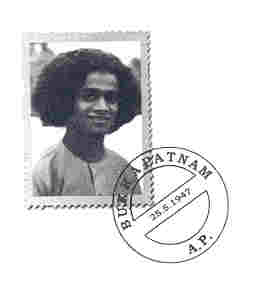 As a boy of 14, when Baba decided to
stand forth as Sai Baba, giving up the role of Sathyanarayana Raju, He
threw away His school books, and walked away from His home, to a garden
outside the town of Uravakonda. He told His sister-in-law who tried to
persuade Him to stay: "I have got My work; My Bhakthas are waiting for
Me". [See
for this story: The Serpent Hill] What was the Work? Who were the Bhakthas? We can see that the work was "the
continuation of what was achieved at Shirdi"; the Bhakthas were those
who adored Him while at Shirdi and subsequently. This was the reason
why He chided a far-famed worshipper of His Shirdi Form who refused to
recognize Him thus: "What is the use of all your adoration and
meditation when you cannot recognize the very God whom you are adoring
and meditating upon?" Even in His teens, He demonstrated to two of His
masters at school, Subbannachar and Kondappa that He was Sai come
again; He granted visions of Shirdi to His mother and father and many
others at Puttaparthi. He gave pieces of the kafni He wore at Shirdi to
Thammiraju Manchiraju and others at Uravakonda.
As a boy of 14, when Baba decided to
stand forth as Sai Baba, giving up the role of Sathyanarayana Raju, He
threw away His school books, and walked away from His home, to a garden
outside the town of Uravakonda. He told His sister-in-law who tried to
persuade Him to stay: "I have got My work; My Bhakthas are waiting for
Me". [See
for this story: The Serpent Hill] What was the Work? Who were the Bhakthas? We can see that the work was "the
continuation of what was achieved at Shirdi"; the Bhakthas were those
who adored Him while at Shirdi and subsequently. This was the reason
why He chided a far-famed worshipper of His Shirdi Form who refused to
recognize Him thus: "What is the use of all your adoration and
meditation when you cannot recognize the very God whom you are adoring
and meditating upon?" Even in His teens, He demonstrated to two of His
masters at school, Subbannachar and Kondappa that He was Sai come
again; He granted visions of Shirdi to His mother and father and many
others at Puttaparthi. He gave pieces of the kafni He wore at Shirdi to
Thammiraju Manchiraju and others at Uravakonda.
Thammiraju Manchiraju
was a teacher at the Uravakonda High School. He has written many
articles about those days in the "Sanathana Sarathi"
magazine. "Since the untimely death of my daughter, my wife was very
depressed and so my 'pupil' at school - Sathya shall I say or Baba -
came to my house frequently to console her. She used to go every
Thursday evening to Him, at the
Telugu teacher's house (the
house of the elder brother of Baba, Seshamaraju). One day, while she was falling at His Feet, He raised her
up saying, "I shall carry all burdens for you. Be happy, henceforth."
Then, He waved His hands and created rice grains (just as He created
for Megha at Viamgaon while at Shirdi) and asked her to tie them up in
the gerua piece of the kafni He had given us earlier.
"We had to go some
distance to the village well for the days stock of potable water. My
wife one day collected the children of the neighbors and asked them to
play with our five year old son, so that she could go to the well and
return. She gave them some sugar and said, "Do Sai Puja, all of you; I
shall come soon. Offer this sugar to Him and then, take it as Prasadam." The
children went into the shrine room; they repeated the hymns they knew.
They saw Sai Baba sitting before them. He ate a small quantity of the
sugar and gave each one of them a handful. My son was so excited at the
Old Man's visit that he ran out to meet his mother and bring her along.
He knew she would be delighted to meet Him. When she came in, the room
was empty. Where has He gone she asked the children. The little
innocents replied "We saw Him go into that picture". Within a few days,
we were at Puttaparthi. Baba told me, "You were sad that I had come
away to Puttaparthi; but I can be here and still be there. I knew you
would believe this only when the children spoke about what they saw."
Thammiraju writes, "The question may arise: Why did He choose the
Shirdi Form? I asked myself this question. I got the answer too from
Sathya: "There is
no 'that form' or 'this form'. Both are one".
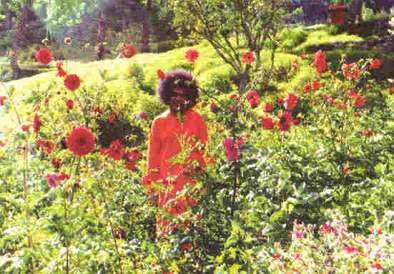
"I and the
circumambient universe are one"
Sai Baba, while young,
used to sing with enthusiasm, and dance with tinkling anklets on His
Feet. In this appearance as Sathya, He used to delight in dance and
impart delight to others by the dance. He sings with enthusiasm
Kirthans and Namavalis which
inspire hundreds of thousands into ecstatic devotion ... Sai Baba wore,
when He came to Shirdi, only a dhothar round His waist and a shirt on
His body; for many years, at Puttaparthi, also, He wore the same style
of clothes. He changed over to the long gown, as Sai Baba did at
Shirdi, only later. He adopted the coloured gown and dhothi for general
wear, at the instance of devotees, so that He could be more readily
identified and not get lost when hundreds milled round Him for
Darsan and to touch His
Feet.
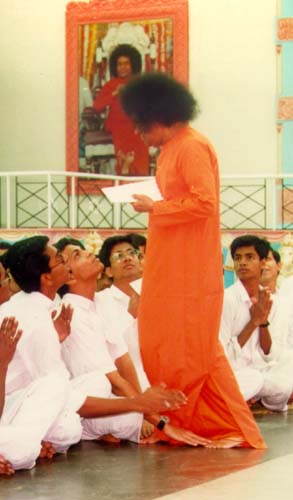 "Your joy is the food I
subsist on", says Sathya Sai Baba. To give joy to the people around
Him, at Shirdi, Sai Baba meekly submitted to pageant and pomp! Every
alternate day, Sai Baba was taken in procession from Dwarakamayi to the
Chavadi, where He slept. Groups of men and women with tal, chiplis, karatala's, mrdanga's, Khanjira veena and other musical
instruments formed the van of the procession. A long line of beautiful
Raths followed behind. Next came the richly caparisoned horse,
Syamakarna, which Sai Baba fondled and loved. Behind the horse, was a
palanquin borne by men who sang hymns, accompanied by many torchbearers
on both sides. There were others with canes, silver sticks, poles with
flags, bearers of poles with carved figures of
Garuda on their crests. They
danced in joy, shouting Jai, to the tune of drums and trumpets.
Fireworks announced the approach of the procession through sound, and
the brilliance of sudden flashes of multicoloured light. Baba appeared
on the steps of the masjid with persons holding yak-tail chowries on
each side of him. The Bhaldars announced His appearance by shouting His
Name. Devotees spread folds of cloth on the road, as He moved along. An
umbrella was held over His head; flowers besmeared with gulal were
showered on Him as He proceeded slowly."
"Your joy is the food I
subsist on", says Sathya Sai Baba. To give joy to the people around
Him, at Shirdi, Sai Baba meekly submitted to pageant and pomp! Every
alternate day, Sai Baba was taken in procession from Dwarakamayi to the
Chavadi, where He slept. Groups of men and women with tal, chiplis, karatala's, mrdanga's, Khanjira veena and other musical
instruments formed the van of the procession. A long line of beautiful
Raths followed behind. Next came the richly caparisoned horse,
Syamakarna, which Sai Baba fondled and loved. Behind the horse, was a
palanquin borne by men who sang hymns, accompanied by many torchbearers
on both sides. There were others with canes, silver sticks, poles with
flags, bearers of poles with carved figures of
Garuda on their crests. They
danced in joy, shouting Jai, to the tune of drums and trumpets.
Fireworks announced the approach of the procession through sound, and
the brilliance of sudden flashes of multicoloured light. Baba appeared
on the steps of the masjid with persons holding yak-tail chowries on
each side of him. The Bhaldars announced His appearance by shouting His
Name. Devotees spread folds of cloth on the road, as He moved along. An
umbrella was held over His head; flowers besmeared with gulal were
showered on Him as He proceeded slowly."
The Sai Sathcharitha
says(*), "What a beautiful procession! What an
expression of devotion! That scene and those days are gone now. Nobody
can see them now, nor in the future."
No; Baba has come
again! He permitted devotees to arrange such processions again at
Puttaparthi during the Dasara Birthday Festivals, until about 1954. At
Shirdi, Baba was bejeweled before He started for the Chavadi. "They put
on His head a Mukuta (crown) and placed jewels round His neck as well
as garlands. (Sakamma from Bangalore brought many jewels which she put
on Baba.) During the short time of the procession, they changed His
headdress off and on." Even now, Baba yields to the prayers of people
when He knows they are sincere and allows them to arrange processions
in towns and villages (as at Sivajinagar, Kalyanapuram, Ootacamund),
though with paraphernalia very much reduced.
At Shirdi, Baba
referred to His Sircar, His Treasury, His durbar; now too, He refers to
Himself as Sath-Chakra-varthi; He speaks to His store-room, His
treasury, His treasure (pennidhi). At Shirdi, He said that "This
Dwaraka-mayi is the Dankapuri of Dakurnath, the Pandhari of Vital, and
the Dwaraka of Ranchod". Baba has announced that the present
Dwarakamayi (Prasanthi Nilayam) is "another Mathura, another
Badrinath and another Thirupathi." The name Dwaraka was applied to the
city built by Krishna on an island, because, the word means, a place
the doors of which are open for the four castes and for the four types
of men namely Aartha, Artharthi, Jijnasu and Jnani, so that they may attain the four Purusharthas.
Certainly, the dwelling of the Lord at Dwaraka, Shirdi and Puttaparthi
deserves the name. Baba has said, "This Prasanthi Nilayam
has no wall or fence round it, for the Lord is accessible to all who
come from directions and all paths! All are welcome to the gift of
Grace." [See SB
: C1-11: Lord
Srî Krishna's entrance into Dvârakâ]
Sai Baba 'expressed a
wish' that a Muralidhar idol of Krishna (with the flute or murali in
His hand) be installed in the quadrangle of the palatial building that
Buty built in Shirdi; but, He 'left' Shirdi before that wish could be
fulfilled. Perhaps for that reason, Baba has a Muralidhar idol of
Krishna on the porch of Prasanthi Nilayam, as the centre of adoration
for all who raise their hands in prayer. He has a Muralidhar in the
shrine in the Prayer Hall. There are two charming images of Muralidhar
in the lovely garden of Brindavan, too.
A close study of the
Sai Sathcharitha (*) is a MUST for any one seeking to unravel the mystery
of Sathya Sai Baba, for the Hand that gives and the Voice that teaches
are the same. When a Brahmachari of the Ramakrishna Mission came to Prasanthi Nilayam to get
his chronic colic cured, Baba asked him to pray to Guru Maharaj
Himself, and instructed him how to do
Dhyan with greater success.
He assured him that Ramakrishna, his Gurumaharaj, will cure the ailment
that hinders the spiritual progress of his child. At Shirdi, Baba would
have given the same advice. "Do not lose hold of the bolster you have
secured" "Apula bap tho, apula bap." (Our father alone is our father);
you cannot change one Master for another, to suit your whim and fancy."
Sai Baba gave Darsan to the disciples of Golapswami as Golapswami, and to the
disciples of Raghunath Maharaj as Raghunath Maharaj. Sai Baba was all
saints in one.
Now also, it is the
same One. While at Prasanthi Nilayam, Baba has given Darsan at
Ramanasram to Swami Abhedananda as Ramana Maharshi and at Shimoga to
Ramanandarao as Ramadas of Kanhangad! Sai Baba has accepted gifts
intended for other saints and Gurus, for He was all of them. Baba too has
surprised many people by telling them that He has been with them for
years, guiding and guarding, when they protest that they are meeting
Him for the first time. Baba makes it clear that He is the very guru
that they have followed so far.
The Secretary of the
Hindi Prachar Sabha, Bangalore had a meaningful experience. He was in
the home of a friend when Baba arrived there, years ago. His friend and
many others fell at His Feet, but, he had no mind to do likewise. He
feared that he may be singled out as a conceited youth, refusing to
revere a great person. So, he fell at Baba's Feet, with a mental
reservation that the prostration was not for Baba but was for his Guru,
who was at Maddur in a Siva temple. When he rose after the fall, Baba
patted him gently on the back and said, with a smile, "Your homage has
reached your guru at Maddur." Thus He came to know, as many did at
Shirdi, that Baba is the Divine vien of gold that runs through all
Spiritual Masters and all Divine Teachers.
The unbroken continuity
of the Sais is established by the identical panacea: they grant 'Udi'. Then, it was given from the dhuni or
fire-place at Dwarakamayi; now, it is created in the Divine palm, for,
a fire-place cannot now be carried wherever He goes or feels like
granting it. I must mention here one interesting fact about the Udi,
and Shirdi Sai Baba. Sai Baba often sang a song on the Udi, a song
which has become immortal, since He sang it "Ramathe Raam! Raam!
Aayoji, aayoji! Udiaonki gonia Laayoji, laayoji!" (O, playful Rama,
come, come! sacks of Udi, bring, bring.) Who is the Rama that is called
upon by Sai Baba to bring sacks of Udi? Rama of the Ramayana did not distribute Udi as a
mark of His Grace. Udi was Baba's own special gift, His unique means of
alleviating man's physical and mental ills. So, it is a call into the
future; for, Baba at Shirdi did not stack the Udi and carry bags of it.
It is a peep into the present time, when we find Baba moving between
long lanes of men and women with a bag or basket of Udi packets and
placing a few in the outstretched palms of hundreds and thousands, in
towns and villages all over the land!
When Baba "took on" the
cerebral thrombosis or as the Director of Medical Services in Mysore
diagnosed it, 'tubercular meningitis' of a devotee of the Lord, we were
reminded not only of similar acts of compassion shown by Him in the
past, but also of such acts done by Him while at Shirdi as Sai Baba.
Sai Baba had taken on four fully developed bubos from the son of
Dadasaheb Khaparde of Amraoti. Showing them to the boy's mother, Sai
Baba declared, 'See how I suffer for my devotees; their suffering is
mine."
When we hear Sathya Sai
Baba announcing, "Vivekananda has come again; he is growing up in Ceylon; he will come to
me and join in my task", as He did one morning or "The man who wrote
the first English biography of Vivekananda was born last night in a
thatched hut on the sea shore on the west coast at Kuttipuram. It is a
charming baby, with bright big eyes", we are reminded of Sai Baba at
Shirdi announcing to the people around Him the past lives of snakes and
cows and goats! In His Discourses, Baba has often said, "I know your
past; I know your future; so, I know why you suffer and how you can
escape suffering." The declarations that resound from Prasanthi Nilayam
are but echoes of those heard at Dwarakamayi. Baba says, "Imagine how
foolish you are! Coming to this Kalpatharu and asking for a little
coffee powder! Your behaviour is like a man coming to a huge
departmental store and asking for a towel." As Sai Baba, He said, "I am
sitting here, ready to give you the gold embroidered shella cloth;
then, why go and steal rags?"
Sai Baba spoke in such
conundrums and parables. He told Kaka Saheb that He will send him a
Vimana when he died. What happened was that he died in a moving train.
Sathya Sai Baba also speaks thus. He told an aged film star, who spoke
to Him of his physical illnesses, "I know, your body is a bundle of
diseases; I shall overhaul you and give you a new body ." What happened
was, he died soon and entered a new body. That film star was blind; he
pleaded that he might at least or rather at most, get a picture of Baba
in his heart. What happened can best be described by quoting a para
from the book, 'Sai the Superman', by Swami Sharananand. He is writing
about Sai Baba of Shirdi, but, exactly the same thing happened at
Prasanthi Nilayam, too! He prayed to Baba, "I have lost my eyesight. I
do not feel its loss; for want of eyesight keeps me away from many
undesirable things; but, I am eager to see the human form in which you,
My Lord have manifested yourself. Please therefore grant me eyesight
till I satiate myself by the sight of your glory. You may withdraw this
grant as soon as this is done." Baba at once granted this request; he
saw Baba with his own eyes and then, he lost vision and became blind
again.
Sai Baba evinced
enthusiasm to safeguard and foster Sanathana Dharma
and to promote scriptural studies, that can alone clarify the intellect
and purify the mind. We read in the Sai Sathcharitha(*) how He rebuked a Ramadasi for retaining his
short temper, in spite of his recital of Vishnu Sahasranama for years.
He rebuked Swami Vijayanada, who had ostensibly given up kith and kin,
when he asked him permission to go to Madras to see his sick mother.
"Go and read the Bhagavatham", he told him! As Sathya Sai Baba, He is
continuing on a vaster scale this role of correcting the craving and
attachments of monks and sadhaks. He rebukes them for celebrating or even remembering their
birthdays; for decorating themselves and others with titles indicative
of spiritual progress, and engaging themselves in competitive publicity
to attract and retain rich followers. Sai Baba asked Haji Sidi Falke of
Kalyan, "Do you read the Quoran like this?" As Sathya Sai Baba, we have seen Him regulating
and modifying the speed and pitch of renowned Vedic reciters. Sathya
Sai Baba places emphasis on the Gayathri, on Omkar as well as on the Gîtâ
(**) as the most efficacious of
manthras and texts. As Sai
Baba too, He did the same. He asked people to read the Bhagavatha, the Patanjali Yogasuthras, the Vicharasagara, the Panchadasi etc.
Dadasaheb Khaparde, an expert in Vidyaranya's Commentaries, 'uttered no
word' in Sai Baba's presence, because, as he confessed, 'learning
cannot shine before selfrealisation'. This is the experience of many a
scholar in the presence of Sathya Sai Baba also. When a renowned poet
and pundit, and popular preacher who has toured USA, USSR, Japan etc.,
and lectured there on religion, fell at His Feet and offered to spend
the remaining years of his life in flying from continent to continent,
spreading the happy news of His Advent, Sathya Sai Baba told him, "Do
not worry about My Advent; worry about your own future. I wish someone
would clip your wings and keep you in one fixed place, so that you can
do some Sadhana and save yourself, before it is too late." "Concentrate on
your own uplift before attempting to uplift others", was His advice to
another popular exponent of the Gîtâ and Upanishads. He has
come to cure the blind, correct the proud, console the ignorant and
comfort the distressed.
The declarations made
at Shirdi and by Sathya Sai Baba everywhere about the Divinity and
Mystery of Sai are naturally identical. Sathya Sai Baba says, "My
Sakthi, My Power, My Mystery can never be understood, whoever may try,
for however long a period, by whatever means". Sai Baba said, "I pull
the wires of this puppet show". At Shirdi, He told Vijayananda, "You
were able to reach this place only as the result of the merit acquired
in previous births". At Puttaparthi, He says the same thing to all
those who come. The reaction to praise and blame, then as now, is the
same. The Sai Sathcharitha(*)
says, "Sai Baba was tolerant, emotionless, unattached, internally
free." Baba has written to His brother when He was but twenty, "I shall
not slaken My activity; for Me, fame and name, reputation and calumny,
are equally trivial. I am unconcerned with the whole lot."
Sai Baba was the
embodiment of Prema;
Sathya Sai Baba names Himself as Premaswarupa. The
Sathcharitha(*) refers to Udivrishti and Kripavrishti, the
shower of Udi and the shower of Grace; any book on Baba then as now
must mention these two showers, for they are the marks of the Sai
Godhead! Sai addressed people as "O, Bhau", "You Anna" or "You Bapu",
in love and endearment; now, in the new Sai Form, He addressed them as
"Bangaru", "Nayana" or "Appa".
Then and now, Sai has
taken every opportunity to proclaim His Glory, for, how else can man
realize His good fortune? At Shirdi, He said, "I am the indweller of
all beings." Recently, He wrote to a learned Pandit, "Do not disparage
the rich; do not disparage any one, Sai dwells in every one and so,
when you disparage any one you are disparaging Me. Professor G.G. Narke
of the Engineering College, Poona wrote of Sai, while He was at Shirdi,
"He spoke as One seated in my heart, knowing all its thoughts and all
its wishes. I tested Him at times. Each test produced the same
conviction that He was all-knowing, and able to mould things according
to His will." Now, in the present Sathya Sai form, Baba told a
Sarvodaya worker, a certain Sri Mehta who asked Him quite frankly, how
He could read his mind so right, "This is no
Siddhi or attainment; this is
My Svabhava, My very nature. I do not by means of a power that I have
learned and earned, enter into your mind, collect all the information I
require about its contents, emerge from it, and then, recite it all to
you, to impress you. No. I am there always and everywhere. I am your
Hrudaya-vasi, the Indweller."
Sai Baba told Balaram
Mankar, when He appeared before him at Mathsyendragad while also at
Shirdi, in person and in answer to Mankar's question as to why He had
sent him away from Shirdi to that hill, "You imagined that, with this
body three cubits and a half long, composed of the five elements, I was
at Shirdi! Isn't it? I wanted to make you know My Reality; that is why
I sent you here, so that I may come before you and show you that I am
not that body only." Sathya Sai Baba too has appeared as such to
devotees in far off places and even beyond the seven seas, making them
aware that He is not bound by the physical frame, which many mistake to
be He. He says, "Learn to yearn, so that you can draw Me to you,
wherever you are. That is a more rewarding Sadhana, than the journeys you now undergo.
Transform your heart into a Prasanthi Nilayam;
then, I shall certainly come and stay there."
The golden streak of
continuity is evident in the miraculous cures they effect, in the
mysterious ways by which they save devotees from accidents, by which
they forewarn and rescue, in the methods by which they teach and train,
in the emphasis they lay on the fundamentals of all faiths. People who
have lived long at Shirdi have noticed at Prasanthi Nilayam, the same
turns and twists in conversation, the same love and mercy, even the
same mannerisms of gesture. M.S. Dixit vouchsafes for one such: "Sathya
Sai Baba waves His right hand, just as the Shirdi Lord used to do, one
or two fingers in the air, as if He is writing in the air." This waving
of the hand, with no evident purpose or meaning is mentioned in the Sai
Sathcharitha(*) of "Hemadpant" in Chapter 27.
Another trait of Baba,
at Shirdi and Puttaparthi is the awarding of nicknames to people
arounding and using them, in general conversation. At Shirdi, the Lord
was Fakir, Panduranga was Vittal Patil; at Puttaparthi He is the Potter, the
Smith. Das Ganu was the 'bridegroom', another person was 'the gourmand'
or 'the fat one'. The nickname, Hemadpant, with which He accosted
Govindarao Raghunath Dabhokar has become historic, since he accepted it
as - his nom de plume -, writing at the end of each chapter, as its
colophon, "Bhaktha Hemadapantha Virachitha Sri Sai Samartha
Sathcharitha"!
Hemadpant was a famous
minister of the Yadava Dynasty who ruled from Deogir (Daulatabad); he
served two of the rulers, Mahadeva and Ramadeva, in the XII century
A.D. He wrote many celebrated works in Sanskrit, like
Chathurvargachintamani and Rajapurusasti, mainly concerned with
sociology and political science. When he was given this nickname,
Dabholkar took it as a "dart to destroy my ego", as a means to teach me
"nithya nirabhimana" (permanent ego-lessness). He contrasted his own
insignificant attainments with the gigantic achievements of the person
whose name was stuck on him; he prayed that Baba may write His story
Himself through the pen he was privileged to hold. And, Baba blessed
Him, 'so be it'!
Now too, there is a
repetition. When recently I scanned my Diary for 1958, I discovered
this entry on the 29th day of November: "Baba accosted me, when I went
to Him at 7.15 A.M. as Nannayya Bhatta!" I had no idea then that it was
a name that was heavy with history. This was two years previous to the
publication of His Life, "Sathyam Sivam Sundaram", a book He wrote while I held the pen, His Sathcharitha. He had blessed me with the task as early as
1948, and I was waiting for His command to begin, even ten years later,
for he was saying, "Now, if you publish a book about Me, people will
not believe it: they will deem it as a fairy tale; wait, till the world
is made ready to receive it."
That name He accosted
me with, is, as I learnt later, famous in Andhra, as the name of the
Adi Kavi, the First Poet, one of the three who together completed the
immortal Andhra Mahabharatham; Nannayya Bhatta is also said to have
composed another great poem, on Sri Rama, "Raghavabhyudayam." He lived
at Rajamahendravaram on the banks of the Godavari River, in the XI
Century A.D., and he had as his patron, the Chalukya Emperor, Rajaraja.
While naming illiterate me, with a twinkle in the eye, as Nannayya
Bhatta who extolled in excellent poetry the glory of Sri Rama and Sri Krishna, Baba was only revealing His Identity. The
nickname was a dart against my egoism, the conceit of this
infinitesimal ripple on the ageless boundless Ocean that He is. May I
too be established in nithya nirabhimana, that is my prayer.
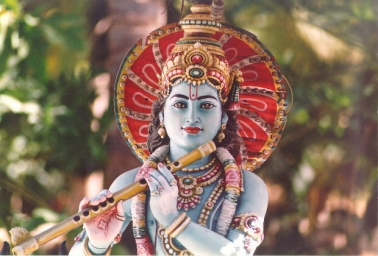
Muralidhar
idol of Krishna
M.S. Dixit, to whom
reference has been made, is the nephew of Kakasaheb, who was intimately
attached to Sai Baba at Shirdi. He had many opportunities of receiving
blessings from Baba, at Dwarakamayi. Once, Baba took
Udi (see also SSS -
Wave of the hand) and
applying it to his forehead with a slap, said, "Go to the Wada, don't
sit here." He was a boy in his teens then; so, he told his uncle, "I
will not go to Baba; He slapped me on the forehead." But, Kakasaheb
said, "You are a fool; the slap means your horrible headache will not
recur." He is seventy now and the headache has not dared to pay him a
visit since that slap. Dixit writes of another incident: "One day,
about 5.30 A.M.(!), Baba sent for the barber and had a shave, after
which He bathed. This was very unusual. He generally had a shave and a
bath in the afternoon. That day, after the bath, he sent a man to the
grocer, and got a coconut, some jaggery and a quantity of ground nuts.
He broke the coconut and cut the kerned into pieces; then, he gave a
piece along with jaggery and groundnuts to all present. After this, He
said, "Bolo Gajanan Maharaj Ki Jai". We all cheered Jai. I wondered why; no one knew who this
Gajanan Maharaj was. Later, Baba said, "I have lost My brother, this
morning." Two days later, a letter came to Kakasaheb from Shegaon
written by Buty Saheb that his Guru, Gajanan Maharaj had left the body
at 5.30 A.M. that day and that, during his last moments, he had assured
him "My brother Sai Baba will take care of you hereafter; go to him, at
Shirdi"! (Sathya Sai Baba too is immediately conscious of the birth or
death or whatever happens to all; He announces to those around Him the
passing away - or rather, the mergence in His Feet - of persons
yearning to have that happy type of release).
Some years ago, Dixit
who was at Mangalore, and reading the 'Guru Charithra' in the orthodox
style, determined to finish the book in 'seven days', a
Sapthaha as it is called. On
the seventh day, he had a dream: "I entered an arched gate which led me
into a magnificent building at the end of a wide road, with dark green
trees on both sides. As I was proceeding, I felt some one was following
me, calling me in a soft sweet voice, Dixit, Dixit. When I turned round
to find out who it was, I saw a charming figure in silken robes, and a
thick halo of hair that was remarkably curly. A few days later, I went
to a friend, a Doctor and I saw in his room, the picture of that same
figure. Who is this? Is He available I asked? The reply took me by
storm. "He is Bhagavan Sri Sathya Sai Baba! "Sai Baba? Sathya Sai Baba I pondered?
The doctor said, "Some of my friends are going to see Him shortly, you
can join them, if you care too." Dixit was overwhelmed with joy; he
joined the party and arrived at Prasanthi Nilayam. He passed through
the arched gate, he proceeded along the wide road with dark green trees
on either side. He saw the charming figure. He heard the silver voice,
when he was called in for a personal talk, in the Private Room.
Let Dixit relate what
happened. "Baba called me in. He saw with me a small photograph of my
uncle. "I know him, he is Dixit, your father's brother, elder brother.
I told him I will be coming again, eight years later. Have you any
doubt?", He enquired. That question was relevant, for until then, "I
was bogged in doubt". Dixit is unshakably convinced now that this Sai
Baba is the same that he served at Shirdi, for he had many an
experience to deepen his faith.
Baba also grants many
fortunate persons such experiences, even the many who have not heard of
either Baba. His plan is, perhaps, to draw them to Him, so that they
may become messengers of the 'Sai Era' of spiritual Joy. Else, how can
we explain the following remarkable experience of Srimathi Shudha
Mazumdar of Calcutta? She is a social worker since many years and has
contributed much to the amelioration of a lot of women in the prisons
of India; she was for a long time the Vice-President of the All India
Women's Conference. Her translation of the Ramayana into English has
kindled the flame of devotion in thousands of hearts all over the
world. Here is her own account of the way in which, quite
spontaneously, Sathya Sai Baba established Himself in her heart and
instilled faith in Him, as the same Sai who was at Shirdi!
There was a slight
drizzle that morning, in October 1964. I was in Darjeeling, high up in
Jalapahar, on a bench under a shelter, on the edge of the road, looking
down the deep valleys. Beyond were the snowy ranges of the
Kanchenjungha, covered with clouds. The beauty of the Himalayas failed
to lift my spirits; I was weighed down by my troubles. As I gazed at
the splendour of nature with unseeing eyes, I noticed a figure, clad in
white, climbing up to where I was. An old man, with a battered umbrella
under his arm reached the shelter, and stood before me, breathing
heavily. He had on a small white cap; from his long white robe, I knew
him to be a faquir. He hesitated, as if he was not sure whether I would
like him to share my bench. I welcomed him warmly. He smiled and sat
beside me, carefully leaning his umbrella against the bench. It was
covered with some white material that had become unstitched, in places
from the frame; I wondered how it served its purpose!
He sat in silence; so
did I. We both gazed at the snow covered peaks before us, for, the
clouds had moved off, revealing the dazzling splendour. When he had
recovered his breath, I asked him where he had come from. "Oh, very
far", he smiled and with outstretched hand, he pointed to the distance.
"From Nepal", he added. "But where do you stay here?" "Oh, anywhere,
when the sun sets" "And, food?" "People are kind; I always get
something to eat and some kind of shelter at nightfall." Then he
laughed. "I enjoyed a fine meal when the poor were fed after Nehru
died". He had crossed his long legs and rumbling in the cotton bag
slung over his shoulder, he brought out a piece of rag, from which he
took out a pinch of tobacco. He did not partake of this, however, he
sat with his eyes on the distant mountains, while he chanted melodious
words in Hindi. "What is this?", I asked. Turning his eyes on me, he
said they were from Kabir. He was a Kabir Panthi. "Yes", he continued,
"both my father and mother died when I was very young. I had no other
kinsmen. Neighbours said I must marry, for some one must cook my food.
But, I thought, since He has chosen to leave me without any people of
my own, it must be because He wants me to leave the world. So, one
night, I left home and became a wanderer. When I was sixteen years old,
I became a faquir, of the path of Kabir."
Here, he hummed another
verse. It had a haunting quality. Taking out a note book and a pencil I
had in my bag, I begged him to give me the words. With kindly eyes, he
looked at me and nodded. One by one, I jotted down the three verses. He
corrected the mistakes and explained the meanings. Here they are,
translated as best as I can:
1.
Choosing bits of brick with care
Man erects a mansion here
Then, he says, 'This home is mine'!
But it's neither 'mine' nor 'thine';
So I heard
It is but a Nest for the Bird.
2. Thy
land shall go
Thy goods shall go
Thy linen fine shall go
With braided hair, the maid so fair ...
The blind too shall go
Oh, so beautifully ...
And for a while thy abode
The wilderness shall be!
3.
With what high hopes the boy was raised
How fondly fed with milk, so pure ...
And he?
Blame not the mother, nor the father
It was all destined for thee.
The faquir taught me
the meaning very patiently, "Homes are but nests for the spirit encased
in the body; the nest is abandoned when the allotted span is spent. ...
All that is in this world will have to be left here, when death
arrives. The body returns to the elements of which it is composed" With
compassion in his eyes, he explained the last verse. "When you do not
get love or gratitude in return for all the labour and pain you have
undergone, remember, that is the result of one's own Karma. Blame
none."
"Very true", I murmured
with misty eyes. "But how to proceed on the path?" I remember he gave
good advice also that I should wake at 4 o'clock in the morning and
repeat these verses and meditate on them. He was so kind and
understanding. I bent low before him with folded hands in namaskar and
placed a rupee beside him on the bench. He gave me his blessings in
many words that I do not quite remember, picked up his umbrella, and
left me with a sense of peace.
Who was this faquir? My
son said, "I go down daily to office from this side of Jalapahar; I
have never seen any faquir. Your habit of making friends with strangers
will land you in trouble some day, be careful".
In the Illustrated
Weekly of November, 1965, there appeared articles and pictures of
Sathya Sai Baba. The hair arrangement completely put me off: I never
even read the article! In March, 1966 came an anonymous post card with
a Bombay stamp - one of those chain letters requesting me to send off
to 20 people what was written on that card about Sai Baba and good
fortune would be mine in 10 days! I was in great mental distress at the
time. I found myself getting 20 post cards and typing the letters in
secret and posting them off! If the family knew, they would have teased
me, for had I not refused to know anything of Sai Baba, because of his
hair?
Date in November, two
friends came to me for discussions over a Seminar to be held the next
month at Bangalore. "You are lucky to be able to go; try and see Sai
Baba if you can", said one friend. "Oh", I said absent mindedly, "Why?
Who is he?" Then, we were told of the miraculous powers of Baba and
that miracles were happening in the home of a Mrs. Rao. The details
sounded so incredible that I must have smiled. "You don't believe me",
she said in a hurt voice. I hastened to assure her that since this came
from her, what she said must be true. She shook her head. "No.
You must see for yourself. I can take you there now; it is not
far".
So, we left our files
and papers, called a taxi and came to the modest home of Mrs. Rao.
Welcoming us, she laughed and said, "See what Baba is doing!" and took
us where amongst other holy pictures, the small framed one of Baba had
benediction in his eyes. Over his forehead, there appeared a fine gray
dust. This was 'vibuthi' we were told and we were given a little folded
in pieces of paper. Mrs. Rao had never seen Baba except once in a
dream; she secured this photograph of His and sometime later, this
fragrant ash began appearing on it and it is stored for devotees. "But,
this is nothing", she laughed, "you should see what is happening in the
home of my dasi".
She related how this woman servant became a devotee of Baba, and
securing three pictures, kept them framed in her place of worship. She
finishes her prayers at 4 o'clock in the morning, before she goes on
her daily rounds to wash and scrub and sweep in different homes for her
livelihood. Over her pictures, as an indication of Baba's
Grace, there appears vibhuti in one, kumkum in another and on the third
photograph, haldi powder!
Good fortune is hers now; she has left for better wages offered
elsewhere. "Is her home very far off?" I asked. "Can we not go there
now?" Mrs. Rao said it was not a distant place, but in the heart of a
bustee where there were no street lights even and the rain that day
must have made the lane leading to it very muddy indeed. We assured her
we would not mind anything if she would kindly lead us there. We walked
with her in the darkness through narrow lanes lit up now and then, by
the flickering flame of oil lamps from adjoining homes, till we reached
our destination.
The maid's name was
Madhuri. She was not at home but her husband, a truck driver, was there
with the four children. Occupying half the small room was a split
bamboo structure fixed on the mud floor on which they all slept
together, keeping their belongings under it. The other half of the room
was reserved for their place of worship.
The place was
specklessly clean, the few brass vessels gleamed in the lamplight. The
wall of this portion of the room was covered with coloured prints of
holy pictures including one of Shirdi Baba and, at the bottom above a
steel shelf covered with a clean cloth, were the three pictures of
Sathya Sai Baba, and true enough, there could be seen the Vibhuti, Kum
Kum and Haldi Powder in profusion over Baba's forehead. A light burnt
on a brass lamp and a beautiful fragrance pervaded the humble home. The
place had a definite atmosphere and overcome, I prayed a prayer and
left a small offering. Two days later, the maid had managed to trace me
and sent a large basket of prasad - mostly
home-made sweets and Baba's Vibhuti. I was moved to the depths and
vowed to myself I must see this Sai Baba.
How I succeeded in my
endeavours when I had given up all hopes is another story; here I will
conclude with only the portion that is connected with my Faquir.
Leaving the car on the road, Usha and I were walking by the foot-path
to where Sai Baba was giving darsan to devotees on his last day in
Madras in January 1967. Lost in thought over what I had seen and heard
of this most extraordinary person, I heard Usha say, "Look Aunty, isn't
that a lovely house?" "Yes, it's indeed beautiful" I agreed. Then,
suddenly remembering that first verse of Kabir, I sang it softly to
myself. "What is it Aunty?" asked Usha. "Oh, only a bhajan given by a faquir in Darjeeling, it's
Kabir's. He was a Kabir Panth". Usha stopped and faced me with puzzled
eyes. "Faquir? Kabir Panthi? Why Aunty?", she gasped, "that must have
been Shirdi Sai Baba!" "What on earth are you saying Usha?" Greatly
excited Usha clutched my hand and nodded, "Yes! Yes! It must be Shirdi
Sai Baba. I have just been reading Arthur Osborne's "Incredible Sai
Baba" and in this, there are incidents when he appears to people, and
he was a Kabir Panthi...". I could do nothing but smile at the
extravagance of her thought. "Aunty", persisted Usha as we continued to
walk, "ask Sai Baba when you meet him this morning, for he is the
reincarnation of Shirdi Baba".
I could never ask him
anything so absurd, I told her, but she continued to press the matter.
Her parting words were "You need not fear, he is never annoyed over
question"......
As I recall the past, I
was amazed at the strange sequence of events that brought me before the
closed door upstairs. I had in my hands a small slip in which I begged
for an interview if he did not think I was too unworthy. It was meant
to be made over to the person who opened the door ... We had not
knocked. The door opened and behold - it was Baba! Playfully he said to
me smiling "Come, do namaskar!" He was giving me my heart's desire. I
bowed low to touch the beautiful feet of the red clad figure with
benediction in his eyes.
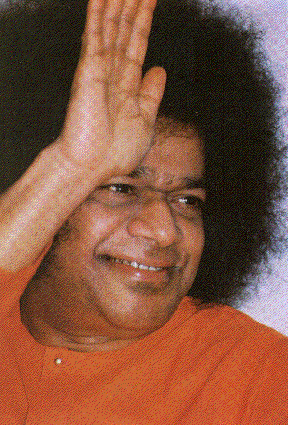 I had meant to ask him
questions about my own troubles, but it was he who told me what my
sorrows were and assured me all would be well. Then, remembering my
niece's words, I stammered, "Baba, Usha was saying I should ask about
the faquir I met in Darjeeling ... he ...". Interrupting me he said,
"That was I in another form. I gave you three Upadesh", he added raising three fingers ... I
remember sobbing at his feet and all that came to my lips was, "Baba,
will you be with me?". I felt his hand upon my head and as in a dream
heard, "Always! Always!". My face was wet with tears. My heart was
full. My spirit was at peace at last ... Then, he materialized as if to
comfort me, Vibhuti and a small photograph with his Abhay Hasta [meaning: fear
not!] raised that had his address too, like a visiting card. "Put this
in your purse", he said and gave me a handful of small packets of
Vibhuti from a brass container. "Come to Puttaparthi during Shiva Ratri
... all facilities will be provided". He also told me he would come to
Calcutta ... He only knows when I will be blessed enough to be at
Puttaparthi and favoured with another darsan.
I had meant to ask him
questions about my own troubles, but it was he who told me what my
sorrows were and assured me all would be well. Then, remembering my
niece's words, I stammered, "Baba, Usha was saying I should ask about
the faquir I met in Darjeeling ... he ...". Interrupting me he said,
"That was I in another form. I gave you three Upadesh", he added raising three fingers ... I
remember sobbing at his feet and all that came to my lips was, "Baba,
will you be with me?". I felt his hand upon my head and as in a dream
heard, "Always! Always!". My face was wet with tears. My heart was
full. My spirit was at peace at last ... Then, he materialized as if to
comfort me, Vibhuti and a small photograph with his Abhay Hasta [meaning: fear
not!] raised that had his address too, like a visiting card. "Put this
in your purse", he said and gave me a handful of small packets of
Vibhuti from a brass container. "Come to Puttaparthi during Shiva Ratri
... all facilities will be provided". He also told me he would come to
Calcutta ... He only knows when I will be blessed enough to be at
Puttaparthi and favoured with another darsan.
June 1967. I was at
Bombay for a meeting, but my mind was bent on a cherished wish. "I
would like to go to Shirdi!", I told my friends.
"Do please make
enquiries", I entreated my host, "and help me to make this visit". He
returned from office smiling broadly one day saying, "Why Aunty, when I
mentioned your desire I was told since you wish to go, Shirdi Baba will
surely fulfill your wish!" "That is all very well to say", I replied
glumly, "but how? With whom"? "And where do I stay in Shirdi?" My
health was not too good and the more I thought about it the more
despondent I felt at the prospect of going to a strange place all by
myself. But the prediction was true. In an extraordinary manner, I was
guided right from the train in which I was going in the wrong
direction, by a charming Maharashtrian lady traveling in the same
compartment. With my two companions discovered at the last moment,
devotees of Baba, she gave us hospitality in her home at Nasik and made
all arrangements for our Shirdi visit one morning.
"The Arati is commencing, come at once!" The bus drive
has been and dusty, so after a quick wash we hastened to the Samadhi
Sthan. Where the mortal remains of Shirdi Baba had been laid to rest, a
gleaming silver sheet covered the spacious place. There were colourful
flowers in abundance there, lights burnt, the air was heavy with the
fragrance of incense, bells were ringing, the crowd surged, I pressed
forward for a better view. My heart stood still as my eyes fell on the
life size white marble image. Sitting with his right leg crossed over
His knee, this figure of Shirdi Baba near His Samadhi Sthan strangely
resembled the faquir I had met in Darjeeling. The same face, the same
pose, only instead of the small cap, there was a scarf wound round his
head. The same kind inscrutable eyes looked penetratingly at me. I held
my breath. Time passed ... My mind gradually accepted an indisputable
fact and ceased to worry over the whys and wherefores. With my
surrender, the tears rained down easing the tension. My trembling lips
murmured, "Baba! Baba!", and wordlessly I prayed for his Kripa. My hands
held on to the tray filled with fruit and flower given to me to make
the formal offering here with the others. My tears continued to fall, I
was blessed with a sense of peace - the peace that passeth all
understanding filled my heart."
Sathya Sai Baba
spontaneously and suddenly choosing Sudha Mazumdar at Darjeeling as His
Instrument and drawing her into the Sai Family, giving her Darsan and Upadesh, in the form of His Previous Body! Faquir,
Sathya Sai Baba, Sai Baba - Sudha Mazumdar is indeed fortunate beyond
words! Her experience is an eye opener to those who refuse to see.
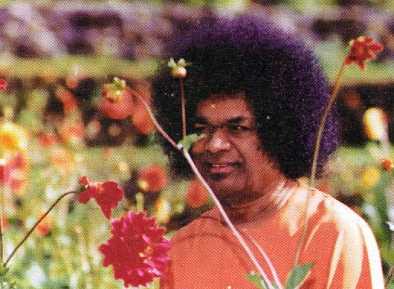
"Nature
is God"
There is an old lady at
Prasanthi Nilayam, whose experience clinches the question of the avatharhood. Her father, a Collector in the Nizam's
Dominions, took her to Shirdi in her third year and again in her
seventh year; she was married at that age; torn by agony at the death
of the four children that she bore, she clasped the Feet of Sai Baba at
Shirdi in 1917, asking for spiritual initiation or Upadesh and permission to stay on with Him. In Lendi
Bagha, Baba told her, "Not now; I will come again in Andhra; you will
meet me then and be with me." She returned to the Nizam's Dominions,
took to the propagation of
Bhakthi by means of musical
recitations on the life-stories of saints and sages, established a
Refuge Home for Orphan Girls named Sai Sadan, and, during her
peregrinations to collect money for her institutions, heard that a Raju
Boy had announced Himself as Sai Baba! She hurried to Uravakonda,
joined the throng that was proceeding to the house of
Seshamaraju that Thursday and
sat near Him, on the right side. She says, that Baba spoke to her in a
low voice in Hindi, as at Shirdi, "So, you have come, My child." He
asked her for a balance of sixteen rupees that she owed him! This took
her by storm. She asked Him how that debt arose. He replied, "Out of
the money you had accumulated to be sent to Shirdi for the Dasara
Celebrations, you lent Balaram forty rupees; he returned only twenty
four." And, He added, in a whisper "I am asking you this, only to
convince you that I am Shirdi Sai Baba ... you have not touched My Feet
... you sat as soon as you came in." This lady had to wind up her
institution and visit Puttaparthi frequently thereafter. She is now at
Prasanthi Nilayam, happy that what Baba told her at Shirdi has come
true.
Incredible, is it?
Well. Arthur Osborne could not get any other adjective to summarize the
glory of Sai Baba; the incredibility of the wonder persists even now.
(*) The whole book of "Sai Sathcharitham" on-line by Shirdi Sai Website.
(**) The
Geetha-Vahini / Bhagavad Gîtâ
|Previous |Next |
Bhajans



