The
Task
Baba visited the
foremost Saivite shrine of India, Varanasi and the foremost Vaishnava
shrine, Badrinath in 1961 in order to infuse spiritual power in those
dynamos of Grace. At Varanasi, He created a unique jewel to be placed
on the idol of Visweswara declaring that it has the mystic might to
charge that symbol of the Lord with Divine potency. At Badrinath, He
drew from under the present Narayana image, a Nethra-linga which
according to Him was brought from Mount Kailasa (!) and ceremonially
installed there, by no less a person than Sankaracharya about twelve hundred years ago! This Nethralinga when it
emerged at the call of Baba, created a chapter in history; a Linga as
the basis of the celebrated Vaishnava shrine was a welcome reminder of
the basic harmony of Saivites and Vaishnavites.
Tradition has it that
the present Narayana idol at Badrinath was thrown by alien hands into
the Alakananda river and that after long and strenuous asceticism,
Sankaracharya was rewarded with the revelation that it was sunk in the
Narada Kunda of that river. Sankaracharya recovered it and installed it
at its present site.
Therefore, when Baba
announced that the Nethralinga was the original nucleus which had to be
"energized" by Him (with suitable rites and ceremonial ablutions with
the sacred waters of the Gangothri, the golden Bilva leaves and the
actual Thumme flowers which He miraculously procured on the spot) even
the Trustees of the Badrinath temple were pleasantly surprised!
Baba spoke of the
Linga as being one of the
Five Lingas which Sankaracharya brought from Kailas and installed in
India, and so, the wonder grew; earnestness to know more of this divine
mission of Sankara was aroused in many. Those who knew Him accepted the
accuracy of this exalted origin of the Linga which they were privileged
to see for some precious minutes on that never-to-be forgotten day.
Saligrama Srikantha Sastry was one of those who were afflicted by this
earnestness to discover the authenticity. He had studied the
Sankara-vijaya, the classical biography of Sankaracharya; he sought to
know the origins of the Lingas that had been installed by Sankaracharya
in the monasteries he had founded. In the reply he received from the
Sringeri Math, the monastery established by Sankaracharya amidst the
mountains of western Mysore, he was told that mention was made of these
Lingas in the Sivarahasya Mahethihasa, a book which he was able to get
after elaborate search from the library of a Vedic College at Varanasi.
In the XVI chapter of the IX Section of this book, it is said that Lord
Siva welcomed Sankara at Kailas and blessed him with the words, "You
are marked out for the establishment in the world of the true teaching
of the Vedas,
viz., Adwaitha. Spend 32 years of your earthly existence spreading this
faith and overwhelming those who decry or deny it. Accept these five
Lingas that I am giving you now. Worship them with the Panchakshari and
with Satharudrabhisheka. Offer the sacred Bilva leaf and Ash and recite
the holy Pranava. Complete your three Tours of Victory dispelling the
darkness of Dwaitha and then, install these Lingas from this
thrice-holy Kailasa, marked by the effulgence of the Crescent, named
Yoga Bhoga Vara Mukthi and Moksha, in sacred sites chosen by you,
before you shed this mortal frame at Kanchipuram." So, the story of the
Linga at Badrinath was authentic!
The Sankara-vijaya of
Anandagiri mentions that one of the Lingas was installed at
Nilakantha-kshetra, which reminds us of the snow-clad
Nilakanthaparvatha, the Queen of the Himalayas, behind Badrinath,
resplendent in its brilliant purity.
There is a temple at
Badrinath, called "The Original Kedareswara." The legend says that
Vishnu discovered that Badri was a fine place for Tapas, but finding that it was already under
occupation by Siva, He resorted to a stratagem to take possession of
it. He assumed the form of a child and started wailing aloud. So,
Parvathi took up the forsaken baby and fostered it, in spite of the
remonstrances of Siva. Some days later, when Siva and Parvathi had gone
to the river, the child assumed its real form. Vishnu insisted on
staying at the place, so that the Divine pair had to seek a place many
miles off for their residence, viz., modern Kedarnath!
This legend indicates
that the Badri shrine was originally Saivite and later became
Vaishnavite. The Kailasa Linga must have been there from the very
beginning, even when the Narayana image was installed on the holy spot.
These surmises arise in our minds when we delve into the history of the
Linga which Baba revealed as having been the initial "spiritual
nucleus" of Badri. Whether as Nilakantha-kshetra or as Kedaram, the
site where the Narayana temple is existing now, was blessed with a
Linga, by Sankaracharya, this is certain. We can only offer our homage
of reverential awe to the unpredictable depth of Baba's divine
Awareness, when we recapitulate the story of the Badirinath Linga.
In pursuance of the
same mission of heightening the spiritual potency of the great shrines
of India, Baba visited the Kasi and Badri of Peninsular India too, to
wit, Srisailam and Pandharpur. At Srisailam which He visited on the 5th
of January 1963, He said. "This shrine has consoled and comforted
thousands and thousands of pious persons year after year, for
centuries. Sankaracharya was here and he sang of the holiness of this
place and the calm he enjoyed here. He has installed a Chakra here,
which I may tell you, is in a small cave by the side of Pathala Ganga".
He added, "The atmosphere of Holy Places should improve. The nature of
the monks who are the custodians of these places requires drastic
correction. This will be done by Me, as part of Dharmasthapana, the
task which I have come to fulfill".
Srisailam is a shrine
saturated over the centuries with the deep devotion of mystics like
Akka-mahadevi and nation-builders like Sivaji. Baba revealed the inner
significance of the Names, by which the Lord and His Consort are
worshipped at Srisailam: Mallikarjuna and Bhramaramba. This too was
something new, a gift from Baba to generations of votaries. Arjuna
means white, pure, without blemish; mallika means the spotlessly white
jasmine flower. So, Mallikarjuna is Siva of the snowy peak Kailasa;
pure, cool, resplendent with the sacred ash spread all over. He is the
fragrant flower that draws the Amba or Consort, the Sakthi aspect,
called Bhramara (the Bee which is attracted spontaneously by the Honey
of Grace). She is the true representative of the tarden devotee and
Mallikarjuna is the purest conception of the Grace-showering God, who
yields to sincere entreaty.
While inside the
innermost shrine, Baba showered on the Mallikarjuna, golden thumme
(Leucas Linifolia) flowers which He created on the spot by a wave of
His Hand. That was the ceremonial rite of multiplying the potency and
improving the sanctity of the focus of worship.
Pandharpur and the
shrines of Panduranga and Rukumayi have woven themselves into the history of the
Marathas and Kannadigas and, of millions of others by the inspiration
they imparted for centuries to a long line of saints, mystics and
poets, famous for the songs that emerged from their ecstatic
experience. Purandaradas, the great itinerant singer of Panduranga's
Glory was a Kannada Saint; Tukaram and a host of other stalwart
servants of God were from the Maharashtra country. Even while a boy,
Baba had gathered a band of comrades at Puttaparthi village, who danced
and sang of the joy derived from a pilgrimage to Pandharpur to witness
the shrine of Panduranga Vittal. He had composed many captivating Telugu songs for His
comrades to sing; some of them glorified the Lord who blessed devotees
at Pandharpur; some detailed the route to be followed; some described
the travails of the long journey; some expressed the thrill of the
exhausted pilgrims when they had the first glimpse of the temple from
afar. A Divine Destiny, an indescribable kinship, was drawing Baba
towards Pandharpur since His childhood.
At last, Baba visited
the shrine with a number of devotees from Maharashtra on 13th June,
1965. He stood silent for a few minutes before Panduranga, the Vittal
whose Vision - He Himself had often vouchsafed to those who yearned to
see that Form in Him; then, He moved on to the shrine of the consort,
Rukumayi, Rukmani, the Sakthi of the Lord and, urged by a quick
irrepressible memory, He created a Mangalasuthra and placed it round
the neck of the Goddess. A page from the
Bhagavatha came alive during
that moment. Besides these temples, Baba has visited and intensified
the sanctity of the temple of Giridhari at Brindavan and of Ramachandra at
Ayodhya in Uttar Pradesh and Bhadrachalam and Mahanandi in Andhra
Pradesh.
"My task comprises
Dharmasthapana, Vidwath Poshana and Vedasamrakshana. All three are
interdependent," declared Baba once at Prasanthi Nilayam.
The resuscitation of the holy places where millions gather to draw
solace and peace is only one of the many means of Dharmasthapana. The
repositories of that Dharma, the interpreters of that Dharma had to be
inspired to a greater awareness of their responsibility. The twin
objects of Vidwathposhana (Fostering of Scholarship) and Vedasamrakshana
(Preservation of the Vedas) can be gained only by drawing the Pundits
of the Land into the circle of His Grace.
Like all acts of Baba,
this shower of Grace came about in a quiet spontaneous manner, no one
noticing the 'grand design' or the harvest of precious grain. The
deltaic region of the Godavari Basin is even now the home of classical
learning in Andhra Pradesh, though the scholars who are struggling to
keep the flag of Vedic learning flying are finding it hard to brave the
buffetings of economic distress and social neglect.
When the devotees of
Baba suggested that a Yaga
be included as one of the functions He might attend when He visited the
East Godavari District, Baba replied that they could as well celebrate
the Yaga at Prasanthi Nilayam itself during Dasara, when thousands from
all over India could have the thrill of witnessing it! Lists of
qualified ritualists and reciters, Pundits and Sastris were sent to
Him, but when Baba saw that they were all selected from the Kona-sima
(delta area) only, He set them aside with the remark that His Sima
(area) is not Kona-Sima only; it was Veda-sima (all areas where the
vedas are revered). So the lists were revised and Vedic scholars and
Pundits were invited from Benares, Bangalore and Hyderabad, besides the
contingent from the Godavari Basin.
When they started from
their villages, these savants did not know how epoch-making the journey
was, both for their own lives and for the life of the country and its
culture, for, each one returned home vastly richer in faith, more
firmly established in courage, more steadfast in loyalty to the Vedas
which were the source of sustenance for himself as well as for the
people.
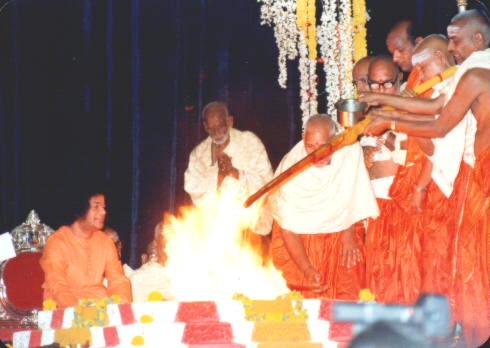
The Yaga was called
Vedapurusha Sapthaha Jnana Yagna and it consisted of two sections, the
morning sessions for seven days of Athi-rudrahoma with all its
complementary rites, and the evening sessions of a Jnanayajna, where
distinguished exponents of the Vedas explained to the vast gathering,
the meaning and significance of the scriptural rites. Since the
Festival had to high-light the efficacy of Vedic injunctions, Baba said
that scrupulous care should be taken to observe them all, down to the
minutest detail. Therefore, the number, size and situation of the
pillars of the Yaga-mantap, the number and shapes of the sacrificial
pits, the location of the shrines of subsidiary deities like the
Yoginis, the Vasthupurusha, the Kshetrapalas like Abhayamkara, and the
Navagrahas, were all correctly fixed. The kusa grass seats for the
participants were prepared in accordance with the do's and dont's that
the Sastras
prescribe. The materials for the sacrifice, like ghee prepared from
cow's milk, earth from ant-hills and royal equestrian stables and royal
elephant stables and royal palace enclosures, the banyan tree twigs,
the spoons made of special wood, were all collected under His personal
supervision. Altogether 2,26,270 spoonfuls of ghee were offered during
the seven mornings into the sacrificial fire, with the concurrent
invocation of the appropriate Name of the Lord, describing one among
His manifold characteristics! The Yaga was certain to promote,
according to the Vedas, the welfare and peace of the world. "Santhi
kaamasthuhomayeth"; those who desire the establishment of peace have to
do this sacrifice", say the Vedas. [See also: Esoteric Significance of the Veda Purusha
Jnana Yajna]
Baba, in one of His
Discourses during the week, referred to the derision with which even
many Hindus react, when they see so much ghee being poured in the Fire.
He spoke of such critics as dwellers in the realm of cash books,
persons who clamour for jars of ghee and bundles of fuel, rather than
the more precious and the more lasting joy of having invoked and
pleased the Gods. The very performance of an ancient honoured rite
gives a satisfaction that cannot be expressed in cash. "These
questioners have consumed hundreds of bags of rice since birth and they
have drunk pots of ghee so far. Let me ask them, whether they have had
a single day of happiness themselves or whether they have been able to
give a single day of joy to their kith and kin. But, this Yaga gives
great joy to many; it gives peace and joy to the world. I and My people
are delighted; that is enough compensation. When ghee is poured into
the Fire, those who do not know or believe in the Vedas say it is a
waste. Those who do not know agriculture may cry that casting seeds in
the furrow is a colossal waste; they do not know that the tiller will
get the grain back, a hundred fold. This is also like that. Letters
reach the addressee only when they are duly stamped with
manthras and dropped into
sacrificial Fire. This is a science as much as any other."
The foremost reciter of
the Vedas in Andhra Pradesh, a person honoured by his colleagues as
Veda-samraat (Undisputed Master of the Vedas) Brahmasri Cherkumalli
Kamesvara Ghanapati was invested with the office of Sarvaadhyaksha
(Overall Supervisor) of the Yaga and a Pundit in the Nyaya Vedantha and
Jyothisha schools of thought was installed as the Officiator. Sri
Uppaluri Ganapathi Sastri, a septuagenarian scholar, one of the very
few in India today who can expound every syllable of the Vedas in
conformity with authentic commentaries, on whom learned Societies have
showered titles like Aamnaayarthavachaspathi, Vedabhashyavisarada and
Vedabhaashyaalankaara, was chosen as the President of the
Jnana Yajna section of the Yaga.
Sri Ganapathi Sastri
has stated that in his fifty years of experience of Vedic Yagas and
Yajnas, he has not had the privilege of witnessing such a scrupulously
correct Yaga, which could pass the most rigorous tests of orthodoxy. As
a matter of fact, the discourses he gave every evening on the
significance of the rites were punctuated with sincere gratitude to
Baba for His upholding the Vedic Injunctions. He quoted Vedic manthras
in support of what looked like 'casual acts' of Baba: His reference to
the rithwiks as 'gods', His distribution of white silk clothes to the
reciters of the Vedas and red silk clothes to those engaged in other
rites and even the order in which He presented awards to the
participants at the end of the Yaga! Baba was the Vedapurusha, he
acknowledged. Baba Himself declared: "Do not be misled; I am not the
person performing this sacrifice. I am the Person receiving these
sacrificial offerings and awarding the rewards". And He gave proof too.
On the Penultimate day of the Yajna, He announced "Tomorrow, when the
Valedictory Offering is poured into this sacrificial Fire I want each
one of you to resolve with your will that you are pouring into the
flames all the evil in you, all the egoism and degrading attachment,
all the habits that drag you down". Many who had equipped themselves
with gold and gems, silk and sandalwood(!) in order to be ready to put
those precious things into the Fire (as is the wont in all Yajnas) were
awakened by this call, into the knowledge of the significance of the
Yajna. Baba made also another announcement; "Tomorrow at the moment of
Valedictory Offering, you will be given the
Darsan of the Yajnapurusha,
the Person who accepts the Yajna".
True to the Promise,
Baba ascended the Yajna Vedi at that very Moment; He granted Darsan to
the tens of thousands, who ecstatically acclaimed Him as the Person who
accepts the Yajna.
It must be mentioned
that the Kamandalu or Watervessel of Shirdi Sai Baba which has miraculously
found its way into Prasanthi Nilayam
was placed on the Yagamantapa to hold the ceremonial water used for
most of the mystic rites; the continuity of the two Sais was thus
symbolized. When the Officiator required images of the Navagrahas for
installation, Baba created them by a wave of His Hand; when he held out
His hand for a plate of gold to be deposited with the relevant manthras in the water-vessel, Baba made it on the
spot and gave it to him; so too, when the time for the Valedictory
Offering approached, He created the Nine Gems and placed them in the
plate held out before him. The pundits as well as the thousands who
attended the Yaga had also another glimpse into His Divinity, when Baba
one evening, down from His seat and moving out of the roofed area,
looked up at the growling sky which was bent on a heavy downpour of
rain; as at Shirdi, Baba must have rebuked the skies and said "Stop
your fury and be calm", for the sky was stunned into sudden calm and
clarity.
The Yaga achieved many
results, chief among them being the transformation it brought about in
the outlook of the Pundits of the land. Many of them came infected with
the prejudice that Baba was only an adept in magic, a hardy prejudice
that had unfortunately kept Sisupala,
Duryodhana and millions of
others away from Grace in previous eras. Ganapathi Sastri confesses
that he too was thus affected, but, "as a result of the constant
association with Him for many days during this Jnanayajna, and
observation of the ever fresh and unique examples of His Glory, I
realized that I was incapable of gauging His reality, for He was
undoubtedly the incarnation of God". Darsanabhushana Chathusthanthri
Kolluri Somasekhara Sastri, who had a similar experience began
addressing Him soon as Bhagavalleelaavaathaara,
Leelaa-maanusha-vigraha, meaning that He was indisputably Divine.
Vidwathkavi Vemparala Suryanarayana Sastri revealed before a large
gathering of devotees, that he had refused to place faith in the theory
that Baba was an incarnation of the Lord; he was not convinced when
many people told him that their lives were saved by the Vibhuthi that
Baba had materialized and blessed them with; even when his friend, Sri
Kamavadhani had shown him the gifts that Baba had created and given him
at Rajahmundry, he had turned a blind eye. But, before the Yajna
concluded he confessed that "the conviction that Baba was Krishna, come
again, was rooted deep in me". Adwaithavedantha Siromani,
Meemaamsavisarada Mallavajhala Venkatasubba Sastri of Warangal, who was
also a doubter, turned into an ardent advocate of the Avatharhood of
Baba.
He said that even the
Viswarupa-darsanam vouchsafed by Krishna to Arjuna could be dismissed
by cynics as a major magic performance; if the Lord presented Himself
before them, they would attribute it to an optical defect or describe
it as an apparition pictured by feverish imagination. He applied the
various tests prescribed by the Sastras and concluded that Baba is
Bhagavadavarthaara-murthi and so, he exhorted all to worship Him with
steady devotion and sincere Love, to select Him as their Teacher and
Guide and by these means to save themselves. [Bhagavad Gîtâ, Chapter 12]
This revolution in the
reactions of the Pundits was in conformity with the declaration by Baba
Himself; for, He has said often that only those conversant with the
Vedas and Sastras can delve into His Reality, to any appreciable
extent. No wonder therefore that the hundred and odd scholars of the
scriptures that basked for seven days in the sun of His Grace decided
without any extraneous prompting to arrange a unique function on the
Tenth Day which they named "Thribhuvana Vijayam" Triumph over the Three
Worlds!" When asked whose triumph they were arranging to celebrate the
answer was, Baba's! The Vedas and other scriptures, along with the
ancient sciences and disciplines by which they could be understood and
practiced (like Grammar, the Six systems of Philosophy, Philology,
Phonetics, Theology) were to approach God on His Throne and beseech Him
to glance at them lovingly so that they may grow strong again and
afford shelter to mankind. They pleaded that Baba must be on the Throne
and proposed that they would approach Him with pleas on behalf of the
sciences of the Spirit. And, Baba agreed. When some objected, "Baba!
They are asking you to act a role! They can be the roles but you are
God". Baba intercepted: "But I am acting a role now in this human form.
The Function-less and the Role-less has come, taking on a Function and
assuming a Role".
A strange thing had
happened, unawares, in preparation for the "Thribhuvana Vijayam"! A
devotee had a dream in Bombay a few weeks previous; She saw Baba as
Narayana on the Primeval Serpent (Sesha) Couch. So, she got ready a
magnificent Serpent Couch in wood, complete with coils and hood and her
kinsmen brought it to Prasanthi Nilayam, in a motor vehicle specially
reshaped for the purpose. The Pundits were happy that the very thing
they needed to make their function realistic, the throne, had come,
through the will of Baba.
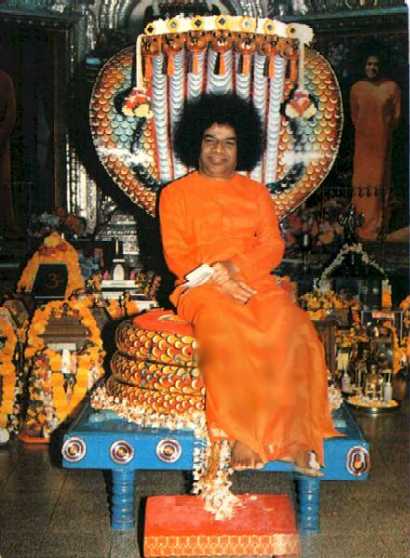
Let Ganapathi Sastri
himself describe the scene; "When Baba reclined on that Seshathalpa,
with the Yagamantapa as the background, each Pundit and Sastri who was
a master of one chosen branch of a scriptural lore stood before Him and
represented as previously arranged, the importance of his field of
knowledge and the urgent need to foster it, everyone saw Mahavishnu in
Vaikuntha reclining on the Sesh Serpent and of Brihaspathi and all the
gods and sages displaying their scholarship and attainments for His
Glorification and praying to Him to save the Sastras from
decline. It was indeed the Devasabha the Divine Durbar and we forgot
all about ourselves in the supreme joy in which we were submerged. It
was an occasion to be personally gone through and experienced; the joy
we felt cannot be communicated to others by even Brihaspathi, the
all-knowing preceptor of the Gods, or by the Four-faced Brahma or the
Six-faced Kumaraswamy or the Thousand-tongued Adi-sesha". To the
Sarvadhyaksha of the Yaga, Sri Kameshwara Ganapati, it was a fruitful
revelation. He came, he saw and he was conquered. He left his native
home in the far-off Godavari Delta, he turned his face away from his
village home set in the midst of the coconut gardens he cherished, and
stayed on at the Prasanthi Nilayam, where he found the Vedapurusha whom
he had been extolling with manthras for sixty years!
The Jnanayajna or
Evening Discourses provided an opportunity for the Vedic scholars to
fathom the extraordinary scholarship of Baba. Ganapathi Sastri
expresses the sense of admiration of the learned Pundits thus: "Apart
from the thrill that the listeners derived from the discourses of Baba,
the reputed masters of the ancient disciplines who had gathered renown
by lecturing to many vast gatherings throughout the land were
themselves struck with wonder at the depth and width of His knowledge".
Mallavajhala Venkatasubbarama Sastri analyzed the reactions of his
colleagues thus: "In all His speeches there was not the slightest
deviation from the Sastras nor the faintest whisper contrary to the
trend of their teachings. And, the subjects He handled! They were
indeed the most profound! The methodology of exposition was in strict
conformity with the canons laid down in the scriptures. There was no
repetition of argument, no irrelevant digression, no jeering criticism,
no jarring adulation, no over-emphasis". Kalluri Venkatasubramanya
Dikshith reacted similarly. "The nectar of His Love filled every word
of His parables and explanations. It was overpowering Grace that made
Him pity the poor understanding of the listeners and search for tiny
tasty stories that could clarify the profundities He was unraveling,
the Goals He desired to picture". In short, the scholars found in Baba
the Master-Mind that was guiding and shaping their own.
But, it was not all
wonder and admiration! The Pundits were made aware of the worth of the
treasure that they were preserving; they were told the reason for their
poverty and for the neglect which is their meed lies in themselves!
They were induced to examine their own lives and beliefs, their own
attitudes and prejudices, their own preferences and foibles. "You may
ask why Pundits and Vedic Scholars are passing through such hard times.
They are mostly hungry, ill-clad and homeless. No one comes forward to
join Vedic schools. I shall tell you why they have come to this pass.
They have themselves lost faith in the Vedas. Let them be fixed in that
faith - then, the Veda will make them happy. If the Veda cannot make a
man happy, what else can?" asked Baba. He filled the
Brahmins with faith in what
they carried in their heads. He also condemned the ignorant sneer which
brands the Vedas as clever stratagems by which the Brahmin priests
ensure their position as intermediaries between man and God and win
superiority in the social hierarchy. "Look at the regimen of
restrictions and regulations, the hundreds of do's and dont's limiting
freedom of life and limb which these Brahmins have imposed on
themselves in order to promote the good of society and of the world and
for their own spiritual uplift. Do not dismiss them as superstitions;
no one will bind themselves from dawn to dusk and dusk to dawn with
such drastic rules and limits for mere fun. They are hard limitations
on daily conduct, social contacts and economic effort. It requires
great courage, hardihood and faith to hold these rules as vital and put
them into practice. Honour those that have faith in that ideal. Their
adherence to those ideals has been of tremendous value to India and the
world, for it has preserved the only culture that can save mankind. I
know the sincerity with which they have been leading the hard life,
for, I have been with every one of them, in their rites and rituals
since years", Baba said; this transformed the hostile attitude of many
towards the Brahmin community, an attitude fostered by pseudo-political
fears and prejudices caused by the ignorance of the sacrifice the
community had been practicing for centuries.
This was no ordinary
Yajna that Baba presided over; it was a revival; it was a revelation;
it was a revolution, a resurgence. It was a symbol of cultural
renascence, for Baba, explained that the Vedas are essentially for all
time and all mankind, that Sacrifice or Yajna is the sign and secret of
all life. He advised the participants to recapture the ancient ascetic
simplicity; He explained that in the manthras, the Glory and Majesty of
the One God is visualized in various contexts; He elaborated on the
symbolism of the Sun and the Moon as guiding the inner and outer vision
of man. He spoke of the tonic effect of the very sound of the Vedic
manthras; they charm away the evil in man. "I want to prove to you and
to those others that a Yajna, celebrated according to Vedic Formulae
will certainly grant the fruits promised by the Vedas", He said. "The
Vedas belong to those who value them, who are moved by thirst for
spiritual uplift, who desire to practice them and who have faith that
they will benefit by that practice. No one else has the right to talk
patronizingly of the Vedas or disparage them. For, all such talk will
be hollow and insincere", He warned.
Fourty five days later,
on the auspicious occasion of His Birthday when thousands had gathered
to celebrate it in His Presence Baba invited the incomparable
Aamnaayaarthavaachaspathi Uppaluri Ganapathi Sastri to inaugurate the
Sathya Sai Veda-Sastra Patasala, the Academy for Vedic and Sanskrit
Study, at the Nilyam. He said, "The Vedas are in need of revival. We
have to prevent the goats from nibbling at the sprouts. I have come for
the sake of this Dharmasthapana". "Vedokhilo dharma mulam", "The Vedas are the root of
Dharma". Vedic scholars have to grow in numbers for the sake of the
promotion of Dharma. So long as Vedic Scholars are produced and
honoured, so long the Vedas will remain green in the hearts of man.
This is the real Dharmasthapana." "My Task is to open your eyes to the
glory of the Vedas and to convince you that Vedic injunctions, when put
into practice will yield the promised results." "My
Prema towards the Vedas is
matched only by My Prema towards Humanity." "My Mission is just four:
Vedaposhana, Vidwath-poshana, Bhaktharakshana and Dharmarakshana".
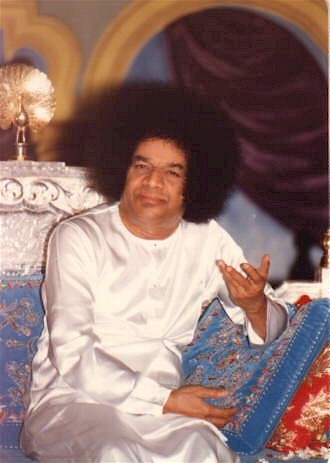
"These boys" He said
pointing to the first batch of boys that was enrolled, "These boys will
grow into strong stalwart pillars of Sanathana Dharma;
they will be the guides and leaders of this land in the days to come,
to save it from vain follies and wild passions. You may say they are
only twenty in number now; but, when a vast country is administered by
a Cabinet of twenty Ministers, this band of students will be ample, for
the work I have in view". "Parents who have sent them to this Patasala
have reason to be happy, for these boys will become lucent gems,
spreading Vedic splendour and
Sastric light. I shall take
care of them, more lovingly than any mother".
Then, the distinguished
Vedic scholar taught the boys the correct pronunciation of the
Inaugural rik, from the Yajur Veda, "Ishethwa" and wished the Patasala
all success. Baba takes great delight in moving among the little boys,
and watching their progress. He instills hope and courage into them. He
pays special attention to health, discipline and character. He insists
on outer and inner cleanliness. Baba encourages them to seek the
meaning and purpose of the riks they recite, for, as He has often
remarked, they should not get transformed into mere tape-records of the
Vedas;
they must charge themselves with the devotion, the rectitude, the
detachment and the sense of kinship with Truth, which the Vedas
teach.
He insists also on an
all-round progress of the boys, so that they may grow into helpmates of
the down-hearted and the distressed. In recent years, He has Himself
written musical plays brimful of the noblest scriptural teachings on
"Markandeya", "Sakkubai", and "Radha-bakthi"; the first depicts in easy
sweet Telugu the story of Markandeya, who defied death and won
Immortality as a Star in space. The second deals with the simple saint
Sakku, whose devotion to Panduranga was so intense that the Lord
Himself took her form and served her husband and mother-in-law in order
to release her from her home, for the pilgrimage to the Panduranga
Temple.
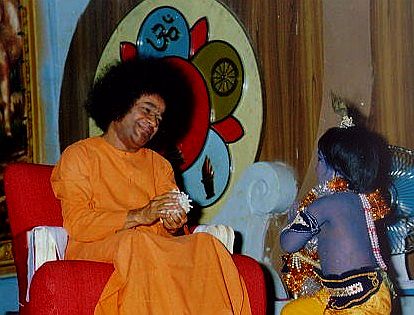
The third reveals the
deep significance of the spiritual yearning which filled the entire
being of Radha, for Krishna. Baba Himself selected the boys for the
cast, assigned the parts, supervised the rehearsals, decided the stage,
fittings and curtains and trained them to sing the many songs He
composed and designed the costumes for every role in every scene, and
on the days when the plays were presented, Baba spent hours in the
green room directing the make-up and encouraging each little boy by a
soft pat with His loving palm when they moved out towards the floodlit
stage, where tens of thousands greeted them with loud applause. For
about a month, the boys had the unique good fortune of being inspired
by His vigilant Prema,
during rehearsals. Since every participant imbibed the entire text,
whatever be his individual role, all the words from Baba's Divine Pen
have sunk into the hearts of all the boys. Baba is thus transmitting
them into proper instruments for the fulfillment of the task for which
He has come. The Patasala is bound to grow into a great Banyan tope,
affording shade and shelter to countless peoples caught in the desert
sands of greed, hate and despair.
Baba saw that the
rampant decline in private and public morals is due to the neglect of
the discipline prescribed in the Vedas. The Brahmin,
Kshatriya and
Vaisya
Varns are burdened with
greater obligations than the rest of the community because they are
initiated into spiritual life, too. This rite of initiation is called Upanayana, 'leading near', that is to say, taking the
boy near the Guru or spiritual preceptor for Brahmopadesam (guidance to
Brahmam). This has to be done according to the
Sastras by the teaching of
the Gayathri manthra
before the boy evinces longings for sensory-pleasures and thereby gets
lost in the wilderness of transitory adventures. The Brahmin boy has to
be initiated into that sacred manthra before he is eight years old, the
Kshatriya has to be initiated before he is eleven and the Vaisya,
before he is twelve. Manthra is ("thrayathe" through manana) that which
saves through constant reflection on the meaning. But, though these
caste structures still persist in varying degrees of strength
throughout India, this great rite has suffered drastic decline. In many
regions and families, it is postponed until as late as the marriage
rite, or completely overlooked. When thus the very spring of spiritual
discipline is allowed to go dry, how can the call of the ancient ideals
raise any response in the heart? Man should not be allowed to remain a
beast, caring only for feeding and breeding.
Therefore, as a great
step forward in the revival of Dharma, Baba announced that He will be
granting members of the three varnas - dedicated to a second birth - the great
chance of being initiated into the spiritual life, by Himself at Prasanthi Nilayam.
The devotees of Baba were thus aroused into a recognition of their
primary duty to their children; they hastened to benefit from the
offer. On February 3, 1963, when 35 boys were "led near Him" and became
Brahma-charis (pilgrims on the path of Brahma-realisation) through the sastraic process of receiving the sacred
Gayathri manthra, Baba
declared addressing the group, "You have come in this body, this
receptacle, in order to realize the Glory that you really are. This
body is the cocoon that you have spun round yourselves with the thread
of your impulses and desires. Use it to grow wings so that you can
escape from it. The Gayathri manthra is a prayer to the Universal
Intelligence to awaken the Dhee-sakthi in you, your faculty of
discrimination, of analysis and synthesis, so that you may realize who
you are and why". Turning to the parents, He said "This is an important
day in the history of Sanathana Dharma,
for it is a great step in the restoration of Varanashrama Dharma.
The study of the Vedas is the highest learning, for, it leads to the
conquest of Death itself. Today, these, your children, are set on the
road to explore their Inner Realm and Innermost Reality".
In 1964 when the Upanayanam rite was again arranged 300 boys were so
blessed; in 1965, the number increased to 450. The festival is made
unforgettable for participants as well as spectators by the shower of
love with which Baba greets not only the boys who are initiated but
even their parents and kinsmen. He makes up for all the ritual lapses
of the parents, like disregard of the 'naming rites' or 'ear-boring
rite', or 'tonsure rite'; He overwhelms the parents and gifts. He does
not allow any display of wealth by the richer parents, least the poorer
are cast into gloom during the auspicious occasion. To have the rite
performed in the Divine Presence is itself a unique gift and many a
devotee has felt sad that he aged too fast. Many are depressed that
their children have undergone the rite already and have therefore
rendered themselves ineligible for the great chance.
Baba's Grace flows
spontaneously towards the assemblage of Brahma-charis. He gives each of
them ceremonial clothes, ritual vessels, momentos and books, besides
what is treasured as most auspicious, the inaugural Bhiksha (alms) when
each boy starts the "mendicant" career that day, as prescribed in the
Sastras for every seeker
during the years of Vedic study. The boys walk up in a long line to
Baba's Presence and after introducing themselves in traditional style;
mentioning their Gothra, Suthra and patron Rishi, pray "Bhavathi,
Bhikshaam dehi", "Ma, give me alms" and Baba as Vedamatha and
Annapurna, fills their plates with grains of rice. Baba insists that
the newly initiated prostrate themselves before their parents; He
explains to each boy, at that particular moment, the Vedic commands "Mathru devo bhava"
and "Pithru devo bhava" meaning "May your mother be your God", "May
your father be your God". The boys as well as the parents are, visibly
moved by this act, which Baba considers, as important as any other item
in the ceremonial. Then He places in the hands of the boys, gifts,
which they pass on reverentially to their parents.
More memorable than all
these, especially to the Brahma-charis, is another spontaneous gift of
Baba, a Blessing that He alone can grant. Baba calls each boy to
Himself, even when the number is 450, and, in the sublime silence, He
whispers into the ear of the child, fresh from his first lesson in
Vedic recitation, a sacred
manthra which He instructs
him to keep strictly to himself. He has to repeat it with
Sraddha and Bakthi, every day of his life. Many an ardent
seeker has striven long to get Manthropadesa from this Avathar of the
Lord, but they still await the gift, while these chosen boys, on the
threshold of the kingdom of God within them, acquire the key which will
help them to enter it, through the spontaneous Grace of Baba.
The Upanayana Festival
is also marked by the discourses by eminent pundits on the Gayathri, as
well as on the need to regulate and restrict the wild senses by the
discipline prescribed in Dharmasastras for the twice-born and others.
Baba too discourses on these and kindred topics; His advice is directed
towards the elders who, by their neglect of this rite have brought
about downfall of the magnificent edifice of Sanathana Dharma.
A gentleman from Mysore had not initiated his seven sons into the
Gayathri; without any resentment, Baba invited him to bring all of them
to Him, for as He said, it is never too late to start on the Godward
journey; his sons, ranging in age from 28 to 8 were all led into the
sacred path. He wanted that parents too must perform the Sandhya rite
and repeat the Gayathri for their own good; the boy should not be made
to feel that this was a chore invented for tormenting him. "Do it
cheerfully, with evident relish. Learn the procedure from these boys,
from your children and grand-children. For your own sake and for the
sake of the human community, start Sandhya today with Gayathri Japa and continue it, with increasing fervour."
"I know how systematic you are in eating and drinking. You take pretty
good care of the body. I do not condemn it; I only want that you should
take equally good care of the needs of the spirit". [Gayathri Mantra, sung by Baba]
The Gayathri is a Vedic
Prayer that has been addressed to the effulgence that is immanent in
the Universe by millions during millennia throughout the length and
breadth of this land. It prays, not for the health or wealth, happiness
or victory but it prays for "awakening of intelligence". It is a prayer
which all men in all lands can well adopt. Mr. J.B.S. Haldane has
written that the Gayathri can be carved on the doors of every
laboratory of the World. "May intelligence grow, prevail and ripen into
wisdom", and save mankind from perdition!
Baba does not hide His
displeasure when he finds that a Brahmin, Kshatriya or Vaisya is not
performing the Sandhya rite, and repeating the Gayathri during the
rite. Fear of that displeasure has persuaded many who come to Baba to
resume the Sandhya, brushing their memory in haste from books or from
their own children. When Baba surprises people with the question, "Are
you doing Sandhya?" many have to accept the lapse, and correct
themselves.
God is said to love the
returned prodigal; Baba encourages by special marks of Grace, those who
come back into the Sandhya discipline. For example, a person from
Shimoga Town came to Him to get His Blessings, for a venture that he
had set his mind upon. Baba surprised him with the question, "Are you
doing Sandhya?" and he too hung his head. "No, Baba, though I have been
enjoined to do it, years ago on the Upanayanam Day" he said. "Well, it
is not too late; start as soon as you reach home" Baba ordered. The
rite took about 20 minutes and had to be done three times a day; at
dawn, when the sun was at the zenith, and at dusk. Rao kept the promise
he had given Baba; he did the Sandhya, with growing devotion and
pleasure. After some time, he felt that a Linga, which his grandfather and father were
worshipping ritually every day for many years, should be retrieved from
the limbo to which he had consigned it. He recovered it; he filled it
with his devotion; he offered flowers and fruits and poured sanctified
water on it, with the appropriate manthras! Baba 'willed' to grant him
tangible proof of his appreciation of this laudable advance; the colour
of the Linga changed from opaque dark into golden transparency. And,
very soon, inside that round-topped little cylinder of hard
translucence, Baba allowed Himself to be 'entangled'! For months now,
thousands have seen, inside the Linga, a lovely captivating picture in
brilliant colour of Baba with His sweet smile, in the centre of a halo
of mellow golden light!
Apart from the day
fixed by Baba, for the Upanayanam of the boys who are brought to
Prasanthi Nilayam, Baba confers the boon on other days also, if
devotees yearn for it and if He feels the boy deserves it. On
Sankarajayanthi Day, the birthday of the great Sankaracharya who
revived Hindu religion and built Hindu philosophy and culture on the
unshakeable foundation of Basic Unity or Adwaitha, He seldom refuses this boon. Baba considers
this ceremony of opening the inner eye of the rising generation to be
so important that He even reminds parents of their obligation to
initiate their children and calls upon them to celebrate the
Upanayanam. This, He does both directly and indirectly. Take for
example the telegram received by Sri C. Ramachandran of Kirkee, Poona.
"On 26th April, 1965, when I went to my residence at lunch break",
writes he, "both my sons came running forward excitedly and put into my
hands a telegram which had been just received. The telegram ran as
follows: "Sri Sathya Sai Baba arriving at your residence on fifth May
to attend Upanayanam of your sons and give them Brahmopadesam". The
words "Satya" "Upanayanam" and "Brahmopadesa" are underlined in the
telegram!
"I had never discussed
with anybody the question of having the Upanayanam of my sons performed
during the summer, although I had a keen desire to perform it as early
as possible, since this function was already overdue and had been put
off, during the last two to three years. I had not made up my mind,
whether to have it performed at Shirdi or Palani, our family shrine. I
was, therefore, surprised to find that the place and the date had been
fixed by the sender of the telegram. We were overjoyed at the prospect
of having Baba with us for the function"
On enquiry, Sri
Ramachandran discovered that the person who was responsible for sending
the telegram from the Central Post Office, Poona, had described himself
as "a person in transit, with no permanent or local address"! and that
when the Postal authorities pressed him to give an address, he had
written his name as Sri Maragathavelu, c/o All India Sai Samaj,
Mylapore! Hesitant to neglect so mysterious a manifestation of Baba's
Grace (of which he was well aware through other more concrete
instances, like Vibhuthi emanating from the pictures of Baba, in his shrine-room),
Ramachandran decided to have the Upanayanam of his two sons celebrated
on the 5th of May as directed. And Baba gave proof that day He was
present! "During the evening Bhajan, every one in the gathering of
nearly a thousand people had a peculiar feeling that the sofa kept on
the platform for Him was not vacant. When
Arathi was over, we found
that the new silk seat-spread had been creased in such a way that we
could clearly make out that Baba had been sitting there. Besides, the
ring of jasmine flowers which was placed on the right arm of the sofa,
as is generally done at Prasanthi Nilayam, was crushed just as if His
Hand was resting on it". A sign is enough for those who seek.
Writing about the Dharmasthapana
for which Baba has come in human form, we have to devote special
attention to the Academy of Vedic Scholars established under His
Guidance, which is fast spreading its beneficent activity from one
State of India to another, since 1964. It was on the sacred day of
Ramanavami, when a million homes all over the country were celebrating
the incarnation of Rama,
described as the embodiment of Dharma, that Baba revealed His intention. He was
that day at Rajahmundry on the Godavari river; at dusk, He entered a
motor launch with a number of learned Pundits and scholars, and we
reached a patch of dry sand, an island bathed in cool moonlight, set in
the dark blue background of the river above the Dhowaliswaram anicut.
There, seated in the center of the circle of adoration, Baba spoke on
the state of the world and of India, which must guide it, with the lamp
of Sanathana Dharma. We must reform the habits of man;
re-construct his character; recondition his ideals and modes of living;
help him regain the spiritual heritage which he is now encouraged to
ignore by protagonists of material prosperity and monetary happiness",
said He.
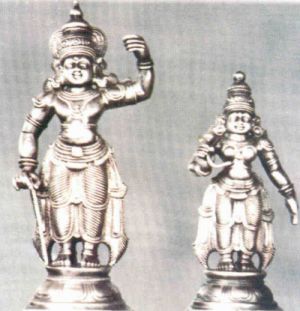 He created from the
sand before Him, resplendent idols of Rama, Sitha, Lakshmana and
Anjaneya; then, He created a charming idol of Nataraja, the Dancing
Siva, symbolising the Energized Universe that expands and contracts (or
breathes) in harmony with the Divine Will. Then, in the climax of that
Sublime Silence, He announced that He had decided on the establishment
of the Prasanthi Vidwanmahasabha, an All India Academy of Vedic
Scholars who will strive to awaken humanity to the need to attain the
Prasanthi (Inner Harmony and Equipoise) which has its Nilayam (Above)
in the Sanathana Dharma, enshrined in the ancient scriptures of
India. Surely, a great moment in the history of this Age.
He created from the
sand before Him, resplendent idols of Rama, Sitha, Lakshmana and
Anjaneya; then, He created a charming idol of Nataraja, the Dancing
Siva, symbolising the Energized Universe that expands and contracts (or
breathes) in harmony with the Divine Will. Then, in the climax of that
Sublime Silence, He announced that He had decided on the establishment
of the Prasanthi Vidwanmahasabha, an All India Academy of Vedic
Scholars who will strive to awaken humanity to the need to attain the
Prasanthi (Inner Harmony and Equipoise) which has its Nilayam (Above)
in the Sanathana Dharma, enshrined in the ancient scriptures of
India. Surely, a great moment in the history of this Age.
Baba had given
indications even in the forties that He will rebuild Vedic Dharma on a
stronger foundation. In 1955, on the first day of October, at 9.30
a.m., as recorded in my Diary, Swami Amrithananda ran towards me, after
an interview with Baba, gasping with joy. He said, "I had a big sum of
money with me which Bhagawan Ramana Maharishi advised, I should use for
Vedic revival. I had invested it in the Benares Bank and later with
some Trusts. I had consulted Madan Mohan Malaviya, Bhagawan Das, and
Bal Gangadhar Tilak about the scheme but somehow, my plan did not
fructify. Just now, Baba told me, unasked, all about my unfulfilled
yearning. He said, "Do not worry any more; the task of Vedic revival is
no longer yours. It is Mine". The Swami died, peacefully, within two
months of this transfer of burden!
In January, 1960, a
great Sanskrit scholar from Sorbonne, France, Valestin by name, who was
in India to translate the commentaries on the Vedas into French,
arrived at Prasanthi Nilayam. One evening, during an interview with
Baba, he suddenly caught Baba's hands and pleaded "Baba! Vedic
scholarship is fast declining in this Holy Land. You must revive it,
you must foster it". I was there, nearby. I felt that East and West
were also there, awaiting with palpitating heart, the reply that Baba
will vouchsafe. For the Vedas are for both East and West, for all
mankind. And Baba did not disappoint mankind. He said, "I have come for
that very purpose, for Vedic revival. It shall be done. I will do it.
Wherever you are, you will know of it. The world will share that joy,
that light".
The Sabha was formally
inaugurated at the Swadhyaya Sapthaha
Yajna during the Dasara
Festival, 1965. About 200 Pundits had assembled at Prasanthi Nilayam
for the Convocation on 20th October. "Bhavani" said Baba, "gave a sword
into the hands of the Emperor Sivaji commissioning him to venture forth
and uphold Hinduism; this "Siva-Sakthi" is today giving these Pundits
the sword of Courage and commissioning them to go forth and revive
Dharma in the world". "I am sure this Sabha will move forward from
Victory to victory, for it is contributory to My Work. In all lands,
the true sense of values has to be restored and faith in the Divinity
of Mau has to be implanted. This is the work for which I have come. The
world has to be saved from the consequences of limited knowledge and of
the blinding pride that precedes a fall. The world is a parched desert,
calling out for rain. This Sabha will give each thirsty mouth a cup of
solace and strength, from the well of the Vedas and
Sastras". He condemned the
criticism of Vedic rites, rituals and teachings of superstitions. "The
Vedas are the root of Dharma. If the roots are injured, the tree will
die". "They gave Ananda and Santhi that are lasting and sustaining", He said. "They transmuted
all activity into worship of the Supreme and saved man from unending
desire and inexplicable sorrow", He said. "Know thyself, instead of the
sun and moon - that way lies the road to Ananda and Santhi".
The purpose of the
Akhila Bharatha Prasanthi Vidwanmahasabha was clarified by Baba during
the discourses that He gave on the days following the inauguration,
while presiding over the lectures that the Pundits gave on the subjects
suggested by him from Vedic and Vedanthic texts. The watchword for the
Sabha should be, He said, the prayer that is mentioned in the Vedas as
arising however indistinct, from every human heart, "Thamaso maa
Jyothir gamaya ... From darkness, lead me unto light". "Eradicate
Ajnana, the ignorance of the Universal that is the basis, the Ocean of
which the individual is but a wave; light the lamp in village after
village. Instill faith in man's freedom from grief and pain, that is to
say, instill faith in the Atma
and the Atmathatwa; share your learning and experience, in love and
sympathy, with the people who are hungry to know and be saved; remind
them of their worth and work. You are not to condemn any one's faith or
to develop any new sect; foster the positive attitude in spiritual
effort; faith is a precious plant, a gust of harshness will make il
wither. Be kind, be considerate, promote love, tolerance, service,
sacrifice, wherever you find them in the heart of man. These Pundits
have at last attained the fruition of their long study, for, they have
secured this medium, this Sabha, for sharing their joy and their wisdom
with their brothers and sisters. They have been allotted districts and
the Central Committee will be supervising the programme and progress.
They will sow in all cultivated hearts the seed of the Karmakanda, the
Upasanakanda, and the Jnanakanda of the Vedas, of Dharma as expounded
in the Manudharmasastra and other texts and of the Glory of God and Man
as explained in the Bhagavatha, the Mahabharatha and the Ramayana", He announced.
Turning to the
thousands of devotees who had come from all parts of India, Baba said,
"They sow the seeds. But, you have to tend the young crop, feed it with
the manure of Manana, rid it of pests, like greed and pride, harvest the
happiness of Love and establish yourselves in the Prasanthi that the
nourishing grain ensures". Baba recognised that the pundits must grow
experienced in the art of explaining the essentials of the scriptural
teachings to the masses in small easily assimilable doses that are
relishing; He warned that, unless the Pundits took care to practise
what they preached, their discourses would be exercises in sheer
hypocrisy. The people too have to be trained in the art of listening to
short, straight, spiritual discourses which arouse the desire to
practise what is taught. For, as Baba said, the greatest sin is
hypocrisy, spiritual weakness, self-condemnation and cowardice. These
can be cured only by the awareness of one's inherent Divinity, that can
never be harmed by such passing clouds of depression", Baba assured.
Baba declared, "This prasanthi Vidwanmahasabha is not something new, it
is Sanathanam. It is now once again set up on the age-old Mission. This
work of Dharmasthapanam is being done over and over again. You have now the chance
to share in it; So, join this great task and make your lives worth
while".
That call was
irresistible. Towns and villages vied with each other in asking for the
chance to arrange meetings and seminars for the benefit of their
citizens. The members of the Sabha were already famous over the length
and breadth of the land. Dr. B. Ramakrishna Rao, a great scholar in
Sanskrit, Telugu, a celebrated linguist, a great social worker and
political leader who served the people as Chief Minister of Andhra and
Governor of Kerala and Uttar Pradesh, is the President of the Sabha; he
has a Central Committee of Pundits who have earned enduring fame by
their scholarship, speeches and writings like Uppuluri Ganapathi
Sastrigal, who is honoured as Amnayarthavachaspathi by his colleagues;
Kolluri Somasekhara Sastry, honoured as a Kulapathi by his gratified
students; Bulusu Appanna Sastry, known as Darsanalankara, the renowned
translator and commentator on Sankara's Githa Bhashya; Remilla
Suryaprakasa Sastry, honoured as Sanga Veda Vidya Bhaskara; Varanasi
Subramanya Sastry, who by his unexcelled scholarship relating to the
works of Vyasa
is celebrated as Balavyasa; Ghandikota Subrahmanya Sastry, the doyen
among Dharmasastra scholars and the master of Vedic lore; Pisipati
Krishnamurthi Sastry, a great expert in astrological observations and
calculations according to all the schools of that ancient science, and
others. To bring such a galaxy of Pundits into the same orbit is itself
an achievement, made possible only by the unique attraction which
Baba's Divinity exerted on them all with equal force.
The Inaugural Meeting
where the Pundits carried the Message to the people at large was held
in the immediate Presence of Baba Himself at Venkatagiri Town, in the
Palace Quadrangle, under the chairmanship of the Raja Saheb of
Venkatagiri. Baba mentioned that the citizens of Rajahmundry on the
Godavari were hoping that the meeting would be held in their town,
since the Sabha was resolved upon 'on the sands of an island in the
centre of the Godavari on Sri Ramanavami, last year'. But, "like all
good things, this too is won not so much by present effort, but, by
merit accumulated through, years numbering to centuries". Baba said
"Venkatagiri has been for centuries the seat of a Royal Family
dedicated to the support and protection and promotion of Dharma.
Consider how many temples were built or renovated and maintained by its
munificence! Take count of the Pundits it has patronised so far and the
number of religious books its donations have helped to reach the
masses. See the interest the Family takes even now, for the upkeep of
temples and mutts although their State and Status have been overwhelmed
by the storms of political change". No wonder that when the Madras
State Prasanthi Vidwanmahasabha was inaugurated six months later, Baba
selected the vast grounds of the Venkatagiri Palace at Madras City as
the venue!
The Mysore State
Prasanthi Vidwanmahasabha was inaugurated at Brindavan, Whitefield near
Bangalore on 13th April, 1964, under the Chairmanship of Hon'ble Sri
B.D. Jatti, the Finance Minister of Mysore State. Inaugurating the
Sabha, Baba said, "The link between the Pundit and the politician, the
religious leader and the ruler has snapped and each goes his own way,
irrespective of what the other thinks or feels. Long years of foreign
rule during which the Pundits were derided as symbols of an out-dated
culture contributed to the widening of the gap. But, even after that
rule ended, nothing has been done to re-establish the link. Sunk in the
search of passing pleasure and cheap recreation, people have become
deaf to the counsels of the past and the call of the sublime. Unless
the people are trained to direct their newly won opportunities into
channels of service and self-control, there will be large scale moral
breakdown, when the Five Year Plans stud the land with dams,
power-stations, furnaces and factories; we must have a Plan, a
well-thought-out Plan, for the moral education and the spiritual uplift
of the nation, in order to avoid disaster".
At the Inauguration of
the Mahasabha in Madras State, Baba declared: "Man's ambition to
conquer outer space, even before he has understood fully the nature of
the earthly home he carries about with him and the discipline needed
for harmony therein is leading him into great disaster. No knowledge,
however impressive, which refused to acknowledge, the existence of God
can be safe and sustaining", Baba declared. The Mahasabha has also been
established with His Blessings at Hyderabad, the Capital of Andhra
Pradesh at a Meeting presided over by the Governor, Sri Pattam Thanu
Pillai. The Maharashtra Branch of Vidwanmahasabha was inaugurated by
Baba at the Shanmukhananda Hall, Bombay, on 7th June, 1965. A Committee
under the Chairmanship of Hon'ble Sri P.K. Savant, Minister of
Agriculture, Government of Maharashtra, has been formed with the
Speaker of the Legislative Assembly, the Chairman of the Legislative
Council and others as members.
Sri Savant is an ardent
devotee of the shrine at Shirdi, where Baba lived the Life Divine and
taught way to God, as Sai Baba; Sri Savant was a member of the "Shirdi
Samsthan Trust Committee" and for some time he was its Chairman. The
Trust manages the affairs of the unique shrine that has grown around
the 'Tomb' or Samadhi of the Sai Avathar. When, therefore, Savant heard
that the Master had taken human form again, he was naturally cautious
about the claim. His curiosity however took him to the bungalow of a
devotee with whom Baba had stayed for three days in May, 1960. There
Savant joined in the Bhajan; he went through the Album of Photographs depicting Baba's
activities; he saw a few hundred feet of film recording Baba's visit to
Badrinath and the Yajna which was celebrated at Prasanthi Nilayam; then, he was
taken into the very room where Baba had stayed during those three days.
It is kept as if He has not left the place, in perfect readiness to
receive Him, any moment. While in the room, Savant was offered the Vibhuthi brought from Prasanthi Nilayam, kept in a
small receptacle there.
Naturally, he opened
his mouth to receive it, but, his breast was suddenly afflicted with an
understandable pang of doubt, whether as a staunch devotee of the Sai
Baba of Shirdi, he could now take in the Udi consecrated by a stranger who claims to be
the "same Baba" come again. There are Babas and Babas, he felt,
spurious, pseudoauthentic, and dubious, pitching their claims to
reverence on all manner of unprovable relationships.
We should not be
surprised when a devotee with Savant's steady faith in Sai Baba was
harassed by doubt; we must indeed be thankful for his hesitation, for
just at that split second, in order to convince him that the Sathya Sai
at Prasanthi Nilayam is Sathya (Truth), the same as the Sai Baba of
Shirdi, a long bright flash of light emerged from the right palm of
Bhagavan Sri Sathya Sai Baba in the picture hanging on the wall of that
room, above the heads of Dr. D.J. Gadhia, who was offering the Udi and
of Sri P.K. Savant who was outwardly ready, though inwardly undecided,
to receive it!
That flash scattered
all argument against the identity of the two Babas; it shattered the
dark clouds of doubt and hesitation. Savant received the Udi. Some
months later, at Prasanthi Nilayam, Baba declared, "The depth of the
devotion of Savant to that Body and this Body of the same Sai is known
only to him and Me". Savant attended the inauguration of the Mysore
State Branch of the Prasanthi Vidwanmahasabha and so, he was happy that
a branch of the Organisation founded by Baba was soon started in
Maharashtra. He and all who shared the thrill of that day were glad
that the Grace of Baba had descended on Maharashtra again and that a
new era had dawned for the Pundits of that State, who could share in
the revival of Dharma under His auspices.
The Vidwanmahasabha has
been actively promoting lectures by Pundits in several towns and
villages. A seminar for about twenty of them was held for a week to
suggest subjects (on which they should speak to the people) selected
from the vast reservoirs of Scholarship that they have each stored in
themselves and to suggest methods of presentation that would receive
response from Baba invariably encouraged the people, the organisers,
and the Pundits either by His physical presence and Discourses or by
some 'sign' of His Presence. The District Committees would arrange the
discourses in the headquarter towns of Taluks, for the devotees in the
Taluk headquarters could carry the Message to the villages around.
Thus, the disciplines and ideals of the Upanishads have been planted
among agitated communities in areca-gardens and coffee plantations,
ricefields, factory-chimney and bungaloid suburbs, University campuses,
pensioners' colonies, pilgrim centres and professional clubs.
Where formerly the
audience at the meetings that these Pundits addressed could be counted
on the fingers of one hand, and where in every place the same few were
the only ones attracted, the meetings of the Mahasabha now drew tens of
thousands in towns and all the population in the villages. For, the
discourses are in the language of the people and are simple and useful,
directly affecting the daily life. Baba's Divine Presence gathers
hundreds of thousands to His Discourses, for they are the authentic
Upadesh of the Lord.
As Baba declared at
Venkatagiri, "The establishment of the Vidwanmahasabha is an
epoch-making event; for it is not less than the Dawn of the Golden Era
of the Liberation of Humanity.
The Liberation of
Humanity from the petty role to which man has condemned it, deciding
wrongly that he is the sheath and not the sword, the body and not its
occupant, this is the very purpose of Baba's advent in human form. Baba
has revealed that the repositories of ancient Indian culture are His
instruments for this purpose. During his Tamilnad Tour, in the village
of Surandai, He encouraged Vedic Pundits to recite Vedic riks in the
Ghana mode, and rewarded them with medallions of gold. Similar
medallions were awarded by Him to Pundits on the conclusion of the
recitation of riks, at Akiripalle and at Rajahmundry. In 1963, at a
Vidwathparishath (Assembly of Scholars) held at Rajahmundry, He gave to
each member, robes of honour encouraging them to apply themselves to
the study and exposition of the Vedas and Sastras.
In 1960, He presided
over the College Day Celebrations of the Markandeya Oriental College.
While welcoming Him to that institution, Dr. S. Bhagavantham (whose
father was the Founder of the College), the great Scientist, now
Scientific Adviser to the Defence Ministry of the Government of India,
said "Whenever I went to have Baba's Darsan, I was amazed to find around Him groups of
people from all countries and professions, great and small, rich and
poor, sick and healthy, young and aged and Pundits filled with academic
conceit wondering how all their learning is found useless before the
All-knowing one". They wondered and the wonder ripened into
devotion.
Baba has blessed by His
Presence the Niranjana Bhajan Mandali, at Maddur, the
Sivanamajapasapthaha (week-long Continuous Recitation of the God) at
Srisailam and the Githa Study Circle at Naini Tal and the Hindu Samaj,
Rajahmundry. The Sanathana Bhagavatha Bhaktha Samajam (Association of
the Dedicated and Devoted) of the Krishna-Guntur Districts has been
taken by Him under His benign care. Baba has also graced the Yajna celebrated by devotees at Rajahmundry,
Venkatagiri and Srinivaspur. He visited the Sanskrit Patasala and the
Vyasasram at Erpedu.
When the Banaras
Sanskrit University arranged the Akhila Bharatha Thanthrika Mahasabha,
it sent Swami Dattareyaji to Prasanthi Nilayam to invite Baba to be
present and bless the Sabha. Though Baba has often declared, "This is
the age of Thanthra", He had to send the Swami back disappointed. The
Organisers of the Vishwa (World) Hindu Parishad approached Baba for
joining the group of Swamis who were guiding it. Baba told them that He
had come for the very purpose of reviving the ideals of Hinduism and
setting it on the road of victory; "I am every moment doing the very
thing you have now in view". When the Telugu Vijnana Samithi,
Malleswaram honoured some members of the Central Committee of the
Prasanthi Vidwanmahasabha Baba agreed to preside over the Meeting.
Governor Pattom Thanu
Pillai said, while inaugurating its Hyderadad Branch, "I am glad one of
the main objects of the Sabha is the fostering of scholarship by
honouring the Pundits and thereby encouraging the study of the Vedas
and Sastras". Baba presided over a vast gathering of admirers and
students when the Hindu Samaj at Rajahmundry honoured three old and
revered Masters of the Ancient Learning, Bulusu Appanna Sastry,
Varanasi Subrahmanya Sastry and Kolluri Somasekhara Sastry. During the
Dasara Festival, 1965, Baba conferred upon these three and on Vidwan
Dupati Thirumalacharlu of Venkatagiri, the mark of appreciation that
Royal patrons used to confer in past ages, namely, the "Suvarna
Kankana" or gemset Golden Bracelet. Every one who saw the tender love
with which He helped the old men to come on the stage, the pride which
He seemed to take in their achievements, and the solicitude with which
He helped the Governor to fit the jewels on the wrists of the
recipients, and cover their shoulders with the gold embroidered shawls,
will cherish the scene as both inspiration and instruction. Pundits
have good reason to welcome the Sathya Sai Era, for He is their
Kalpatharu come on earth. When a Pundit read before Him some poems that
he had composed about Goddess Kamakshi of Kanchipuram, Baba created a
golden image of that Goddess and granted Him that precious gift; when
others offered Him works on Yogavasishta and Githa-bhashya that they
have composed Baba's grace provided them funds to publish them. Baba is
Veda-maatha; He cannot tolerate a Vedic scholar toiling with the sweat
of agony on his brow.
Except, of course, when
He is set on teaching a lesson! For, He is a hard task-master, intent
on maintaining the moral standard of those who claim to be masters of
the ancient scripture. For example, a Pundit from the East Godavari
District was so desperate financially that in his dispair he denied
Baba's Grace! He denied his wife the permission to write to Baba asking
for succour. Two days later, he was amazed to receive a letter from
Baba who was at Prasanthi Nilayam, 800 miles away, in which He severely
reprimanded him for it, "Why did you tell her,'You have no permission'?
Do I not know? Can I know only, when she writes or any one writes? Do I
not know, for example, that you went to Ramachandrapuram expecting to
collect some little money through discourses on the Gita and that you
returned home having incurred loss? Do I not know that you then started
condemning yourself that all your learning was a waste, that all your
experience was of no value? For Me who is providing for all this world,
it is no burden to provide for you and your family. I am placing all
these hardships on you only to teach you a few lessons". The following
extract from the letter, which the Pundit placed in my hands at
Amalapuram, indicate the lessons: "When life flows merrily on, people
claim that it is due to their own effort and they forget the Lord. When
failure resists the flow, they start cursing and losing faith. When you
grow desperate, you are insulting the Atmathatwa, the Atma principle
which you really are, that knows no pain or joy. You have become
condile in many subjects, but you do not try to derive the fruits
thereof by putting them into practice. If only you have the faith that
nothing can hinder the Atmananda which is the live spring in every
heart, how happy you can be! Just imagine how calm and collected you
could be then.
In your lectures, you
dilate on the Atma
and the Ananda derivable by man and drill deep down into it. It is easy to
advise others; when it comes to practising what you recommend, you feel
it awful bother. Carrying all the Vedas, Sastras,
Puranas, Ithihasas and
Upanishads stuffed in your
brain, this wailing do and this anger not become you. Instead of
resorting to the most effective specific for all anxiety, namely, the
Name of the Lord, why do you waste time recapitulating and lamenting
over pain, fear, loss and grief?
Engage yourself in that
which is enjoined as your duty, the duty which your status demands. Do
it courageously and gladly. Strive to gain the four Purusharthas;
then, you can certainly experience the Highest Truth. Practise and earn
the Highest Bliss. Do not decry the rich; no, not the rich only, do not
decry any one, in any manner. For remember, Sai is in every person. So
when you decry another, you are decrying Sai Himself".
After this paternal but
firm admonition, Baba closes the letter with the revealing colophon:
"He who resides in your heart, Sai". "Nee Hrudayanivasi, Sai"! This
vigilant supervision of the workings of the Inner Consciousness of the
Pundits who have come within His Orbit is another of the many ways in
which this Vedamatha (Providence which revealed the Vedas) seeks to
promote Sanathana Dharma; for, unless, we have a brave band of Vedic
scholars who live the Vedic life, the world cannot be enthused to
honour and accept the Vedic teaching of Fundamental Oneness.
|Previous |Next |
Bhajans



