In
Confidence
From
Baba, His Story
At Ootacamund in the
Nilgiri Hills, when the Summer Course on Indian Culture and
Spirituality for college students came to a close, Baba held an
exclusive session with the student participants. He was then in an
unusually jovial and reminiscent mood. He desired to thrill the
students with an account of His early days at school, so that they
might realize that His oft-quoted statement, 'My Life is My Message', was true even when He was physically
emerging into boyhood, and even before He had announced His advent as
an avatar. He related to them how He moved among his
cousins and classmates, His teachers and comrades, and also the
villagers of Puttaparthi, Bukkapatnam, Uravakonda and Kamalapura. He
would exhort them to ponder over this chapter of His story and implant
in their hearts the ideals He had placed before Himself even as a
child. When the summer course of 1978 held at Bangalore concluded,
students who had heard of the Ootacamund discourse pleaded with Him to
disclose to them episodes of His boyhood days, at school and outside,
in which He provided glimpses of His Leela (divine play); and Baba graciously revealed to them a few
more incidents of the past which laid bare His mission and His divinity.
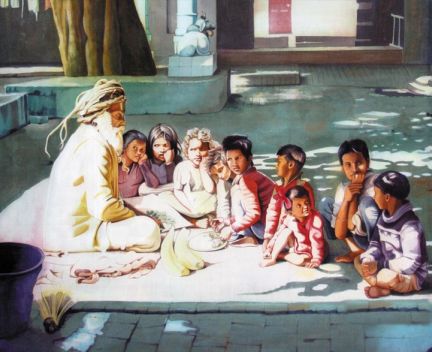
In the pages of Part I of this series, I have mentioned that even as a child of
five summers, He had earned the epithets, 'Guru' and 'Brahmajnani', because He corrected and counselled the
children who gathered around Him as playmates, and because His
conversation and conduct were on a level of consciousness higher than
even the adults who sought to guide Him. [*]
Even as a child and later at school, He was meek but morally fearless,
abhorred violence, vengefulness and falsehood, and preferred simple
living to gaudiness and ostentation. He could easily sing, dance, and
compose hymns and poems, while other children of the same age were
still struggling with the first few letters of the alphabet. He also
demonstrated ready compassion for birds and animals. He avoided meat
and eggs, and shed tears of sympathy when drought animals like bullocks
were mercilessly beaten. He stood forth as the leader of a band of
children to whom He taught the ways of God and the means to win His
grace.
He stayed most days at
the house of the
Karnam (village accountant)
where the mistress, Subbamma, tended Him with maternal care. Baba
sought shelter in her affection in order to avoid the sight of
slaughtering fowl in His family home nearby and to watch the Puja (worship) conducted by that Brahmin lady in
the room set apart for ceremonial rites. Baba never played truant at
school. Rather, He relished the company of children, whom He helped to
get the best out of school.
Towards
Upper Primary School
At Ootacamund, Baba
narrated the story of a journey in a crowded cart drawn by a pair of
bullocks from Puttaparthi to Bukkapatnam, and from Bukkapatnam to
Penukonda, sixteen miles away. He was then ten years old. He and the
other children could scarcely squeeze into the cart; a few spilled
over. They were in the lower primary class and could join the upper
primary school only when they had passed an examination which was to be
held at Penukonda town. There were eighteen children in all,
overcrowding the vehicle. Whenever the road rose to negotiate a bump or
a hill, the bullocks could not drag the cart behind them. So the
children were pulled out and made to walk up. There was also no brake
to hold the cart in check as it rolled downhill and, as a consequence,
the children had to walk the road downhill also! The children were sent
to the 'distant, unfamiliar town' from their homes, after propitiatory
prayers to the family deities, prayers that were also meant to help
them pass the examination.
At Penukonda they
stayed together, and the teachers who led them gave last minute
lessons. Baba agreed to be in charge of the kitchen. Lunch and dinner
for the party were cooked by Him and He did not demand or welcome help
from anyone. This arrangement continued on all the three days of the
examination. Baba had no time to revise His texts, nor could He attend
the special classes held by the teachers. Yet, when the results were
announced a few weeks later, He happened to be the only candidate
declared fit to proceed to the upper primary school! The good people of
Bukkapatnam, the village three miles away, warmly welcomed Baba into
the school situated in their village, taking Him through the streets on
a chair placed on a flower-bedecked cart that was drawn by caparisoned
bullocks, right up to the doorstep of the school. They were all happy,
even proud, that the 'wonder-boy' of
Puttaparthi, already famous as 'God's Son', was attending classes in their school.
Baba was the cynosure
of all eyes at Bukkapatnam. Though He seldom listened to the lessons
and rarely opened His textbooks, He was hailed as the brightest pupil
of His class. This drew upon Him the envious looks of the ones who
trudged along with Him every day from Puttaparthi. They often
overpowered Him physically while on the Chitravathi sands and dragged
Him along, ruffling His shirt and knickers and damaging them out of
shape. When the Chitravathi was flowing, they dowsed Him with gusto.
Baba said that He neither protested nor complained, but bore all this
as the pardonable sport of ignorant youngsters. His refused to name any
of the tormentors nor did He bear any ill will against them.
As
Monitor
 In those days every classroom echoed with the
swish of the teacher's cane, which was busy falling on the backs or
palms of the luckless little brats. When the teacher got too exhausted
to inflict the punishment, this privilege was transferred to the
brightest boy in the class. Baba said that one day the question
presented before the pupils was: "Describe the glory of India." The answer had to be in English. The other
boys knew little of India, and less of English. Baba, however, tersely
but confidently replied, "Consisting of high mountains, large rivers with many
branches and many plains, India is beautiful with all these grand
contents." Baba then related
to us details of the rest of this episode:
In those days every classroom echoed with the
swish of the teacher's cane, which was busy falling on the backs or
palms of the luckless little brats. When the teacher got too exhausted
to inflict the punishment, this privilege was transferred to the
brightest boy in the class. Baba said that one day the question
presented before the pupils was: "Describe the glory of India." The answer had to be in English. The other
boys knew little of India, and less of English. Baba, however, tersely
but confidently replied, "Consisting of high mountains, large rivers with many
branches and many plains, India is beautiful with all these grand
contents." Baba then related
to us details of the rest of this episode:
"The
punishment the others deserved according to the teacher was my slapping
them on their cheeks. I was to hold their noses tight with the left
hand and then give them the resounding slaps. There were about thirty
students in the class, some far taller than me, and I had to climb upon
a bench to fulfil my most unpleasant and unpopular duty. But I could
not bring myself to slap them as forcibly as the teacher wanted and my
blows fell softly on their cheeks. So the teacher was angered. He
called me near and shouted, 'Did I want you to apply Haldi (turmeric, used as a cosmetic) to their cheeks? I asked
you to beat them. I shall show you how.' He held my nose and counted
the slaps he gave me, about thirty or so, before he stopped. I bore it
all in silence, for a teacher should not be insulted or let down. It
was my fault for having annulled, by softness, the purpose of the
punishment he desired to inflict, however absurd the prize for my
superior knowledge of Indian geography and history."
Baba disclosed that,
being the monitor of the class, He was burdened with duties and clothed
in authority.
"I
undertook to show the students and the monitors of other classes how a
monitor should conduct himself. I would reach school a few minutes
earlier than the rest. I cleaned the blackboard before the class
commenced and often had to clean even the benches and desks,"
Baba explained.
"Rama
sat at the feet of Vasishta and attended class with other boys [See Ramakatha Rasavahini, Ch. 5]. Krishna, too, had Sandeepa as his guru, [see Bhagavatha Vahini Ch. 41] while Sudama and others
were his classmates. When the formless, attributeless Divine Principle
takes human form and appears among men, It has to conduct Itself as an
agreeable companion and as an understandable example to contemporaries."
In His discourses Baba
confirmed that He had 'willed' the incident at the Bukkapatnam school
when the chair stuck to the posterior of Kondappa, one of His teachers.
He confessed that His intention in reducing him to a ridiculous figure
was not to avenge His having been made to stand up on the bench for
hours. He had designed it only to reveal a little of His uniqueness,
give a glimpse of His divinity, and to make the world around Him sit up
and ask, "Who
is this boy?"
When Kondappa's hour of
teaching was over, he naturally had to vacate the chair for Mehboob
Khan who was to take the next class, but he could not get up because
the chair stuck to him. [see The Rhythms of
His Feet] The boys
suggested that the calamity had happened because Sathya was punished.
Then Mehboob Khan, who loved and adored Baba, and who had glimpses of
His divinity, revealed to Kondappa, "You do not understand. Raju is not an ordinary person; He is a divine
boy and I have seen divine brilliance in Him many times. Withdraw the
punishment you have given Him immediately and your own punishment will
disappear." Then Mehboob Khan asked Baba to step down from the bench
and Kondappa, too, could get up and walk away.
The
Classmates
 Swami narrated the
events at Uravakonda (about thirty miles away from Anantapur), where He
spent about two years with His elder brother who was a teacher of the
Telugu language in the high school there. [N. Kasturi:] I myself visited Uravakonda a year and a half ago. There I
walked along the long, broad verandas of the high school, hallowed by
His footprints. I spent some times in the room which was once His
classroom and sat on the same desk that had been used by Him as student
- a bench-cum-writing desk, with a makeshift shelf underneath the
incline of the top. Three pupils could sit on each bench with their
books in the bottom shelf. I sat on the bench and imagined little Baba
seated next to me!
Swami narrated the
events at Uravakonda (about thirty miles away from Anantapur), where He
spent about two years with His elder brother who was a teacher of the
Telugu language in the high school there. [N. Kasturi:] I myself visited Uravakonda a year and a half ago. There I
walked along the long, broad verandas of the high school, hallowed by
His footprints. I spent some times in the room which was once His
classroom and sat on the same desk that had been used by Him as student
- a bench-cum-writing desk, with a makeshift shelf underneath the
incline of the top. Three pupils could sit on each bench with their
books in the bottom shelf. I sat on the bench and imagined little Baba
seated next to me!
Dr. Moinuddin, now a
medical practitioner at Uravakonda, was with me at the school that day.
He had been a contemporary and classmate of Baba. He said, "I was
allotted a seat on the bench directly behind Baba, and I could tease
Him by whisking away His cap. He would then implore me to return it to
Him, for no student could attend class without a cap. I knew that Baba
would not fight or complain to the teacher or whisk away my cap in
turn; He was so quiet, soft and non-violent. So I would insist on His
creating some sweetmeat for me - a rasagolla, a laddu or a Mysore pak. I was tired of taking sugar-candy. Baba
would then circle His palm twice or thrice and produce for me my
favourite sweets. But this invariably set all tongues dripping. So a
general clamour would arise for a repetition of the act and the noise
would bring in the teacher. Then, he too, would have his share before
the lesson began." Another of His classmates, Sri Sitha Rama Rao, told
me that Baba had confided in him that He would set the world right and
establish the reign of truth in all lands.
I saw the tangled
branches of the old dwarf trees right in the centre of the quadrangle.
Baba had described to us how He used to play the monkey game on five
trees in that quadrangle. Two of the trees have now been axed, but
Providence has spared the rest. The monkey game involved two rival
bands of primates. They crawled along the branches, then dangled
without dropping, moving from one hold to another, trying to unnerve
and to demoralize members of the rival band, until one of them was
touched and declared 'out'. They snarled and growled at their rivals as
angrily as they could. They swung and swayed, clung and clambered, slid
and slithered. If they fell, they 'died' and were pronounced 'down and
out'. They shook the branches with all their might to unseat the
'monkeys' of the opposite gang, loudly jeering and cheering all the
while. If any of them slipped into the vocabulary of homo sapiens and
revealed his true identity, he 'died' at that instant. Baba gave each
one of them some sweets at the end of the game. Many like Dr.
Moinuddin, who had once frisked and frolicked on those trees, are even
today chewing the sweet cud of memories of the game.
The
Scout Troop
Swami related in a
discourse the story of His 'boy scout' days.
"We
had a physical instructor," He said, "who formed a school scout troop.
He was very insistent that I should enrol, and though I, too, was eager
to use the chance to direct the 'good turns' of scouting towards the
path of Sadhana (spiritual discipline), I could not join because my
family was too poor to afford the uniform and other contingent
expenses. To make you aware of the depth of their poverty, I shall
relate an incident: I used to attend classes every day wearing the same
shirt, for I did not have a second. Some of the boys who discovered
this fact started laughing at me. They teased me on the way to school
and back and, pulling at my worn-out shirt, they tore it. As I had no
pin to even keep it together, I was forced to use a cactus thorn
plucked from the fence of my neighbour's field to serve the purpose.
"Realising
the reason which held me back from the troop, my chums were very sad.
The boy who always sat to the right of me was the son of the chief
accountant at the revenue office. He went to his father and persuaded
him to make two pairs of uniforms comprising a khaki half-sleeved shirt
along with khaki knickers. He rolled up one pair and put it on the
shelf of my desk with a note that was addressed to me which read: 'You
must take this and wear it. We are brothers, so do accept this from
me.' But I was not happy, and decided to refuse this gift. I left the
uniform on the shelf of his desk along with a note saying, 'If you wish
our friendship to last, you must not indulge in such games of giving
and taking material objects. When a needy person accepts something from
another, anxiety lurks in his mind as to how he might return the
favour, while pride enters and pollutes the mind of the giver over his
act of charity. True friendship should be from heart to heart. If we
build friendship on a give-and-take basis, the person who takes feels
small and he who gives feels proud. Such friendship does not last. So I
am not accepting the clothes you left on my desk and am returning them
to you with this note.' The next day that boy pleaded, 'You can return
them to me after leaving the scout movement.' But I did not agree even
to that. 'I do not need nor seek help,' I told him. 'I seek only the
chance to help and show others the best way to help. Besides, your
father got the uniforms made for you - they were not meant for my use.
I am Truth, as my name indicates. If I wear it instead of you, I will
be setting Truth aside.'"
I am tempted to relate
in this context what happened to a kinsman of mine about twenty years
ago. He had bought in Rangoon, a Burmese umbrella, flat-topped, with a
bright, garish-coloured cloth cover, as a birthday gift for his sister
living in Bangalore. But as she refused to accept it, it was lying
unused. Later his parents placed it before Baba as an offering. Baba
told them, "Why
do you bring Me stolen articles? This belongs to your daughter, whether
she uses it or not." Anything
offered to Baba must be 'ab initio'
intended for and dedicated to Him.
The
Thursdays
At Uravakonda, I looked
into the well from which Baba used to draw water for His home everyday
and carry it, slung across His shoulder, in big mud pots. The well is
at least one kilometer away, and Baba trudged the distance six times a
day. The well, the only potable water well in the village, being very
deep, He must have gone through great physical strain to get the pots
filled. "The
time spent in supplying water for the home did not leave me any time
for other activities," says
Baba. I was also able to see Mr. Mehboob Khan, the teacher who loved
and revered Baba as a boy, and who had foreseen that He would one day
become a World Teacher.
The house where Baba
lived with His elder brother is now a jumble of mud blocks. We
scrambled in and stood reverentially before the sacred spot where Baba
had started sitting every Thursday after declaring Himself as the
reincarnation of Shirdi Sai. Even as we were standing lost in reverie,
an old resident of the village related a story of those years: "One
night, a group of women from an adjacent village journeyed to Urvakonda
by bullock-cart to witness a movie. They were huddled in a thick
cluster in the cart. Taking advantage of the oncoming night, a woman
unfastened a gold ornament from the hair of the woman sitting beside
her. The loss was discovered only when the women alighted, but none
suspected the other, since they knew one another well. Some suggested
that the ornament might have got loosened by itself and fallen on the
road, while others asked the lady to recollect whether she had worn it
at all. Then an old man ventured to say, 'There is a 'miracle boy' here
whom we can consult. He is the brother of the Telugu teacher.' As soon
as they trooped in, Baba sighted them and said, 'Eh Janakamma! Give the
jewel back!' The startled Janakamma did as Baba had ordered, her head
bent in shame. Baba told the others, 'Go! Take her also to the movie
with you. Repentance is enough punishment. Forget this lapse. It was
your fault, tempting the weak-minded woman. I am sure she will not do
it again, for she has been blessed by Me.' "
The
Rocking Chair
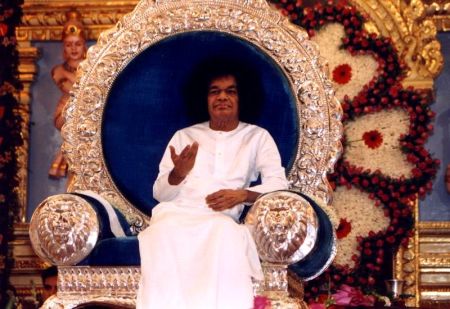 Baba
told the students how He had borne poverty and hardship in His
childhood and youth, in silence and without complaint. There was a
rocking chair in the house, upon which Baba sat one evening. When His
brother's brother-in-law saw Him rocking Himself in the chair, he was
very incensed and remarked, "Who gave you permission to sit on that
precious chair and rock back and forth like a Maharaja! Get up and go
out of here." Baba replied, "The day is coming when I will be a Maharaja sitting on
a silver chair. You will live to see the day." This angered him all the more, but he did
not pursue the persecution. About seven years later, the Rani of
Chincholi, who could not bear to see her Swami sitting on a wooden
chair, brought a silver chair for Him. But Swami did not permit the
chair to be unpacked even during the Shivaratri or the Dasara
celebrations. On the occasion of Swami's birthday, His brother's
brother-in-law came to Puttaparthi. Then Baba asked him, of all people,
to unpack the silver chair and place it in position on the dais of
Prasanthi Mandir which was then ready for Bhajan gatherings. The man
shed tears of repentance and asked to be pardoned. Baba soothingly told
him not to worry. This was, perhaps, the only instance when Baba
reacted, for He usually bears others' anger with remarkable
indifference and restraint. He told the boys that He was ever alert to
guard the honor and reputation of the family in which He was born, and
to ward off the derision of cynics and carpers.
Baba
told the students how He had borne poverty and hardship in His
childhood and youth, in silence and without complaint. There was a
rocking chair in the house, upon which Baba sat one evening. When His
brother's brother-in-law saw Him rocking Himself in the chair, he was
very incensed and remarked, "Who gave you permission to sit on that
precious chair and rock back and forth like a Maharaja! Get up and go
out of here." Baba replied, "The day is coming when I will be a Maharaja sitting on
a silver chair. You will live to see the day." This angered him all the more, but he did
not pursue the persecution. About seven years later, the Rani of
Chincholi, who could not bear to see her Swami sitting on a wooden
chair, brought a silver chair for Him. But Swami did not permit the
chair to be unpacked even during the Shivaratri or the Dasara
celebrations. On the occasion of Swami's birthday, His brother's
brother-in-law came to Puttaparthi. Then Baba asked him, of all people,
to unpack the silver chair and place it in position on the dais of
Prasanthi Mandir which was then ready for Bhajan gatherings. The man
shed tears of repentance and asked to be pardoned. Baba soothingly told
him not to worry. This was, perhaps, the only instance when Baba
reacted, for He usually bears others' anger with remarkable
indifference and restraint. He told the boys that He was ever alert to
guard the honor and reputation of the family in which He was born, and
to ward off the derision of cynics and carpers.
The General Stores of
Kote Subbanna, from where Baba got His apparel and items of stationery
in return for songs and slogans, was still there as I could see. It is
now being run by Subbanna's grandson. Subbanna had once sought Baba's
help for boosting the sales of his baby foods and ayurvedic
drugs. Baba agreed, and in return got from the shop the articles He
most needed but could not purchase. The publicity value of Baba's lilts
was great, for, as I was told by the contemporaries of Subbanna, when
these were sung in chorus by several boys carrying placards advertising
a product, it would be sold in no time. Venkapa Raju, Baba's father,
thanked Subbanna for the help he was rendering Baba, as a result of
which He could replenish His wardrobe and get a few notebooks. Whenever
a new product (like 'Balamrit' of Pundit D. Gopalacharlu of Madras) had
to be introduced to the people of Uravakonda, it was done by means of
such street music. There was a weekly fair at the town, and on such
days, when the villagers from surrounding areas assembled, Subbanna had
a hey-day with his placards and his merry 'choirboys'. [see for this
story 'The
Cattle Fair']
The
Mentor
Swami said that even as
a boy He had been intent on correcting the vagaries, vices, defects and
deficiencies of society, by means of ridicule and satire expressed in
drama and poetry. 'Cheppinattu
Chesthara?' which means, 'Are your deeds in
accordance with your words?'
is a fine example of His educative experiments. It exposed the
hypocrisy of parents and teachers - an evil which children and pupils
spontaneously absorb. So also today, Baba exhorts us to coordinate
thought, word and deed. He tells us that when He spent vacations at
Puttaparthi, He composed long lampoons in folk metres, on the evils of
drink, the absence of literacy and the irresponsible accumulation of
debt by the villagers. These songs were quickly learnt by the children
who were taught by Baba, and were recited by them in groups in front of
every house. Some householders were angered at this onslaught on their
shortcomings and fixations, but many encouraged the boys to continue
their reformatory task.
The village accountants
also were a target of Swami's lampoons. There was one who prided
himself on his 'Hitler moustache', on his watch with its shining strap
and even on his Don Juan diversions. Swami told the students how he had
composed a satire in verse on him and trained a band of urchins to
parody his pomp. They stood opposite the door of his house and sang it
till their voices turned hoarse. The butt of their ridicule came out to
thrash them, but the members of the gang fled into the many lanes and
could not be impounded. Such shout-and-run tactics were continued until
he shaved off the horror under his nose, removed the leather-strap from
his wrist and gave up his secret visits. Baba also wrote a play in
Telugu entitled 'New Times', which revolved round a poet who was
ignored and insulted while alive, but whose stirring poems provided his
son enough ammunition for a rousing victory in an election a few years
after the passing away of his father.
The house where
Thammiraju, the teacher who persuaded Swami to produce the play
entitled
'Cheppinattu Chesthara?' on
the annual day of the school, still stands intact opposite a heap of
mud that was once the house of Seshamaraju. It is indeed a thrice holy
spot, for Swami spent many hours there with His teacher and his devoted
wife, engaged in providing them precious glimpses of His Leela, while also playing with their son who was His own age. By
merely calling out their names, He had made to appear on a wall of that
house images of the Ten Incarnations of Vishnu (see: Bhagavân on Bhâgavatam) and various other deities and saints
revered by the teacher's wife. She wrote a poem about this incident in
the monthly magazine published by the Sai Samaj, Madras. The house of
Narayana Sastry, immortalized as the person who had witnessed the
golden aura around Swami when He left home to 'carry on the task for
which He had come', is almost
adjacent to the place where
Seshamaraju lived.
Narayana Sastry had once the pride of his scholarship pricked by Baba
when, as a little boy, Baba had questioned Sastry on his exposition of
the classical texts. We could get some idea of the ecstasy that must
have overpowered Sastry that day, when we met and heard Dr. Baronowski
of the University of Arizona, who was wonder-struck and delighted by
the aura he saw around Baba for days together at
Brindavan, Whitefield, when He gave Darsan to the thousands gathered on the grounds there.
Teaching
Prayers
Swami told the students
that He had seen what we would call 'hard days', at Uravakonda, though
He was the favourite of the school and the town. He was the 'hewer of
wood' and 'drawer of water' for the family of His brother. He collected
dry twigs and branches from the hills around and tied them up into a
head-load bundle which he brought home every two or three days. He drew
water from a well, the only potable source, which was not too near. In
spite of these and other exhausting chores, He was ever fresh and
vibrant and full of infectious humor. His neighbors were anguished at
His plight and entreated Him to write to His parents asking them to
take Him away. Some even offered to write the letter themselves. But He
told every one not to worry for He was happy that He could be of
service. "Why
are you bothered? I enjoy being useful," He would say.
I stood on the very
dais from where Swami used to sing, everyday before the lessons began,
the school prayers before the assembled students. It was from that very
dais that, one historic morning, Swami had announced, "I do not belong to you
henceforth. I belong to them who need Me and call on Me." [See The Serpent Hill] Swami said that He came down the steps even
before the congregation realized the significance of what He had
declared. Then He walked to the house where His brother (Seshamaraju),
the Telugu teacher lived. Throwing His books aside, He moved on to the
edge of the town, where stood the house of Anjanajulu, the government
inspector of Excise Revenue. Anjanajulu loved and adored Baba. Perhaps
he was one of those who needed Him and called on Him to illumine and
liberate. But He did not enter the portals of that house. There are
dozens of round, flat-topped boulders obtruding among the trees in the
open ground in front of that house. Swami sat atop a medium-sized one,
right opposite Anjanajulu's house. The congregation that followed Him
from school had swelled now to a sea of heads all around. Anjanajulu
had a vision that the trek from school marked the inauguration of a
World Revolution. So he had a Mantap (a commemorative structure)
constructed over the stone, for it had to be marked out from the rest.
Recently Baba permitted the good men of Uravakonda to purchase and take
possession of the land around, and to erect a community hall for
carrying on service activities under His inspiration.
The
Announcement
Seated upon that
boulder, Swami revealed that His devotees were calling Him and that He
could no longer pretend to be a student or even a member of the Raju
household. "I
have My task to complete," He
declared, indicating that a part had been accomplished while He was at
Shirdi. He then directed the congregation to sing Bhajans (devotional songs) and to recite the name of
the Lord. He stood forth as the Teacher of Teachers, whose message can
liberate man from grief and greed. "Manasa
Bhajare" He sang, "Guru Charanam, Dustara
Bhava Sagara Taranam" (Adore
in song with sincere devotion the feet of the divine teacher, for they
can take you across the ocean of misery). [Listen how Swami sings this Bhajan (MP3) & Text] Who was the divine teacher whose feet He
was referring to? Those who knew Him (but they were only a few)
recognized that they were in fact the feet of Sai. Swami was
emphasizing even in those early years that union with God demands
communion with man. Swami saw the helplessness, the distress and the
disease that sapped the happiness of people all around Him. He was
moved with compassion. The candle was no longer under the bushel. Its
light was soon to spread, bright and blazing, in every heart and home,
school and sanctuary, village and town. Swami had made the clarion call
to the entire world to clasp the feet of the Divinity which had
condescended to encase Itself in human form, and to be saved from
pollution and perdition. Those Lotus Feet which He presented in their
magnificence that day, have walked on rose petals, snowy mountain
terrain, rain-soaked slush, fair-weather tracks and sandy seashores,
ever carrying consolation to grief-stricken people in all lands.
During the short time
He was at Uravakonda, Baba had installed Himself in the hearts of both
the old and the young. He had brightened their eyes with laughter and
sweetened their ears with song. He was the bard and the boast of the
school, the pride and paragon of the populace. Every family had some
story to tell about His mysterious power, His love and His wisdom. So
when He left home and school and talked of His task and of those
waiting for Him the world over, their courage failed and their tongues
were tied in unspeakable sorrow.
The
Tiger Skin
 His return
from Uravakonda and the announcement at Puttaparthi that He was the Sai Baba of Shirdi, came when He was only fourteen years of age. But the
villages around, and even far off Anantapur (forty miles away), knew of
His being Sai Baba. (photo: on throne in mandir)
His return
from Uravakonda and the announcement at Puttaparthi that He was the Sai Baba of Shirdi, came when He was only fourteen years of age. But the
villages around, and even far off Anantapur (forty miles away), knew of
His being Sai Baba. (photo: on throne in mandir)
One day a jeep-driver
crossed the river bed and walked the streets of Puttaparthi, trying to
locate Swami. His master, a young English sub-divisional officer, had
gone for Shikar to the forest on the other side of the Chitravathi, and
while returning to Anantapur the vehicle had stopped right opposite
Puttaparthi village. The driver did his best, as did the officer, to
get the vehicle moving, but failed. The driver suggested that there was
a 'Boy' at Puttaparthi who could materialize Vibhuti (sacred ash). Yes, "create, by a circular
movement of His palm, the very panacea for all ills, even for the
jeep!" Stranded halfway, the Englishman agreed and let the driver go to
the village, while he himself sat in the jeep. The driver bumped into
the Boy at last, but was astounded to hear Baba say,
"I am coming,
myself, to the jeep." He
walked across the sandy bed, and on reaching the road, peeped into the
vehicle and saw the carcass of a tiger that the officer had shot barely
two hours ago. Swami's deep love for all beings could not tolerate
animals being killed or tortured. He said,
"I
stopped the jeep at this place, for it is a mother, whose three small
cubs are at this very time loudly wailing and calling out to her, that
you are carrying. Go back! Recover those cubs and gift them to some zoo
where they will be well looked after. And do not shoot wild beasts
again, for they have caused you no harm. Why do you kill them, surround
them and lay traps to catch them. Shoot them instead with a more
superior weapon, your camera. That won't maim or kill them."
The Englishman was at
once enlightened, and he never carried a firearm again. Shooting wild
beasts armed with a camera, he discovered, was far more adventurous and
Sathwic (pure). He presented
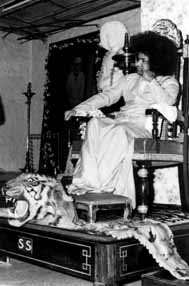
the orphaned cubs to the zoo, and when the tiger skin came back from
the taxidermist, he brought it to Puttaparthi. Prasanthi Mandir was
then under construction. He met Baba and placed the skin at His feet.
Sakamma of Coorg pleaded with Him to sit on it in Yogic fashion, with a rosary between His fingers.
She had a photographer ready. And Baba obliged, though He has never sat
in Dhyana (meditation) or held a rosary!
A
Book On Him
Smt. Nagamani Purnaiya
has written a book in Telugu (later also translated into and printed in
English), entitled, 'Divine Leelas of Bhagwan Sathya Sai Baba'. In the foreword to the book she says, "I
have availed myself of every opportunity of witnessing His divine
powers." The book describes more than 140 miracles, of which she says
"more than 115 were witnessed by me with abundant joy." Nagamani Amma
was the wife of Sri Purnaiya, the chief commercial superintendent,
southern railways, and the miracles she records were revealed at what
is called the 'old' Mandir (temple) in the village, in the first few
years after Swami's announcement. When the present Mandir called Prasanthi Mandir was inaugurated in 1950, the Mandir
at the village became old! The miracles described relate to cures
effected by the administration of Vibhuti created by Swami, and of raging floods subdued at His
command. Baba revealed to her, "It is because of your faith and trust in
Me that your bus could cross the river in spite of the surging floods." Swami created Tulsi (basil leaf) garlands, rings and pendants for personal
wear. He also performed surgical operations. "One day I saw Swami
throwing something like a banana peel over the wall," narrates Nagamani
Amma. "Then He came towards me and asked for water to wash His hands
which were red with blood. 'You had prayed to me to cure that man, so I operated upon
him,' He said. That night I
could not sleep due to my anxiety for the man, since he was operated
upon without cocaine and in full consciousness. I was very troubled by
the thought of the pain he must be suffering in the adjacent room, and
so I stayed wide awake. At daybreak Swami called me and asked me to
give the patient some surgical cotton. 'Go and give the cotton at once' He commanded. When I went in, after
hesitating at the door for a while, I found the patient eating a
plate-ful of idlies and chutney. Swami stood behind me. 'This
is not an operation by a doctor,' He chuckled. 'I have done it; so
there is no pain caused, no rest required and no special diet
prescribed. He can eat whatever he wants.' I was shown a long mark on
the stomach but could discover no stitches. Swami said, 'The Vibhuti I
created and applied on his brow acted as an anaesthetic. I created a Trisul (trident) and a knife for the operation.
After I had finished, I smeared Vibhuti, and it was all over.'
"On another day, four
men came to Prasanthi Nilayam with the intention of testing Swami,"
continues Nagamani Purnaiya. "When they reached Bukkapatnam, three
miles away, they exchanged the wrist watches they wore, deciding among
themselves to find out whether Baba would discover what they had done.
'If He is God, He should know,' they thought. Swami called them and
said, 'I
know why you have come and what you were talking on the way. One is
wearing the watch of the other. I know that you have come to test Me,
but this is a place for devotees. You can go back to where you have
come from.' "
The
Song He Made Them Sing
Baba had not only to
encourage
Bhajan and give a boost to
the declining
Bhajan Mandalis (groups of
Bhajan singers) in the village, but He had also to compose Bhajans and Namavalis to satisfy the demand for new songs. During those early
years He wrote quite a few. The four pillars of the mansion of Sai Dharma were first demarcated in one such song
composed by Him when He was seventeen years of age.
|

With Sathya, Dharma, Santhi and Prema
Let, step by step, the pilgrim road of life be trod.
Your duty is to but trudge and try;
Whether you win or lose the game - 'tis the Will of God.
Fill your mind with God, be devoted in full to Him;
'Twill grant you freedom from grief and pain.
Janaka was king, but he lived in God;
He ruled his realm and gained Moksha (liberation) too.
Why yearn for superhuman skills? Have faith, O man!
They swell your ego and blind your wisdom eye.
While passing through this trackless jungle,
The name of God is the only guide.
Your heartland is a precious field;
Plough it with your mind; and use
Your virtues as animals yoked.
Hold the intellect as the whip to urge them on,
And gather the harvest of love and light.
|
|Previous |Next |
Bhajans

[*]
See also: Srîmad Bhâgavatam, Canto 7, Chapter 6: Prahlâda Instructs His
Asura Schoolmates