Bhagavân
on Bhâgavatam
Bhagavad
Purâna
The
Story of the Fortunate One
based
on the Divine Discourses
of Bhagavân S'rî Sathya Sai
Baba
With an equal
vision having moved beyond the notion of good
and bad
a wise man will not praise those who are
doing or speaking very well,
nor criticize others who are doing or
speaking poorly [see also B.G.
5:
18].
Vyâsadeva
(S.B. 11.11: 16)
Listen
to Sai's Verse - Pata
Paduma
-
Text
1.
What is
Bhâgavatam?
[S'rîmad-]Bhâgavatam
is one of the greatest of the eighteen
Purânas.
2.
What is the essence of the 18
Purânas?
"Paropakaraha
Punyaya, Papaya Parapedanam." To do good
to others is merit. To hurt and cause
suffering to others is sin.
3.
What is the main theme of
Bhâgavatam?
It
is the story of the Divine glory of Lord Hari
and His devotees.
4.
What are the subjects dealt with in
Bhâgavatam?
It
gives a description of the creation of the
universe, the story of the Avatâras,
the story of Nârada, a detailed
narration of the Avatâra of Krishna and
many other episodes.
5.
Who wrote Bhâgavatam in
Sanskrit?
Sage
Vyâsa.
6.
Who inspired the Sage to write
Bhâgavatam?
Sage
Nârada. [SB,
1:4]
7.
Who narrated Bhâgavatam even before
Vyâsa?
Brahmâ
narrated Bhâgavatam to Vyâsa,
sage Vyâsa to S'uka.
[SB,
1:1]
8.
How does Vyâsa begin the
Bhâgavatam?
Sage
Vyâsa begins Bhâgavatam as a
narration by the sage S'uka to king
Parîkchit who was on his death bed
because of a curse.
9.
What is the curse?
King
Parîkchit was cursed that he would die
of a serpent bite on the seventh day
commencing from the day he was cursed.
[SB,
1:18]
10.
Who cursed King
Parîkchit?
Thapasvin
Sringi. [Bhagavatha
Vahini : 26]
11.
Why did he curse?
One
day king Parîkchit went for hunting.
After some time he was very thirsty and was
in search of an âs'rama. He caught
sight of one and entered. He called aloud.
But no one answered. He saw a sage deep in
meditation. There were signs of people moving
about, but none came to him. He got angry
because he did not receive the honor due to
him as the ruler of the country. He saw a
dead serpent on the ground, he lifted it and
put it round the neck of the sage and went
his way. When Sringi, the son of the sage
(S'amîka) came to know about the sinful
act, he cursed that the man who committed the
sin would die of a serpent bite within seven
days. [SB,
1:18]
12.
What was the reaction of Sringi's father to
his son's hasty action?
S'amîka
did not approve of the hasty action of his
son. He should not have cursed the ruler of
the country because it would affect the
entire country. Parîkchit had been a
righteous and a kind ruler, but for this one
impulsive act, yet he could not do anything,
but asked his son, to see that the king was
informed about the curse.
13.
How did the king receive the
curse?
King
Parîkchit was sad and sorry for his
impulsive act and welcomed the curse as a
boon, because he was given a chance of
involving himself in holy activities before
his death.
14.
What do we learn from this
episode?
Whether
one commits a sin, knowingly or unknowingly,
one has to suffer the consequences, but
repentance would absolve him of the sins
committed.
15.
What do we learn about the life of Sage
Nârada
from
Bhâgavatam?
Nârada
was the son of a servant maid.
[SB,
1:5-23]
She was serving some Rishis who had come to a
forest, to stay for four months
(Chathurmasya Vrata). Nârada was
a small boy. He would often sit and listen to
these sages. When they were about to leave
after four months, he wanted to follow them.
But they advised him, to chant the name of
Hari, and to take to the path of devotion. He
was made to realize, that God alone is the
dearest to an individual and none other. One
day when Nârada's mother died of a
serpent bite, he left the forest in search of
his goal. One day he heard a divine voice
warning him to give up the desire of having
the vision of God too. Then he took to
"Soham" ("I am That" - "I am
God")
meditation
and gave up his life only to take a new life
form.
16.
What is the special name given to each
chapter in
Bhâgavatam?
Skanda
[Canto].
17.
How many Cantos are there?
Twelve.
18.
Who is the famous writer of
Bhâgavatam in Telugu?
Bammera
Pothana. [see
Pothana]
19.
What is an Avatâra?
Avatârana
means descent. Avatâra is the descent
of the nameless and attributeless divinity in
a form suitable to execute the task of
destroying the wicked and protecting the
good.
20.
How many types of Avatâras are
there?
Avatâras are many in number. There
are some Avatâras that appear on earth
only for a short time, fulfill the Avataric
mission and disappear, Matsya (fish), Kurma
(tortoise), Varâha (boar), Narasimha
(half-man half-lion) and Vâmana
(dwarfman). There is the Avatâra of
Râma who is called an
Amsa-Avatâra because He shared the
divinity with His three brothers (Lakshmana,
Satrughna and Bharatha); the Krishna
Avatâra is an example of
Purna-Avatâra (total).
21.
Mention the 10 Avatâras of Vishnu.
The
ten Avatâras in sequence are Matsya,
Kurma, Varâha, Narasimha, Vâmana,
Paras'urâma, Râma, Krishna,
Buddha and Kalki.
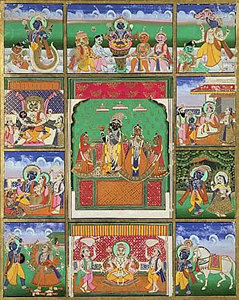
Above
painting shows:
In
the center square,
Krishna
is shown in His original two-handed form,
holding a flute. Surrounding Him are ten of
His eternal incarnations, pictured in the
order in which they appear in the material
world, beginning clockwise from the left-hand
corner.
1. Matsya,
the fish incarnation, is saving the
Vedas.
2. Kurma,
the tortoise incarnation, is holding the hill
on His back.
3. Varâha,
the boar incarnation, is fighting with the
demon Hiranyâksha.
4. Nrisimhadeva,
the lion incarnation, is killing the demon
Hiranyakas'ipu.
5. Vâmanadeva,
the dwarf incarnation, is begging some land
from King Bali.
6.
Paras'urâma
is killing the demoniac kshatriyas.
7. Râmacandra
is going off into exile with His wife,
Sîtâ,
and brother, Lakshmana.
8.
Krishna
is lifting Govardhana Hill, and beside Him is
His brother Balarâma.
9.
Lord Buddha.
10.
Kalki
is riding on His horse, killing all the
demons and thus liberating them.
 S'rî
Das'âvatâra-stotra
S'rî
Das'âvatâra-stotra
The
Das'âvatara Stotra is a
Hymn in salutation to the ten
incarnations of Lord Mahâ
Vishnu. The Stotra forms the
first section of Gita Govinda,
the masterpiece work of
S'rî Jayadeva. He was a
court poet of King Lakshmanasena,
who ruled Bengal during the 12th
Century. S'rî Jayadeva was
a great devotee of Lord Krishna
and a mystic. His mastery of
Sanskrit language was matched by
his extraordinary talent in music
and dancing.
[See for further reading and
texts of the Bhajan:
S'rîmad
Bhâgavatam Devotional Music
Pages]
|
Matsya
Purport: The
first avatâra signifies the restoration
of true knowledge (Vedas), recovered from the
deluge of egoism, which has to be destroyed
in the process.
Kurma
Purport:
The incarnation of God in the Tortoise form
during the churning of the Ocean, signifies
that the churning of the ocean of experience
with the churn of knowledge, towards the
Absolute can rest only on the immovable,
all-sufficient, all-sustaining basis of
self-evident truth, symbolized by the
Tortoise avatâra.
Varâha
Purport:
The Boar avatâra is identified with
sacrifice both in the Vishnupurâna and
Bhagavata. As sacrifice (of worldly affairs)
is essential for the stability of mind for
contemplation on God, it is symbolized by the
Boar form of the Lord.
Nrismha
Purport:
This avatâra illustrates that a true
devotee is fearless (as Prahlâda) and
God comes to his rescue.
Vâmana
Purport:
The Dwarf avatâra shows that valour (as
exemplified by King Bali) can find its
fulfilment only in complete
surrender.
Paras'urâma
Purport:
When the rulers, endowed with power for
protection of the subjects, had however
degenerated into an oppressive tyranny, it
had to be crushed ruthlessly. This is
illustrated by the
Paras'urâma
avatâra.
Râma
Purport:
The
Srî Râma avatâra is an
ideal demonstration of how a man can rise to
divinity, by unswerving adherence to dharma,
in all its details.
Kalki
Purport:
The yet
to be avatâra is Kalki, the mighty
warrior, born in a pious family, to rid the
world of the oppression of its unrighteous
rulers.
22.
What was the purpose of the advent of these
Avatâras?
a)
MATSYA
AVATÂRA
The
purpose for which the advent of Matsya
Avatâra took place was the restoration
of the Vedas from the hands of the demon
Somakasura, who stole them from Brahmâ
and hid them in the sea. Dharma is based on
the Vedas, so the protection of the Vedas was
the Avatâric task.
[SB,
8:24]
b)
KURMA AVATÂRA
The
gods and demons desired to acquire Amrith
(elixir of life), that would confer
immortality and prayed to Lord
Nârâyana. He instructed them to
churn the ocean of milk having the mountain
Mandhara as the churning-rod and
Vasuki-serpent as the rope. When the mountain
was about to submerge in the ocean creating a
vast deluge, Lord Nârâyana
assumed the form of a Tortoise and bore the
mountain on His back. While they were
churning, poison emerged out of the
ocean.
Both the gods and demons became panick
stricken. Then Lord S'iva came and swallowed
the poison. Several things emerged from the
ocean both living and non-living. When at
last Amrith was brought by a celestial being,
gods and demons fought for the possession of
Amrith. Then Lord Nârâyana had to
assume the form of a beautiful celestial
woman to distribute the Amrith. Of course the
demons were deprived of their share because
if demons were to be immortal what havoc
would result, no one need to be told. So the
purpose of the Tortoise Avatâra was to
protect the good and bad as well and grant
immortality to gods (Devata's)
[SB,
8:7].
c)
VARÂHA
AVATÂRA
Lord
Nârâyana assumed the form of a
boar to bring back to the surface, the earth
that had gone to the bottom of the sea. While
the divine Boar was carrying the earth on his
tusks and was still in the water, the demon
Hiranyâksha attacked him. But the Boar
clawed and pierced him to death. Thus the
purpose of the
Varâha
Avatâra was to restore the earth safe
and fix it firmly in its place.
[SB,
3:13]
d)
NARASIMHA
AVATÂRA
Lord
Nârâyana had to assume the form
of half lion and half man to kill the demon
Hiranyakas'ipu. Hiranyakas'ipu was bent upon
taking revenge on Lord Nârâyana
because He had killed his brother
Hiranyâksha. Hiranyakas'ipu did penance
to Brahmâ and obtained a boon that he
should not die in the hands of any one of the
beings created by Brahmâ. Death should
not occur to him either during day or night,
on earth or water or sky nor by any weapon,
indoors or outdoors. Hiranyakas'ipu grew all
powerful and arrogant after obtaining the
boon. [SB,
7:3]
His son was a born devotee of Hari. The
father tried his best to dissuade him from
praying to Hari but in vain. He subjected him
to many tortures, yet, Prahlâda would
not give up chanting the name of Hari. At
last Hiranyakas'ipu had to challenge his son
to show him his Hari who is said to be
omnipresent in a pillar. He struck the
pillar. It split into two. The Lord in the
form of Narasimha (man-lion) emerged and tore
him to pieces by his claws. The main purpose
of this Avatâra is to prove his
devotee's faith in the omnipresence of God.
[SB,
7:8]
e)
VÂMANA
AVATÂRA
When
the demon Emperor Bali became all powerful
desirous of conquering all the three worlds,
Lord Nârâyana decided to curb
Bali's pride of strength. So Lord
Nârâyana took the form of a
Divine brahmana boy and approached Bali while
he was performing Visvajith Yaga. He demanded
a gift of three feet of land from Bali
[SB,
8:19].
Bali agreed, even when his guru
Sukrâchâraya warned Bali not to
gift and that the Brahmana lad was none other
than Hari come to bring about his fall.
Vâmana grew to such a stature that with
one foot he covered land, with another the
sky and questioned where he should keep his
third foot. Then the emperor Bali bent his
head and asked Him to keep His foot on his
head. Hari pushed Bali down to the
under-world. Emperor Bali was not in the
least sad or sorry because he had the
privilege of giving away a gift to the Lord
of the three worlds. Lord Hari purposely did
this only to proclaim to the world the total
surrender of Bali to God. It is indeed
strange to understand the ways of the divine.
He might seem to be punishing one externally
but the punishment would be only for the
redemption of the punished.
[SB,
8:18]
f)
PARAS'URÂMA
AVATÂRA
Paras'urâma
was the son of Renukâ and Sage
Jamadagni. They had with them the celestial
wish fulfilling cow Kamadhenu. Once
Kârtavîryârjuna the ruler
of the region visited the âs'ram after
a day's hunting. The Sage received the
emperor and his retinue, fed them well with
the help of the celestial cow.
Kârtavîryârjuna became
envious and drove the cow and her calf,
disregarding the feelings of the Sage. When
the party were proceeding, Paras'urâma
accosted them and attacked them. After a
fierce fight chopped off the head of the
emperor. Later the sons of the emperor
beheaded Jamadagni Rishi when
Paras'urâma was not in the hermitage.
Hearing the loud cries of his mother
Renukâ, Paras'urâma returned only
to see his father's head on the ground.
Incensed he rushed to the city of
Mâhishmatî and killed all the
hundred sons of
Kârtavîryârjuna. He took a
vow to exterminate the Kshatriya clan out of
existence. The purpose of this Avatâra
was to warn and punish the arrogant rulers
(Kshatriyas) who did not give respect due to
the Rishis. [Ramakatha
Rasavahini
7d],
[SB,
9:15]
g)
RÂMA
AVATÂRA
Lord
Nârâyana was born as the son of
Dasaratha and shared His divinity with His
three brothers (Lakshmana, Satrughna and
Bharatha). The purpose of the
Avatâra was not only to destroy the
wicked and to protect the good, but to set an
example to the entire world, how man should
observe truth and righteousness in life. He
was the very embodiment of Sathya and Dharma.
[Ramakatha
Rasavahini],
[SB,
9:10-12]
h)
KRISHNA AVATÂRA
The
Krishna Avatâra is an Avatâra of
love and peace. His mission was to protect
the good and punish the wicked. But His main
mission was to preach the gospel of life
through the Bhagavad Gîtâ (The
Song of the Lord). [Bhagavata
Vahini] [SB,
Canto 10]
i)
BUDDHA AVATÂRA
By
his own example Buddha proved that, every man
can attain the Buddha-state, the enlightened
One by taking to the eight fold path. His
main gospel was to conquer desire and to
practice love and compassion.
j)
KALKI AVATÂRA
The
Kalki Avatâra is none other than Sai
Avatâra. It is indeed a Yuga
Avatâra. S'rî Sathya Sai is
engaged in carrying out the Avatâric
mission of the nine Avatâras through
love and love alone.
23.
What is the inner meaning of the ten
Avatâras in sequence?
When
we study the advent of the Avatâras in
a sequence we realize that it is the story of
evolution of species - from fish to tortoise,
from tortoise to boar; then to half animal
and half man, the dwarfish boy, then the man
in whom rajasic tendency dominated. Finally
the Avatâras of Râma, Krishna and
Buddha, the ideal man endowed with virtues of
Truth, Righteousness, Love, Peace and
Nonviolence.
24.
What is the relationship between
Hiranyâksha, Hiranyakas'ipu,
Prahlâda ('the joy of understanding')
and Emperor Bali?
Hiranyâksha
and Hiranyakas'ipu were brothers.
Prahlâda was the son of Hiranyakas'ipu.
Bali was the grandson of Prahlâda.
[SB,
Canto 7, chapters
5,6,7,8,9&10]
25.
What do we learn from Prahlâda's
story?
God
would always come to rescue His devotees. God
would do anything to prove the faith of His
devotees. Prahlâda believed and
preached that Hari is Omnipresent. The Lord
proved his verdict to be true.
26.
How could Prahlâda become a devotee of
Hari even as an infant?
Prahlâda's
mother Lelavathi (Kayâdhu)
[SB
7:7]
was in Nârada's asram when
Prahlâda was in the womb of Lelavathi
(Kayâdhu [SB,
6:18 verses
12-13]).
She would constantly listen to the glory of
Lord Vishnu sung by Nârada. This sacred
listening (sravana) had an impact on
the child in the womb.
27.
What was the Mantra always chanted by
him?
Om
Namo
Nârâyanaya.
29.
What are the other episodes in the
Bhâgavatam?
The
story of Dhruva [SB,
4:8-13],
Ambarîsha [SB,
2:7],
Gajendramoksha [liberation of the
elephant Gajendra, SB,
8:2-4],
Ajamila [SB,
6:1-2],
Sage Dadhîci [SB,
6:9-10],
Daksha [SB,
4:2],
Jada Bharatha [SB,
5:9]
and Sunakshepa.
30.
What lesson do we learn from Dhruva's
story.
Dedication,
devotion, discipline, discrimination and
determination can make one achieve anything
related to this world or spiritual world.
31.
What was the Mantra that he chanted during
the penance?
Om
Namo Bhagavate
Vâsudevâya
32.
Who taught this Mantra to Dhruva?
Sage
Nârada.
33.
What do we learn from the story of
Ambarîsha?
Even
when sage Durvâsâ sent a demon to
kill him, Ambarîsha never prayed to
Lord Hari to save him. He left everything to
the will of God. This is a supreme example of
total surrender to God. [SB,
9:4-5]
34.
In which Canto do we have the story of
Krishna?
In
the
Tenth Canto,
[called: The Summum Bonum, Krishna, the
Supreme Personality of Godhead].
35.
Where was Krishna born?
Mathurâ
- In the Royal Prison (of King Kamsa)
[SB,
10:3]
36.
What are the details related to His birth,
date, month etc.?
Month:
Sravana (May), Thithi - Astami (eighth
moon-day), Star: Rohini, Krishnapaksa
(new moon).
37.
Why was he shifted from Mathurâ?
Krishna's
uncle Kamsa was determined to kill the eighth
child born to his sister Devakî. To
avert this calamity, the Divine child was
taken away from Mathurâ. It was
declared by a voice from the sky, "The one
who will slay you will be born as the eighth
child of your sister".
[SB,
10:1-34]
[Bhagavatha
Vahini, 43]
38. Why did Kamsa hate
Krishna?
For fear of being killed by Krishna, the
eighth child of his sister Devakî.
39. To which place was Krishna
taken?
Repalle
[Gokula (cow-village) -Vraja,
SB,
10:3].
40. Who were the parents of Krishna?
Devakî and Vasudeva.
41. Who were the foster parents of
Krishna?
Yas'odâ
and Nanda.
42. Who gave the name Krishna to the Divine
child?
Sage Garga. [SB,
10-8]
43. How does Swami explain the meaning of
Krishna?
Krishna means: One Who Attracts.
'Karshathethi Krishnah'.
Krishna means: One who cultivates the heart
of the devotee. 'Krishyalhethi
Krishnah'.
Krishna means: One who is always in bliss and
confers bliss. 'Kushyathethi
Krishnah'.
44. Who is Balarâma?
He (Balarâma)
is the Brother
of Krishna.
45. How did Kamsa try to kill Krishna?
He sent several demons under the guise of
several animals to kill Krishna. [SB,
Canto 10, Chapters:
6,
7,
11,
12,
15,
18]
46. Who was Pûtanâ?
She was a demoness, who wanted to kill
Krishna by suckling Him with her poisonous
breast. [Bhagavatha
Vahini, 35]
[SB,
10-6]
47. What was her past history?
Pûtanâ, in a previous life was
Ratnavali, the daughter of emperor Bali. The
Lord came as Vâmana to Bali, and asked
him to give Him just three feet of land in
his kingdom. Vâmana appeared so
charming, shining with all divine effulgence,
that Ratnavali felt how much she would have
enjoyed, rearing him, if he had been her son.
All of a sudden she saw Vâmana, placing
his foot on Bali's head; enraged at the
sight, she was filled with a desire to kill
him. Ratnavali desired at once to fondle
Vâmana as a mother, and also to kill
him. So she was born as Pûtanâ,
who suckled Him only to kill Him. In the end
she was killed.
48. Why is Krishna called 'Giridari'?
Because He lifted the mountain, Govardhana.
[Bhagavatha
Vahini, 38]
[SB,
10-25]
49. Why did he lift the mountain?
To protect the people of Repalle and all
living beings from the terrific down pour of
rain. Every year the cowherds in Repalle used
to offer worship to Lord Indra for rain. But
Krishna advised them to worship the mountain
that gave food to man and pasture to animals,
rain as well. God Indra got angry and cursed
them with terrific down pour of rain.
[SB,
10-24]
50. Why did he not stop the rain?
It is not proper to go against the laws of
nature. When any natural calamity occurs, God
may protect His devotees and give strength to
withstand but not avert the calamity.
51. What is the story related to
Govardhana hill?
Govardhana
hill was one of the hills chosen to be hurled
into the sea, for the construction of the
bridge by the monkeys in the epic
Râmayâna. When the particular
mountain was about to be thrown, the bridge
was already completed. It was deprived of the
joy of serving Râma. Then Râma
assured the hill, that He would bless the
hill by the next Avatâra.
[Ramakatha
Rasavahini,
7a]
52. Who were the gopikas in their former
lives?
gopikas
and Gopalas in their previous birth were
Rishis in Krita Yuga. They were able to get
only the darsan of the Lord. In Treta Yuga
they were born as monkeys and were able to
enjoy the darsan of the Lord as well as
Sambhashanam (talk). In the Dwapara Yuga they
were born as gopikas and Gopalas to enjoy
Darsan (seeing), Sambhashan (hearing) and
Sparshan (touching).
53. Who was sent to bring Balarâma and
Krishna to Mathurâ by Kamsa?
Akrûra ['not cruel, gentle'; name
of Krishna's trusted paternal uncle who was
sent to Vraja by Kamsa in an effort to kill
Him]. [SB,
10-36,
10-38,
10-39
&
10-40]
54. Why did Krishna kill the royal
washerman?
When Balarâma and Krishna were
proceeding towards the palace of Kamsa, they
saw the royal washerman carrying a bundle of
royal robes. Krishna snatched the bundle,
opened it, gave one robe to His brother and
dressed Himself with another. The washerman
got angry and entered into a quarrel. Krishna
gave him a hard slap on the cheek. He died on
the spot. Balarâma could not understand
and asked Krishna to explain. Krishna replied
that He had killed the washerman because he
wished to die in His hands. He was the same
washerman who had been responsible for mother
Sîtâ's exile (reborn). Later he
regretted and requested Râma to kill
him for the unpardonable sin he had
committed. Râma assured him that his
wish would be fulfilled only by the next
Avatâra in Dwapara Yuga. [SB,
10-41,
verse 32 and further]
55. Who is the Guru of Krishna and
Balarâma?
Sândipâni.
[SB,
10-45
en
10-80]
56. What was the Gurudakshina that the
brothers offered?
Krishna
and Balarâma on hearing the
inconsolable grief of their Guru over the
loss of his only son, assured their Guru that
they would bring back his son. They went to
the Prabhasa thertha where the lad was
drowned and searched for the demon who
swallowed him. They could not find him. They
were told by the king of the Sea that the lad
had been handed over to the Lord of Death
(Yamarâya). They approached Yama and
demanded him to hand over the lad to them.
Yama at once handed over the boy to the
brothers. Krishna and Balarâma took the
boy and entrusted him to their Guru with
folded arms and said "Guruji accept our Guru
Dakshina". Even Avatâras revered their
Gurus to set an example to the world.
[Bhagavatha
Vahini, 41]
[SB,
10-45]
57. What is the name of another boy who
studied with them?
Sudâmâ. [SB,
10-80 &
81]
58. Why was he destined to live in poverty
for some years?
Once Balarâma, Krishna and
Sudâmâ
went to a nearby forest to collect twigs for
the sacrificial fire for their guru. They did
collect some twigs. After some time Krishna
said that he was tired and would like to
rest.
Sudâmâ
opened the packet of parched rice he had
brought and began to munch. He presumed that
Krishna was really sleeping. Krishna all of a
sudden questioned
Sudâmâ
what he was eating.
Sudâmâ
replied "nothing". So was he blessed with
nothing. One should never utter lies even for
fun. He was destined to live in poverty by
his own act of uttering lies.
59. Why did Rukminî prevent Krishna
from eating the third morsel of parched
rice?
Rukminî
wanted to have her share of the parched rice,
it being the favorite food of her Lord. She
was His better half, no wonder she claimed
her share.
60. Who was Uddhava?
Uddhava was the friend of Krishna. [SB,
3-4,
10-46
& Canto
11-11]
61. Why did Krishna send Uddhava to Gokulam?
What happened there?
Krishna sent Uddhava only to make him realize
the devotion of gopikas, their pointed
devotion and total surrender to Krishna.
[SB, 10-47]
62. How did Krishna teach Nârada about
gopikas' devotion?
One day Krishna pretended as though He had
been suffering from severe headache. His
wives were very much worried. Just then Sage
Nârada entered. Nârada enquired.
Krishna said that the dust of the real
devotees of Krishna, if applied, would cure
His headache. Nârada asked Krishna's
wives to give the dust of their feet, since
none could be as devoted to Krishna as they.
But they exclaimed in one voice that it would
be a sin. They requested Nârada who
always chanted the name of Hari to give dust
of his feet. He too said it would be a sin.
Krishna asked Nârada to go to
Vrindâvana and ask the gopikas. At once
Nârada went to Vrindâvana and
told them he had come from the Divine
presence of Krishna. At once the simple women
surrounded him and enquired how their dear
Gopal was faring. On hearing that their dear
Gopala was suffering from headache and that
He had sent Nârada to fetch the dust of
their feet; they brought a blanket, spread it
to collect the dust of their feet. They
bundled it up and gave it to Nârada.
They requested him to proceed to
Dvârakâ at once. The moment the
gopikas collected the dust of their feet,
Krishna's headache disappeared. When
Nârada approached Krishna, Krishna said
that He had already been relieved. The true
nature of a devotee is to obey the command of
the Lord, not to question or
discriminate.
63. What is the difference between the
devotion of the cowherds of Vrindâvana
and that of the Yadhavas - the kinsmen of
Krishna?
The gopikas always declared: "Krishna, we
belong to you", while the kinsmen of Krishna
and the Yadhavas said: "Krishna, you belong
to us".
64. Who was Râdhâ?
Râdhâ was the cousin sister of
Nanda.
65. What is the relationship between
Râdhâ and Krishna?
Râdhâ
is the embodiment of Prakrithi
and Krishna the embodiment of the
Purusha.
66.
How did Râdhâ describe to Uddhava
that where Krishna is - there she would
be?
Râdhâ
described to Uddhava how she could never be
away from Krishna in the form of a song and
asked him to convey the message to
Krishna:
"Were
You a tree fully grown, I would wound round
You like a creeper".
"Were You a blossoming flower I would hover
round the flower like a bee".
"Were You the mountain, Meru, I would cascade
like a river".
"Were You the boundless sky, I would be a
star in it".
"Were You a bottomless sea, I would merge in
You like a river".
(Baba)
67.
Describe the end of Râdhâ
Râdhâ
lost all interest in life, she gave up food
and water and was surviving only by chanting
the name of Krishna. She knew that her end
was near and wished for the darsan of her
dear Krishna. The mere thought brought
Krishna to her side. She requested Krishna to
play once on His Murali (flute). Listening to
the Divine music she gave up her life.
Krishna threw away the Murali and from that
moment He never touched the Murali again.
68. How did Krishna prove the devotion of
Draupadî to Rukminî and
Satyabhâmâ?
Rukminî and Satyabhâmâ
often used to wonder why Krishna should make
much of Draupadî's devotion. They
expressed their doubt. Krishna waited for an
opportunity to make them understand
Draupadî's devotion. Krishna along with
Rukminî and Satyabhâmâ went
to Draupadî. She was combing her
long tresses. Krishna asked Rukminî and
Satyabhâmâ to help His sister to
comb her long tresses. They readily agreed.
They parted the hair, one half was taken care
of by Rukminî, the other by
Satyabhâmâ. The moment they
started combing, they heard the sound
of "Krishna" "Krishna" from every
hair's end of Draupadî's long tresses.
They could realize the devotion of
Draupadî.
69. Why did Krishna try to encounter
Narakasura so many times?
Krishna purposely planned to encounter
Narakasura [or Bhaumasura] several
times. He pretended as though He ran away in
fear. The real reason was to make Narakasura
more angry and hateful. These two would make
even a very strong man weak. Krishna's plan
was to make Narakasura's weakness responsible
for his fall. It would be easier to kill him
then. [SB, 10-59]
70. Why was Satyabhâmâ made to
kill Narakasura?
Satyabhâmâ's one weakness was
envy. Krishna did not desire that Narakasura
should meet his end in His hands (of
divinity) but of envy. Moreover Narakasura
had abducted many a princess and molested
them. It was really most proper that a woman
should kill him.
71. Who was 'Paundraka
Vasudeva'?
In Bhâgavatam there is a character by
name Paundraka who sought to become a
possible imitation of Krishna. He called
himself as Paundraka Vasudeva. He got made an
imitation conch and a wheel and carried them
about in the two artificially made hands. He
tried to imitate Krishna in every way. He
wore a yellow dress, walked just like Krishna
and imitated his gestures. Some fools
gathered around him mistaking him for the
Lord. However he was put to shame by Krishna.
[SB,
10-66]
72. Who were the rival kings of Krishna?
Jarâsandha
[SB,
10-72],
S'is'upâla [SB,
10-74],
Dantavakra [SB,
10-78].
73. How was Garuda's pride pricked?
Krishna hearing about the mischievous pranks
of a strange monkey, directed Garuda to
proceed and scare the animal out of the city
limits. Garuda failed even though he took
with him the entire army. His pride was
humbled. Krishna sent a message to the monkey
who declared himself as Anjaneya
(Hanumân) that he should come to His
palace. Anjaneya replied he would obey only
the orders of Râma. Krishna again sent
another message that Râma was inviting
him to His audience hall. Anjaneya hurried to
see Râma. Krishna gave him the Darsan
of Râma Himself. Satyabhâmâ
had offered to change herself into
Sîtâ and stood by the side of
Krishna.
Anjaneya could not see Sîtâ in
the form Satyabhâmâ. He replied
that he longed to see Mother Sîtâ
and wondered who that lady was. Thus
Satyabhâmâ's conceit was broken.
Then Krishna asked Rukminî to stand by
His side; Anjaneya at once recognized in
Rukminî,
Mother Sîtâ.
74. Why did Krishna fight with
Jâmbavân?
Jâmbavân
(leader of the bears) was a close friend of
Râma. [Ramakatha
Rasavahini,
6b]
He had a fantastic desire. He wished to fight
a duel with Râma. His wish could not be
fulfilled. In Dwapara Yuga when Krishna was
accused by the king Satrâjit of having
stolen his Syamantaka gem, He had to go in
search of the gem. He went to the forest and
followed the spoors leading to a lion's den.
There He found the Syamantaka gem in the
possession of a bear - Jâmbavân.
He challenged him to a duel. The duel lasted
for 28 days. At last by a sudden flash of
illumination Jâmbavân realized
that his adversary was his friend Râma.
At last his wish was fulfilled. He gave to
Krishna not only the Syamantaka gem but his
own daughter [Jâmbavatî]
in marriage. [SB, 10-56]
75. What was the constant prayer of Queen
Kuntî?
Kuntî constantly prayed to Krishna that
she should always be made to experience
sorrow and grief - that would induce her to
think always of the Lord.
[SB,
1:8]
76. What is the greatest command of
Krishna?
The greatest command of Lord Krishna was "Be
my instrument".
77. How did Krishna meet with His
end?
Krishna realizing that He should give up His
mortal coil, one day went and sat under a
peepul tree. He reclined on the ground and
leaned against a tree, and assumed the form
of Vishnu. His left foot looked like a red
lily. A hunter Jarâ by name, mistaking
the red foot for a deer's mouth, struck this
red foot with the arrow. The arrow was a
piece of iron remnant of the accursed mace of
the rishis with a sharp point. Krishna was
fatally wounded by the arrow.
[SB,
1:14,
SB,
11-1, vers
23
& SB, 11-31]
78. What is the symbolical significance of
the following :
a)
Lord Narasimha emerging from the pillar
split into two:
Lord
Narasimha
did not hide Himself inside the pillar. The
pillar here stands for deha or human body.
The Lord will manifest Himself only when the
pillar or the human body - consciousness
(deha - tathwa) is gone. The moment
Hiranyakas'ipu hit the pillar and split it
into two, the Dehi revealed himself. The
I-am-the-body consciousness of man should go.
"I am Atma consciousness" must emerge.
[SB,
7-8]
b)
Gajendra Moksha:
Gajendra
Moksha:
The
story in short is an elephant bathing in a
lake was caught by a crocodile. The elephant
struggled hard to free itself of the clutches
of the crocodile but in vain. At last it
prayed to God for help. The Lord comes and
kills the crocodile with His wheel. The inner
significance is: The lake is symbolic of
samsara. The individual with a mind like that
of a wild elephant, enters the lake which is
in the forest of life. The mind is thirsty
for sensuous pleasures. The moment the man
(elephant) steps into the lake of samsara,
the crocodile (attachment) catches hold of
the man. The man struggles hard to free
himself of the bondage. When he becomes weak,
he prays to God and asks to save him. When an
individual caught in the bondage of samsara,
if he prays to God in complete surrender then
God will certainly release him from bondage.
[SB,
8:2]
c)
Kaliya Mardhana;
Kaliya
Mardhana: [SB,
10-16
& 17]
A serpent by name Kaliya was poisoning the
atmosphere and the waters of the Yamunâ
with its breath. All those who approached
that area - men, cattle and birds fell dead.
Krishna, the blue boy of Vrindâvana,
jumped into the depths of the river and
forced the foul snake to rise above the level
of the river and leaping on its hoods danced
upon them. The pressure of His tender feet
was enough to force the deadly poison out
from the fangs of the monstrous cobra, and
render it harmless for ever. The inner
significance: In the mind-lake of man, there
lurks a poisonous cobra with six hoods, lust,
anger, greed, attachment, pride and hate. The
name of the Lord when continuously chanted,
dives into the depths of the mind-lake and
forces the sixhooded cobra to come to
surface, so that it may be destroyed. Allow
the Divine Name to dance, on the six hooded
cobra in the mind-lake. Then the cobra would
be tamed and made Sathvic.
[Bhagavatha
Vahini, 40]
d)
Rasakreda;
Rasa
Lila or Kreda:
This indeed is a much misunderstood and
misinterpreted episode. The blue boy of
Vrindâvana dancing in the moonlight
with the Gopis, each gopika dancing with a
Krishna. [SB,
10-33]
The Lord multiplied Himself into many and
stood beside every gopi. The inner meaning of
the divine sport is: The entire universe is
verily a Vrindâvanaam. All gopikas are
the jîvas. Every jîva longs to be
with the Lord, and await the call of the
flute. The sport is the joy, the Lord, the
Paramatma shares with the gopikas or the
jîva-âtmâs.
[Bhagavatha
Vahini, 35]
e)
gopika Vastrapaharana;
gopika
Vasthrapaharanam:
This is yet another misinterpreted and
misconstrued episode by ordinary people. Not
recognizing the divinity, they revile Krishna
as a philanderer, and a thief, who stole away
the saris of gopikas when they were bathing
in the river. [SB, 10-22]
Krishna gave away the saris the moment the
gopikas lifted their hands in total surrender
and prayed to Him to save them from shame.
The meaning is that unless a spiritual
aspirant loses his body consciousness and
prays to God for grace, he would not win the
grace of God. In fact deha means that which
is worn, a vasthra. When the gopikas
questioned Krishna whether it was Dharma
(righteous) on His part to steal away their
dress, Krishna said it was the gopikas who
were not observing Svadharma (Atma dharma or
their true nature) but observing Paradharma
(Dehadharma or body consciousness).
f)
Navanetha Chora;
Navanetha
Chora:
Krishna is described as a butter thief.
Krishna did not actually desire butter - but
He desired the pure mind kept in the
heart-pot of the gopikas. Navanetha means
pure mind. Mind made pure by constant
churning that is the sadhana (devotion) of
namasmarana (remembering the Lord's name).
[see for example: SB, 10-8]
g)
Krishna having eight queens and sixteen
thousand gopikas;
Krishna,
the husband of eight queens and sixteen
thousand gopikas:
First of all one must understand the meaning
of (bhartha) husband: One who is the
over-lord, the one who looks after. Who else
can truly be called a husband than God. Here
the body is the residence for divine
consciousness or God. In the body there are
six spiritual centers through which the
Kundalini shakthi (the coiled 'serpent'
power, the divine energy) rises from the
Muladhara chakra (basal energy centre) to
Sahasrara, (the thousand petalled lotus
center) on top. In between, there are four
centers. When the Kundalini awakened, reaches
the Sahasrara, enlightenment takes place. The
Kundalini reaches the Hridhaya Chakra (lotus
of the heart with 8 petals). The 8 petals
stand for 8 spirits, 8 directions and 8
guardians. Krishna being the husband or Lord
of these eight queens representing the 8
petals. The Kundalini Shakthi rises again to
Sahasrara, a thousand petalled lotus, each
petal having 16 Kalas or rays. So 16.000
gopikas are these 16.000 Kalas, then the
illumination takes place. [SB,
10-58
and footnote*]
h)
Kshirasagara Manthana.
Kshera
Sagara Manthan:
Kshera
means milk, Sagara means ocean, Manthan means
churning. Once the Devas (demi-gods) and
Asuras (demons) desired to become immortal
for which they should obtain Amrith to drink.
Lord Nârâyana instructed them to
churn the milky ocean, having the Mandhara
mountain as the churning rod and Vasuki
serpent as the rope. The Devas and the Asuras
began to churn. All of a sudden the mountain
began to sink; they were frightened. The Lord
assumed the form of a tortoise and bore the
mountain on His back. The churning continued.
Poisonous fumes emanated and the churners
were scared. Then Lord S'iva came and drank
away the poison. They churned and churned.
Many things emerged - living and nonliving,
human and divine. At last they got Amrith but
this Amrith was only given to the Deva's.
[Ramakatha
Rasavahini,
7b]
[SB, Canto
8]
The
inner meaning:
The ocean of milk is the human heart filled
with satvic tendencies (kindness, purity and
goodness). An individual in whom are present
both the good impulses (gods) and bad
impulses (asuras) contemplate on God. This
contemplation or sadhana is the churning
process. At times desires (poison) will
overtake him. If he prays to God, He would
chase away the desires and the individual
continues his sadhana. All of a sudden he
might feel he might die without tasting the
immortal drink. Once again his prayer will
win for him God's grace, till at last God
gives him strength and courage to subdue bad
impulses and continue his sadhana. Once again
he might be tempted to pray for worldly
things but he should churn and churn on to
secure amrith that would grant him
immortality. Here amrith stands for
liberation from the cycle of birth and
death.
79. What is Uddhava Gîtâ?
Uddhava Gîtâ as the name
indicates, are the teachings of Krishna to
Uddhava (a confidential friend of Krishna in
Vrndâvana). It is considered to be an
amplification of the Bhagavad
Gîtâ. The main emphasis is on the
yoga of renunciation and of course the other
yogas of Karma, Bhakti and Jnana (work,
worship and wisdom) are also explained. The
same lesson of total surrender is taught and
the extinction of the 'I' and 'My' sense are
also emphasized. [SB, Canto
11, General
History]
80. How does Swami explain the meaning of
the following:
a)
Bhâgavatam
Bhâgavatam:
Bha + Ga + Va + Ta + M
'Bha' stands for Bhakti (devotion)
'Ga' stands for Jnana (wisdom)
'Va' stands for Vairagyam (detachment)
'Tha' stands for thathvam (That you are)
'M' stands for Mukti (liberation).
Bhâgavatam enables one to attain
liberation through devotion, wisdom,
detachment and Atmajnana (knowledge of
Atma).
b)
Gopala
Gopala:
'Go' means not only cow but all beings,
Jîvas. So Gopala means one who is the
Lord of all beings.
c)
Raadhaa
Raadhaa:
This word when spelt from the other side is
'Aadhaar' then it also becomes 'Aaradh' and
then into 'Dhaaraa' and then 'Dharaa'.
'Raadha' believed that Krishna is the
'Aadhaara', or the basis. She did 'Aaraadh'
worship to Krishna in a continuous Dhaara or
stream. In fact she herself is Dhara or
Prakrithi while Krishna is
Purusha.
d)
Murali
Murali:
The flute has 9 holes and it's hollow melody
emanates when one breathes through the hollow
reed. Human body is verily a nine holed
instrument and if it is rendered hollow
devoid of all passions then the Lord will
make one His Divine instrument of music.
[SB,
4:25]
e)
Kleem Krishna, Govindaya, Gopijana
Vallabhaya - Svaha.
Krishna
is the Lord of the five elements and is
described as Kleem Krishnaya, Govindaya,
Gopijana Vallabhaya-Svaha. Kleem refers to
the earth; Krishnaya to water. Govindaya to
Agni (fire); Gopijana Vallabhaya to Vayu
(air), Svaha to ether. Thus Krishna
principle is embodied in the five elements.
Divinity is immanent in all the five
elements.
81.
What are the different types of
Sâdhanas prescribed for the four
Yugas?
The Yugas and Sadhanas
prescribed:
Krita
Yuga - Dhyana (meditation) and Thapas (
penance)
Treta Yuga - Yaga and Yagn'a or vedic
sacrificial ceremony
Dwapara Yuga - Archana or worship
Kali Yuga - Nama Smarana (remembrance
of the Lord's
name)
82. What are the nine types of devotion?
They
are:
Sravanam
(listening)
Smaranam (contemplation and chanting)
Kirtanam (singing)
Archanam (worship)
Vandanam (namaskar, obeisance)
Padasevanam (pressing the feet of the
Lord)
Dasyam (seva or devotional service)
Sneham or Sakhya (friendship)
Atmanivedanam (surrendering of body, mind and
everything to God).
83. Who are the exponents of these types of
devotion?
They
are:
King
Parîkchit - Sravanam
(listening)
Prahlâda - Smaranam
(chanting)
Leelaa Shuka - Kirtanam (singing)
S'rî Lakshmî - Padhasevanam
(pressing the feet)
Akrûra - Vandanam (obeisance)
Prithu Chakravarthi - Archanam (worship)
[SB, 4-15
etc.]
Arjuna - Sneham (friendship)
Hanumân - Dasyam (service)
Emperor Bali - Atma-Nivedanam
(surrender)
84. What are the six types of devotion?
They
are:
Shantha
Bhakti (balanced and peaceful)
Sakhya Bhakti (the brotherly or
friendship)
Dasya Bhakti (that of a servant)
Vathsalya Bhakti (that of a mother)
Anuraga Bhakti (affection)
Madhura Bhakti (supreme love eager to merge
in the Lord).
85. Who are the exponents of these types of
devotion?
They
are:
Bhîshma,
Arjuna, Anjaneya (Hanumân), gopikas and
gopalas, Yas'odâ,
Râdhâ.
86. What according to Baba is the fifth
Purushartha (goals of material life)?
The fifth Purushartha is Parama Prema
(Bhakti).
87. What was the question put by
Yudhishthhira to Nârada when
S'is'upâla met with his death in the
hands of Krishna?
How could the sinful S'is'upâla who
hated S'rî Krishna from his boyhood
days, deserve the unique favor of the Lord;
the Lord caused the Atma Jyoti of
S'is'upâla to merge in Him. [see
also: SB,
10-74]
88. What was the answer of Nârada?
Sage Nârada said that thinking
constantly of the Lord even through hate will
earn God's favor, because the individual who
hates the Lord vehemently will be thinking
only of his enemy, thus diverting his mind
from sensuous objects. Concentration on the
Lord is important even in hatred.
89. What was the secret of the birth related
to that of Râvana and Kumbhakarna,
Hiranyâksha and Hiranyakas'ipu,
S'is'upâla and Dantavakra?
Hiranyâksha, Hiranyakas'ipu,
Râvana and Kumbhakarna,
S'is'upâla and Dantavakra were none
other than the gate keepers of the Lord's
abode, Jaya and Vijaya. [SB
3:15 etc.]
One day they did not permit the four
Kumâras (Sanaka, Sanâtana,
Sanandana and Sanat-kumâra) to enter
Vaikunthha mistaking them for small children.
The Kumâras cursed them to be born as
mortals. The Lord appeared at the gate
apologized to the brahmana-sages for the
treatment meted out to them by His servants.
The Lord asked Jaya and Vijaya whether they
would prefer to be born seven times as
devotees or three times as enemies. Jaya and
Vijaya preferred to be born as Asuras
(enemies) so that they may return to the
Lord's abode soon. They were assured they
would remain firmly united in thought
intensified by anger and return to His
service.
90. What is the incident that proves women
are more devoted?
The incident that proves that women are more
devoted is that of the wife of Kuchela or
Sudâmâ, who induced her husband
to go to Krishna for help. [SB,
10-80,
verse 6]
There is yet another incident. Once Krishna
was in the forest with His friends. The gopas
told Krishna that they were very hungry.
Krishna asked them to go to a particular
place where some Brahmanas were performing a
yagn'a and request them to give some food.
The rithviks (priests) were very angry with
these boys and said they would be given food
only after offering it to God.
The gopas ran to Krishna and told Him what
had happened. Krishna asked the gopas to go
and request the women who were busy cooking
in the kitchen to give some food. When the
women heard that Krishna and His friends were
hungry, they immediately made arrangements to
carry all the food to the place where Krishna
was. They served food with delight to all the
children. This shows that women are more
devoted. It is their instinctive selfless
love that
gives them the right to enter the mansion
where paramatma lives. [SB,
10-23]
91. Why did the gopikas perform the
Kathyayani Vrata?
The Kathyayani Vrata was performed by the
gopis on a particular Monday in the month of
Karthika (August). They desired to realize
the unchanging and permanent aspect of
Krishna through this Vrata (vow offering).
They considered Krishna as their Natha. Natha
does not mean husband but one who takes care
of one and all. The gopikas aspired to
realize this aspect of Krishna as a result of
their Vrata (Vow).
92. What is the story that illustrates the
power of uttering the sacred name?
The story of Ajamila. Though a brahmana by
birth and pious by nature suddenly fell in
love with a mean woman and gave birth to many
children and thus became a sinner. At the
time of dying he called endearingly his last
son of whom he was fond of
'Nârâyana' and breathed his last.
Since he died uttering though unwittingly the
sacred name of the Lord Nârâyana,
he was taken to heaven and not to hell. Of
course, the story is only to inspire us to
always chant the name of God because we do
not know when death will come to us.
[SB,
5:1,2]
93. Comment upon Daksha Yajn'a.
Daksha Prajâpati married the last
daughter of Manu and gave birth to sixteen
daughters. The last one Satî was
married to S'iva. Once he (Daksha) performed
a great Yajn'a to which he invited everyone
except S'iva. Against the wishes of her Lord,
Satî visited the Yaga. She was not only
not welcomed but ignored completely. Unable
to bear the insult, Satî sat in yoga to
give up her breath. Her body caught fire.
Lord S'iva became indignant. He threw down a
piece of His matted hair. There arose a
fierce human form. He was Vîrabhadra.
He went and did havoc in the Yajn'a hall of
Daksha. Swami says the Yajn'a of Daksha
turned into a battle because he ignored Lord
S'iva (God), whereas the battle of
Kurukshetra was transformed into a Dharma
Kshetra and a Yajn'a because it was led by
Lord Krishna. [SB,
4:1-7]
94. What does the story of Dadhîci
illustrate?
Lord Indra wanted to destroy the demon
Vritrâsura [SB,
6:9]
who had become very powerful. Lord
Nârâyana asked Indra to request
Sage Dadhîci [SB,
6:10]
to gift his body so that a very powerful
weapon may be made from Dadhîci's
bones. Dadhîci's bones acquired such
great potency because of the constant
recitation of 'Nârâyana Kavacha'.
Dadhîci, a self realized individual did
not care a bit for the body, agreed and
gladly cast away his body. Indra extracted a
powerful weapon from the bones of
Dadhîci and Lord Nârâyana
sharpened it by His own power.
Dadhîci's spirit of sacrifice is indeed
very great. "There is nothing greater than
parting with one's own body for the good of
all".
95. Reference to context:
a)
"Do the cows have shoes, I too will not
have"
These
words were spoken by the boy Krishna to
Yas'odâ. One day Krishna asked
Yas'odâ for permission to go with other
gopalas and with the cows when they go for
grazing. Yas'odâ said that till she got
a pair of shoes for him to wear, he should
not go because His tender feet would get hurt
while he walked in the forest. Krishna
replied that His mother always addressed him
as Gopala, meaning one who is the leader of
the cows. Being a leader he must set an
example. Since the cows do not have any shoes
nor his comrades, he should not wear any
shoes. This is how He set an example for all
leaders.
b)
"In this world Krishna is the only Purusha,
all the others are
women".
These
words were spoken by Râdhâ to the
watchman of Vrindâvana. One day
Râdhâ wanted to enter
Vrindâvana. There was a watchman who
did not allow Râdhâ to enter
saying that Krishna instructed him only to
allow men to enter. Then Râdhâ
replied: "Oh you poor fellow, know the truth;
in this world Krishna is the only Purusha,
all the others are women". Krishna knew how
Râdhâ would reply and so He had
asked the watchman to behave like that, so
that the entire world may know
Râdhâ's attitude towards
Krishna.
c)
"Oh Murali: How fortunate you are, you are
very near and dear to Krishna. What is the
secret behind this?"
These
words were spoken by a certain gopi in a
soliloquy (monologue) to the Murali that was
lying by the side of Krishna while He was
sleeping. They wanted to know how it enjoyed
the breath of Krishna, the touch of Krishna
and always the company of Krishna.
d)
"We can also become Muralis in the hands
of Krishna".
This
is Râdhâ's reply to the gopika:
"Examine the Murali carefully, you will see
that it is hollow and has no pulp in it;
hence the sweet breath of Krishna flows
through it freely producing melodious music.
We must also render ourselves hollow getting
rid of all desires. Then Krishna will make us
His instrument of music".
96. "Krishna and Balarâma are
considered to be the patrons of the twin
occupations necessary for the sustenance of
human beings". Explain it.
Krishna is always referred to as the cowherd
of Vrindâvana, so He is the
representative and the caretaker of the cows
that are responsible for cultivation and
dairy farm. Balarâma who is always
depicted as 'holding a plough' - which is the
representative of agriculture and farming -
another important occupation for man to
engage himself for his sustenance.
97. What does the sudden arrival of the Sage
S'uka, when king Parîkchit was awaiting
death, signify?
The unexpected arrival of Sage S'uka
signifies that the Lord would certainly
fulfill the genuine desire of a sincere
spiritual seeker by sending a Guru at the
appropriate time to enlighten him.
[SB,
1:19],
[Bhagavatha
Vahini, 29]
98. Explain the meaning of "Hrudaya
Vrindâvana".
The devotee's heart itself is a
Vrindâvana. The Jîva (resident)
is verily Râdhâ along with the
gopikas in the form of ideas performing Lilas
with Atma-Krishna.
"Regard your heart as Vrindâvana,
yourself as Râdhâ and surrender
yourself to Krishna (Atma) the Lord. Your
thoughts must be like the thoughts of the
gopikas"
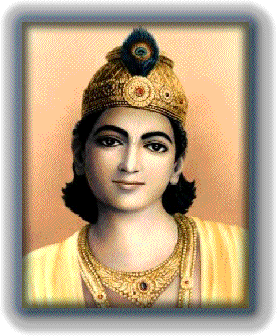
99.
Why is Lord Krishna considered "Lila Manusha
Vigraha"?
Lila Manusha Vigraha (form, appearance) means
the Divine manifesting as man for performing
His Lilas (miraculous deeds). He is Purna
Avatâra subduing and transcending
Mâyâ, manifesting His Divinity to
the world in full, though at times He might
behave as if He were subject to
Mâyâ (or worldly illusion).
100. How does Baba describe
Bhâgavatam?
Bhâgavatha is a huge tree. Lord
Nârâyana is verily the seed of
this tree. Brahmâ is the plant (that
emerges from the seed as a sprout, sapling, a
plant and then into a tree). Nârada is
the trunk. Sage Vyâsa is the branches.
The sacred story of Krishna is the fruit,
filled with sweet juice.