"Sign
and Signature"
When Baba called, "Roll up your bed and
follow Me", very few
realized that the call was for Nagarasankirtan!
At the World Conference, Baba advised His devotees to wake up at 4 or
4.30 in the morning (the Brahmamuhurta as it is called), and move along
the streets singing the Glory of God, awakening people into the
awareness of the Divine. Sankirtan of this type was a common feature of
village life in the past, but due to apathy and ridicule, the habit is
fast disappearing. After Baba's command, people who had never seen the
sunrise, since they arose from their beds only when it was high up in
the heavens, have started moving out into the cool, refreshing air to
join their brothers and sisters in rendering the new day a happy event
to themselves and to others. When Baba said, "Follow Me", it was clear that He meant He, in any one
of the Infinite Forms that God assumes, and with any one of the
Infinite Names that God can be remembered. As a matter of fact, Baba
has announced that hymns on a variety of these Forms and Names have to
be sung, and that no portrait of either Himself or of any other Forms
of Divinity be carried when the Bhajan party moves on. "Follow God", that is His call.
The intricate mysteries
of metaphysics are beyond the ken of the common man; even those who can
delve into them, do it for the pleasure of disputation or dialectic
gymnastics; they do not intend to practice even an iota of the
principles of life underlying them. The abstruse labyrinth of rituals,
with its armoury of do's and don'ts, create only apprehension in him.
Mere Jnana, (knowledge) can make you a good logician or
a debater capable of indulging in hair-splitting sophistry. But if it
is lived through, or in other words, implemented, then you become a Jnani (a wise man).
Sadhana or practice helps you
to achieve the goal of life. Baba has restored faith in the Name and
the efficacy of the Name "Call on Me in your distress; it is your right to
invoke My Grace."
Dr. D.J. Gadhia, of the
H.H. Agha Khan Dispensary, Arusha, Tanzania, writes: "In May 1971, Mr.
Jamnadas M. Patel became seriously ill. When this poor soul was called
to attend on him, there was no breathing; the heart-sounds had
completely stopped. The pulse could not be felt. The heart was massaged
with sacred Vibhuti, with sincere prayers. He recovered
miraculously. When Mr. Jamnadas visited Puttaparthi, Baba told him, "I gave you new life, as
your doctor called Me at the right time." Devotees of Baba know the unfailing power of the Name to
bring forth the Grace of Baba. They need no elaborate argument to
convince them that Sankirtan is the shortest and the sweetest means of
winning His Grace.
But, there were some
who had their fears! Will people get up so early? What about the rich,
the officers who wield authority over the area? Will the neighbours
permit singing in the early dawn? Will the police keep quiet? What
about dogs, will they not bark us out or even inflict a bite? Many who
felt they should not be seen singing in the streets, but who wanted to
observe Baba's command, started at 3 a.m. when the streets were empty
and all were sleeping soundly, and came home quickly before they could
be discovered! But soon the atmosphere changed. A wave of wholehearted
enthusiasm swept over the land from one end to another. Neighbours
welcomed the melodious tonic! The police themselves joined, to imbibe
delight! The dogs were no problem at all. From one day in the week the
Kirtan was increased in frequency to two or three, and in some places
every day in the week. The distances covered increased, the number in
each group multiplied. Soon each section of the town or city had its
own Nagarasankirtan party. They usually met in a temple and proceeding
from there, ended up in another temple.
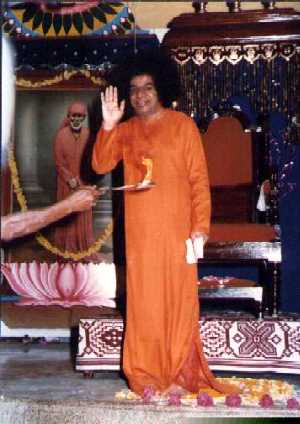 In
Sathyavada, it was found that some mysterious person knocked at the
doors of sleeping members and asked them to wake up and join the party.
In Chembur, Bombay, they noted that on no day, even during the most
furious monsoon days, was the Nagarasankirtan party disturbed or
bothered by even a drizzle. At Gauhati, Assam, Sri Dutt Gupta moved on
along the usual route at the usual time, with the name of God on his
lips and the group behind him. A cyclonic wind was raging and roaring,
bringing "cats and dogs" with it; on the way, the chaprasis and
watchmen of the State Treasury warned them to take shelter from the
oncoming calamity, but they sang and stepped as slowly as usual, to the
place where they generally end the Bhajan and perform
Arati before they disperse.
The rain did not fall upon the road, the drizzle did not wet their
clothes, the wind did not disturb their hair! People unable to walk
without a stick have, after attending a few of these matinal Bhajans,
thrown off the stick and walked majestically along. I know of an
invalid in Channarayapatna, Mysore, who earned Grace in this manner.
Baba has said that the Nagarasankirtana is
Bhagavatha in practice. When
the senses are still dormant after the night's sleep, before they get
too loudly involved in the pursuits of the busy day, you should move
along the quiet streets in the cool, thrilling pre-dawn silence,
bringing God into every ear, radiating the fragrance of the Divine Name
through every open door and window. This is self-help as well as social
service of the highest order. It is a tonic to the body and a shake-up
to the mind. Every song cuts the knot of laziness that is infecting
someone. You remind your neighbours to offer thanks to God for the gift
of another day; it is a mission of love. It is a purificatory Yajna, for it disinfects the air fouled by slogans
of anger and cries of pain and pride. It helps to remove inner and
outer pollution.
In
Sathyavada, it was found that some mysterious person knocked at the
doors of sleeping members and asked them to wake up and join the party.
In Chembur, Bombay, they noted that on no day, even during the most
furious monsoon days, was the Nagarasankirtan party disturbed or
bothered by even a drizzle. At Gauhati, Assam, Sri Dutt Gupta moved on
along the usual route at the usual time, with the name of God on his
lips and the group behind him. A cyclonic wind was raging and roaring,
bringing "cats and dogs" with it; on the way, the chaprasis and
watchmen of the State Treasury warned them to take shelter from the
oncoming calamity, but they sang and stepped as slowly as usual, to the
place where they generally end the Bhajan and perform
Arati before they disperse.
The rain did not fall upon the road, the drizzle did not wet their
clothes, the wind did not disturb their hair! People unable to walk
without a stick have, after attending a few of these matinal Bhajans,
thrown off the stick and walked majestically along. I know of an
invalid in Channarayapatna, Mysore, who earned Grace in this manner.
Baba has said that the Nagarasankirtana is
Bhagavatha in practice. When
the senses are still dormant after the night's sleep, before they get
too loudly involved in the pursuits of the busy day, you should move
along the quiet streets in the cool, thrilling pre-dawn silence,
bringing God into every ear, radiating the fragrance of the Divine Name
through every open door and window. This is self-help as well as social
service of the highest order. It is a tonic to the body and a shake-up
to the mind. Every song cuts the knot of laziness that is infecting
someone. You remind your neighbours to offer thanks to God for the gift
of another day; it is a mission of love. It is a purificatory Yajna, for it disinfects the air fouled by slogans
of anger and cries of pain and pride. It helps to remove inner and
outer pollution.
Several such groups
operating in different parts of Hyderabad converged towards the Lotus
Feet of Bhagavan. The sight and sound of Bhajan
was a feast for the eye and ear; Baba blessed the participants and
granted them further impetus to continue their Sadhana.
An Akhand Bhajan
(singing the Names of God continuously for 12 or 24 hours) was arranged
on 25th July by the Bhajan Mandalis of Bangalore at the famous Lal Baug
gardens in the glass house. The inscription at its entrance "The garden
of flowers is the temple of God" appeared so apt during the singing of
Bhajan in the Divine Presence of Baba. Baba lit the lamp to mark the
inauguration of the Bhajan, and when it came to an end, He sprinkled on
the heads of the thousands attending, the water sanctified by the holy
hymns. In the evening when Baba arrived to give His discourse it was
raining. Baba does not like anyone suffering in sun or rain. His heart
is moved with irrepressible compassion. He moved amongst the people,
made them sit inside the building, lifted an iron chair for Himself
from behind the table on the dais and placed it in a position from
where all could have Darsan, and thereafter
commenced His Discourse.
Krishna Jayanti, 1968
was celebrated at Prasanthi Nilayam for 3 days. Many Samithis call it
Sai Krishna Jayanti; they have converted it into a children's festival,
when children are given new clothes, trained to enact small plays and
sing Bhajans. At Prasanthi Nilayam Bhagavan gave three discourses on
Krishna and the significance of the Leelas. Dwelling on the value and validity of the Name, He said
that the root of the Name Krishna implies power to attract, to enchant.
Krishna is the personification of the Divine principle that is born in
the umbilical region of the body (Mathura),
which is conveyed to the mouth (Gokulam),
and there fostered by the tongue (Yasoda),
who alone knows the sweetness. "Foster Krishna on your tongue", He advised. "Just as the poison from the hoods of the
serpent Kalinga [See Bhagavatha Vahini, Chapter 40] was ejected when
Krishna danced upon them, bad thoughts from your system will evaporate
if you recite the name of Krishna,"
He said.
His interpretation of
Krishna-Avatar as a consummation of Yogamarga reveals that this Avatar
has come to coordinate and collate the apparently differing paths to
God. The three systems of philosophy - the dualist promulgated by
Madhawacharya, the qualified non-dualist promulgated by Ramanujacharya
and the non-dualist promulgated by Shankaracharya - are all emphasised
by Him as adjusted to the needs and capabilities of seekers and
listeners.
An Avatar appears from
age to age whenever Dharma is on the
decline so as to reaffirm faith in right conduct. [See The Gita -
Fourth Chapter, verses 7&8]
Chitha-shudhi
leads to Jnana-Sidhi, that is, goodness leads to Godliness. The Avatar will guard and guide and fill
with Divine bliss, all those who have
Sathvic pure virtues. This
declaration is addressed to a dualist. From the "qualified non-dualist"
point of view, Jiva and Deva are the two rails, along which the engine, Manas,
is dragging the coaches of Vishaya Vasana. Each
coach contains items of luggage viz., Buddhi, senses
etc. Atma is the
driver of the engine; if the coupling with the engine is not well
tightened, the coaches will be left loose on the line. Bhakthi and
Sraddha are the coupling, they should be tightly
fixed. It is 'absolute non-dualist' philosophy when the seen (Drsya) world is superimposed on the undivided,
indivisible Brahman. It can only be as real as the turrets and bastions of a
city among the clouds. Can anyone build castles in the air and live
therein? The turrets and bastions are fantasies and creations of your
own fancy, ephemeral and meaningless. So too, in this Akash-like Parabrahma, this Jagat is superimposed; it is baseless
and false. Everything is only the
Chaithanya of the non-dual,
unequalled, bliss-pervaded Parabrahma. According to Bhagavan, what
others think you are is the dualist view; what you think you are is the
qualified non-dualist view; what you really are is the non-dualist
Truth!
Dasara 1968! It was
remarkable for more reasons than one. Baba made it clear that He is the
Sanathana Sarathi as well as Parthasarathi ('the charioteer of the earth'),
while addressing the volunteers.
"I
too have certain vows to fulfill, they have been mentioned in the
Bhagavad Gita. I have to uphold the supremacy of Dharma; I have to bear
the Yogakshema (acquisition and maintenance of welfare) of those who
are immersed in thoughts of Me alone. The best way to please Me is to
see Me in all beings and serve them, just as you yearn to serve Me."
Elaborating a
declaration about Himself that He had made in the Gita, Baba said,
"I
have none to compel Me to work, nor do I profit by work. Still, I work
without intermission, in order to guide and teach and set things that
are awry. If I remain inactive, [BG: Ch. 3 : 22-28] how can the wheels of the
world revolve? I have no manager, secretary, aide or assistant. I
attend even to the minutest detail, here and everywhere. I do
everything Myself. I need no other food than the Ananda of beings. I am
Anandaswarupa, My nature is Ananda; Ananda is My sign and signature."
On another day, He
announced,
"Shall
I tell you exactly when I feel restful, relieved and content? When I
know that you are having Ananda, through the cultivation of detachment
and the spiritual discipline of Seva. I am ever engaged in some
activity or other for your benefit. There is none to question Me if I
do not act; there is nothing I would lose, or could gain. Although I
have no urge to be active, yet you see Me ever active! The reason is, I
must be doing something all the time in order to inspire and instruct
you or to set an example for you. I am engaged in activity, so that you
may learn to transmute every minute into a golden chance to elevate
yourselves into Godhood."
Clarifying another
statement made in the Gita [see also Geetha
Vahini], Baba said in one of
the Discourses,
"When
the Gita directs you to give up all Dharma, it does not ask you to give up all Karma! For you cannot escape that obligation. But, when you do
Karma for God, through God, and knowing that He is the doer, not you,
every Karma becomes Dharma, leading to Grace. No Karma can then be
tainted by sin or sacrilege. The Gita assurance is therefore not an
invitation to licentiousness, sloth or inactivity, it is a call for the
surrender of the ego and dedication to God of all that it 'is' and
'does'."
Dharma is the inner
voice of God, in the individual and community. It is the voice of
history; the conscience that has shaped itself like a cocoon, to
protect the caterpillar so that it may take wings and fly into the
Bliss that is its heritage. And on the last day of the seven-day long Yajna, when the Valedictory Offering of silk,
gold, sandalwood and 'the precious gems He creates for the oblation'
were placed ceremonially in the significance of that act, He said,
"You
have to pour into the flames that rise up to destroy, (for they are the
flames of revelation, purification, discrimination) the limited vision,
that sees nature as different from the divine. The divine created all
this through the divine and with the divine substance."
"Sarvam
Brahma Mayam": All this is Brahman. The offering is Brahman, the fire
is Brahman, the offerer is Brahman, the goal is Brahman. Transmute
every trifle into God; everything in the objective world is the divine,
appearing to the limited, the myopic, the ignorant vision as different.
In a silver idol, the crown is silver, the clothes are silver, the
pedestal is silver, the flesh is silver, the face is silver, the eye is
silver. Know the silver and declare: "Sarvam Brahma Mayam"
In another discourse,
Baba integrated the three paths of Karma,
Bhakthi and Jnana, in a very illuminating manner, so that the
world could follow them with proper understanding.
"When
someone asks your name, you do not give your real name; you fob him off
with the name by which your body is identified as separate from other
bodies in this life. You do not give the name that has been with you
life after life, that has survived many deaths and births, namely, Atma!
That name is ignored by you, since it is overlaid by three veils -
Mala, Vikshepa and Avarana; Mala is the dirt of vice, wickedness and
looseness. This is removed by Karmamarga, the observance of selfless
activity dedicated to high purpose, and with no tinge of pride or pomp
or sense of ownership so far as the fruits of that activity are
concerned. The second veil is Vikshepa - ignorance which hides the
truth, befogs the intellect, confounds reason, and clothes falsehood
with the tinsel that attracts. This is removed by Bhakthimarga,
steadily worshipping the source and sustenance of all, Him, the True,
the Good, the Beautiful, the Embodiment of Love, Peace and Joy, in all,
as all, for all, through all."
"The
third veil is Avarana, the superimposition on the eternal of the
temporary, on the rope of the snake, on the noonday desert of the
gleaming lake, on the mother-of-pearl of silver, on the Sarvam-Brahma
Mayam (Brahman that is the real Reality of the Universe) of the
multiform, multicolored, distracting, changing world. This veil is
removed by Jnanamarga, which reveals the Atma as all-pervading,
all-inclusive, all-sustaining. When the illumination of Jnana is
gained, the reality is experienced and man is free. He merges with the
truth from which he broke off aeons ago, on a long and arduous
adventure into the dark night of individuality."
Dasara is a Festival of
Victory, of Power (Sakthi), adored and celebrated in three forms, for
three days each - Mahakali (the facet of Power as anger, vengeance,
adventure, audacity, the Thamasic nature), Mahalakshmi (the facet of
Power as wealth, authority, imperium, prosperity, the Rajasic nature),
and Mahasaraswathi (Power as self-control, vision, value, validity,
knowledge, keenness, discipline, justice, aspiration, adoration, the
Sathwic nature). Dasara at Prasanthi Nilayam is for everyone who
invests himself in it for initiation, instruction and inspiration.
Kindred souls come from all over the world, and so one is bathed in the
glory of Sai which each one brings in his heart, treasured with loving
care. Each person has a golden book of experiences of Baba's Grace
written in tears of gratitude. The scholars whom Baba encourages to
delve into the intricacies of philosophical speculation so that they
may ultimately gain the philosopher's stone which transmutes
distinctions into the One Divine, speak in his Presence of the
unfathomable mystery, and later Baba unravels the same and renders it
understandable by His sweet simple comments. As the supreme educator of
the Age, He leads us through song, drama and discourse, through glance,
gesture of gift, through word, wit or rebuke, into the path which leads
through Love unto Light.
The Yajna which is
performed for seven of the nine days is a lesson in spiritual science,
for we experience, while it is witnessed, the whole gamut of bliss. The
bliss of contemplating the formless, attributeless, cosmic principle
described in the Upanishads; the thrill of conceiving and adoring the
solar orb as the source of Light and Life; the joy of installing in our
hearts the author of this amazing adventure of Creation (Brahma) -
Continuance (Vishnu) - Destruction (Shiva) as emerging from the
formless into form, or as merging from the form into the formless (as
the Linga or Spheroid) symbol which is worshipped as part of the Yajna;
the exhilaration one is filled with when the Sakthi is consecrated,
praised and propitiated through an image into which she is invited
ritually to contain herself, the recalling to memory of the sweetness
of Vedic hymns, and the ecstasy of epic poetry - Baba uses every medium
of expression to convey to us the message of self-control to silence
the clamour of the senses and the mind.
Every Dasara He writes
a play in which the children of the Vedasastra Patsala, whom He trains
for the purpose, pronounce spiritual truths. This Dasara, the play was
on Dhruva, [*Dhruva's
story*] the princely lad of
five who went into forest to win by austerity the Grace of God, so that
he might be restored to the love of his father. But, as the austerities
cleansed his mind and sublimated his nature, the wounded pride was
healed and he prayed for the boon of mergence with God. "People come to
Me to get a chronic illness cured, but when they get to know Me more,
they clamour for more substantial boons which I am ready to grant,"
says Narayana in the play, an echo of the experience of most of the
pilgrims to Baba's presence!
Twenty thousand heavy
hearts left Prasanthi Nilayam after the Dasara Celebrations, with these
words of Baba ringing in their ears and booming in the cavity of their
hearts:
"Ponder
over the ameliorate and curative advice I have given you out of the
fullness of My Love; try to cleanse your minds through repentance of
wrongs committed or contemplated; resolve with unshakable firmness to
shape your lives anew, rid it of deep-rooted deleterious habits of
speech, thought and action, and lead it in conformity with the divine
plan, by which each will blossom into the fully Divine."
|Previous |Next |
Bhajans



