|
|
Beacon
of Bliss
'There
are four things in which every man must interest himself:
who am I, where from have I come,
whither am I going,
how long shall I be here'
Confusing and
confounding stories depicting the illness of Baba, and details of the
operation that was not performed, generating distressing news that He
would not be able to make a public appearance for months, filled the
drooping hearts of devotees in Bombay with fear and anxiety. These
uncalled for fears, the progeny of rumour and hallucination were
allayed by Baba's Presence at Dharmakshetra on Christmas Day. The
gathering heard a long discourse, followed by many Bhajan songs, from
Baba. They heard the authentic version of the assumption of the illness
and its equally sudden dismissal. Illness had appeared to affect that
holy Body, but in fact it cannot afflict it. It had been a passing
phase, belonging to someone it came and went like a passing cloud.
"But, I have no contact with it; many people, however have the courage
to suggest to Me ways and means of dealing with such situations!"
According to them the Swami should not allow the illness of another to
come upon Him, causing sufferance to lakhs of people. Baba told the
gathering that it is His duty to take upon Himself the suffering of
those who surround Him. Likewise it is the duty of His devotees too to
suffer on that account. But the truth is, there is no suffering, and as such no
reason to get anxious. Christ sacrificed His life for the sake of those
who put their faith in Him. Service is God, Sacrifice is God - that was
His declaration. The whole world can derive joy from that Divine
assurance. "Do not grieve, the Savior who will take on your grief, has
come."
On the first day of the
new year, the Kamanis, the famous industrialists had the privilege of
welcoming Baba at Kurla. Their community hall, which is really a Prayer
Hall, was declared open that day. Even though entrance to the
commodious auditorium was restricted by passes only, there was not an
inch of space even to change one's sitting posture. The auditorium
consisted of workers and their families. The area was tastefully
decorated with simple unostentatious dignity, television sets provided
the entire gathering with the thrill of Darsan.
Commenting on this, the
Bhavan's journal wrote: "When a sage brings down his mind from the
higher realms of beatitude to dwell on a mundane matter like
employer-employee relations, the subject is bound to acquire a new
dimension and a fresh sparkle of spirituality. The words of wisdom
contained in the discourse delivered on January 1, 1971 by Sri Sathya
Sai Baba at the premises of a massive industrial establishment in
Bombay have great relevance to modern India".
While exhorting the
employees to develop the enthusiasm to earn rights by fulfilling
obligations, Baba also exhorted the employers to take care of the
employees and provide amenities to their children to develop a strong
and virtuous character. To put it in the words of the Divine
Master:
"Happiness
and peace are mental conditions which grow in the soil of love, and not
of power, affluence or skill.
The tree of life yields as its most precious fruit, the quality of
Love, sweet fruits have bitter rinds. This fruit too is encased in a
thick bitter six-fold rind, composed of lust, anger, greed, attachment,
pride and hate. If these are negated and the rind removed, the
nectarine sweetness of Love can be tasted and taken into the system.
Those who make effort to explore into that treasure of Love within,
they alone can have the Peace and Bliss. Sadhana is the name of process
by which man discovers the Spring of Universal Love within him, by
which he is privileged to share it with all beings.
Riches of various kinds, possessions and power, name and fame - these
are not of much worth; the precious possession called Love, is the very
breath of Life for man. A heart devoid of Love is an altar plunged in
darkness. Bats of evil passions will make it their home. They will
render it in a dirty sinking seat of chaos. Only the Light of Love can
illumine the heart and drive away these vicious inhabitants.
We
have here, gathered in thousands, the employees of the Kamani
factories. The industrial, agricultural, mercantile, political and
administrative fields are as five vital airs to the human community.
They have to be healthy and harmonious, so that mankind can live in
peace and prosperity. If these five are aware of their
interrelationship and interdependence and if they lovingly cooperate in
common endeavor, this country, and the world too, can celebrate each
day as a festival day, can festoon each door-sill in green.
But,
at the present time, the bond of love and mutual cooperation is absent.
There are factions in each of these fields, each producing its own
share of confusion; so, the country is heading every moment into deeper
and deeper anxiety. People are moving about in fear, grasping their
lives in the palm of the hand, doubtful what the next moment holds for
them. This is not a proper state of things to be welcomed.
Emotions
and passions have a way of suddenly rising into devastating floods.
Really speaking, every worker has to earn the authority, before
standing forth as a part of the organization, of which he is a limb.
Emotion and passion have to arise out of earned authority; now, they
surge forward from persons who do not carry out the duties undertaken
by them. Authority and influence have to emerge from the discharge of
one's duties. Then only will they be effective. We must be convinced
that rights are deserved only by the discharge of obligations.
But
today, agitation is only for rights; there is no enthusiasm to earn
right, by fulfilling obligations. Every one must work with the
consciousness that Duty is God and that Work is Worship. If devotion to
duty is developed and all work is done as sincerely and as correctly as
acts of worship, then each one can be happy, and society will be free
from discontent and misery.
The
Kamanis are fabricating transmission towers in their factories. Every
person who is engaged in the fabrication and erection has to carry out
his work correctly and sincerely, so that the towers may be strong and
secure. Who among them does the more important item of work? It will be
impossible to discriminate. Each item is important, and each worker
earns his right by discharging well his particular share of the total
obligation. There should not be any attempt to compare and claim
superiority or confer inferiority. Such attempts will only promote ill
feeling, and obstruct the flow of love and tolerance.
Let
me illustrate this by an example. There was a man going along a country
road whose eyes saw ripe fruits on a wayside tree. The eyes told him
that they were desirable and would provide him a feast. So the mind got
attached to them, the feet took him nearer the tree, the body was bent
by the muscles of the back, the hand moved down to the ground, the
fingers picked up a stone and clasped it, the shoulders gave the needed
thrust when the hand threw the stone on to the tree in the direction of
the fruits. That made one fruit fall on the ground. But, more items of
work still remained to be done by the limbs of the body. The fingers
have to pick it up, the hand has to offer it to the mouth, the tongue
has to place it between the teeth, the teeth have to chew it and the
gullet has to swallow it and send it to the stomach. Now, which among
these items are more important and which less? Which limb had done more
and which less? Each limb has done its duty exactly when needed to the
best of its ability and so, the fruit on the tree reached the stomach
of the hungry person. We must respect each worker as the contributor of
a valuable share of the common task. Feel that all are divine, all are
equally to be loved; that is the Sadhana that will bestow Ananda on both the individual and society.
Doing
the duty that has fallen to one's lot is the best way to make life
worthwhile and to contribute the skill and intelligence one is endowed
with for the common good. This is the debt one has to discharge for
having come into this world embodied as a human being. We have not come
into this world for the sake of eating and drinking; we eat and drink
in order to live; we do not live in order to eat and drink, we have to
reach the far higher goal - the Presence of God, through the Path of
Love. That is the higher duty, the most elevated item of work we are
engaged in the Factory (the Body) where we are. All our energies and
skill have to be fully directed towards this effort. Or else, we may
waste our lives in the chaos of emotional impulses.
Of
course, the question may be asked: Who is God? Where can we find Him?
Who has seen Him? I can tell you a story to elucidate this. A sanyasi
(monk) wearing a gerua robe entered, during his pilgrimage, a village,
renowned for its godlessness. Seeing his robe which indicated a person
who had dedicated his life to God, a crowd gathered around him and
started heckling him, on the existence of God. "Can you show Him to
us?" they asked and the monk said, "I can." However he called for some
milk, evidently to overcome exhaustion. When the milk was brought, he
stared into the cup for a long time in the silence. The group of
villagers lost patience and clamoured that God be shown to them, as
promised. They asked him why he was staring at the milk so long. He
replied that he had heard that milk had butter in it and so, he was
trying to see the butter! They laughed; they called him a fool and a
simpleton. "Don't you know that milk has to be boiled and cooled,
curdled and churned before the butter can be seen as such, clear and
distinct? Now it is there in the milk, in every drop." The monk said,
"There, you have the answer to your question. God is in everything and
being, in the Universe. If you want to see him clear and distinct, you
have to go through various processes called Sadhana. You can see Him thereafter, not now, by
merely asking me."
The
essential ingredient of this Sadhana is Love. Sadhana without Love
(Prema) towards all creation, will reveal only Satan.
'It
is your duty to ask God. Words must be said and the words must
correspond to the thought. The thought must be put into a true
word.
It is true enough that the Divinity knows all.
But He requires that the true word be said.
The mother may know that to maintain life the child requires food.
But milk is given when the child asks for it.
Even when you have to speak harshly to a child or a parent
because all other means of bringing a point home have failed,
let your heart be soft, let it not be hardened by prejudices or hatred
...
the basis of the teacher's Sadhana is love'.
I
shall explain this a little more. Around us now here, we have the radio
waves carrying music from the broadcasting station Bombay. We have the
radio waves from Delhi also; in fact we have, here and now, the radio
waves from stations all over the world, though we are not able to see
them or listen to the 'programmes' they carry. When we have with us a
Yantra, called receiver, and when we adjust the wavelength to the
station that transmits the programme and tune the receiver correctly,
then we can hear the music or the news. God who is also here, now all
around, can be cognised clearly by means of a Mantra (meditation on a
meaningful mystic formula). Have the Mantra, concentrate on it (i.e.
the adjustment to the wavelength), with Love (i.e. the tuning in) and
you become aware of God (i.e. listening to the omnipresent programme).
If the tuning-in is not accurate, you run the risk of listening to the
nuisance, not to the news! So too, unless love is poured out in
profusion without any idea of Self, you run the risk of cognising
Devil, not God! And if you do not develop concentration, your mind will
wander in many directions at once, causing confusion.
Therefore,
Love is the best instrument to win Grace. Draw everyone near, as you
draw your own brother and sister, and resolve to bear your
responsibility with the utmost care and skill you are capable of. In
fact, life as a worker is most valuable and fundamental. Work, worship
and wisdom are three stages on the Godward path; work is the base -
work that is dedicated, work that is done righteously and in reverence
to others. The employer and the employees are bound close to each
other, as close as the heart and the body. The master is the heart and
the men are the body. There can be no heart without a body and no body
without a heart; both are essential for each other. The
employer-employee relationship is as the bond between a father and his
children. It is only when such affection and regard prevail, when the
atmosphere of brotherhood is recognized among workers, that mutual help
and service can flourish. Under such conditions, each can fulfil his
duty gladly and peacefully.
When
the employees have any problem that worries them, they can place them
before the employer and both can discuss them calmly and sweetly,
without unnecessary passion, without arousing hatred or malice and
spreading unrest among others. Above all, each person must be conscious
always of his obligations as well as of his rights. That is the basic
requisite.
The
community centre has been inaugurated by Me just now. I suggest that
you gather in the place once a month, or more frequently, once a
fortnight or once a week, for Satsang, where you can have Bhajans, spiritual discourses or other programmes
which will turn the mind towards the contemplation of the glory of God
or the spiritual treasures in your own selves. I desire also that the
children of the labourers be provided with schools where they will be
initiated into Bhajans, instructed in spiritual discipline and theistic
beliefs and inspired to develop strong virtuous character.
Discipline
is the most essential equipment for man; the acquisition of discipline
should be the primary goal of all endeavor. Life is rendered worthwhile
and valid, only when it is lived out in disciplined ways. It is a great
source of Ananda for me to be with you. Let the new year bring you new
opportunities to establish joy and peace in your hearts."
The beginning of 1971
was conspicuous because of its auspiciousness for devotees in Bombay
who had the benefit of Baba's immediate presence there. In the evening
of the first day of January, Baba addressed a public meeting in the
compound of Dharmakshetra; the sea of humanity seemed to overrun its
precincts. John Hislop is inseparable from paper and pen, whenever he
is in the August Presence; he jots down notes of what he hears
on spiritual matters from Baba. On this occasion Hislop posed two
questions, viz.:
"What does
Baba mean to me, as a person born and educated in a foreign
country?
And what does Baba mean to the subtler aspect of me which has no
nationality?"
These questions
were answered by himself when he went on to state,
"He is the
Lord of the heart. He has removed from my heart the hardness
accumulated during the years and made it fresh, new and joyous."
The second question he
answered, saying:
"Baba's
Divinity is an overwhelming and incomprehensible mystery. He is the
Supreme Teacher, He guides us to liberation."
Blessing the devotees,
Baba told them to pray for peace and concord amongst communities and
nations. Mankind must learn to live happily as one human family.
During Baba's stay in
Bombay the children attending Bala Vihar classes enacted plays, recited
poems, sang Bhajans, and repeated stories selected from the Epics
and Puranas.
There were occasions when they felt so deeply the impact of Baba that
they broke down in tears, in sympathy with the characters they were
portraying. One boy concluding his account of Bhagavad
Gîtâ with a direct appeal to the Sai Krishna
who was standing beside him, sobbed in uncontrollable joy. No wonder
Baba considered those children the Prahlâdas of the present age. [See also Srîmad
Bhâgavatam, Canto 7, for the story about Prahlâda etc.]
"The children of the
Sathya Sai Baba Vihars must know the Sathya Sai residing in their
hearts.
The teachers must also take it as the Puja of Sai Ram. How to reveal
these children the Sai who
is in their hearts - that is the problem you should set before
yourselves.
By leading the children towards Divinity, the teachers are serving
their parents and society,
for they will cleanse and brighten their homes and surroundings," Baba
said.
Talking to the members
of the Service Organization, Baba emphasized the role of Sadhana
which leads man to Self-realization, implying that all are waves of the
vast ocean called the Higher Self - Paramatma. Warning them against any display, pomp and
publicity, he advised them to link themselves with God by the chain of
love, through the recitation of names saturated with His loveable
qualities. His Name uttered in sloth or slight, in resentment or
rancour, will constitute a weak link and the chain will not bind.
The 7th January was
Vaikunta Ekadasi,
the day on which "the Gates of Heaven are opened." Baba observes
these festivals in order to restore their significance. At the
conclusion of the Akhanda Bhajans on that day, Baba revealed the real meaning
of Ekadasi -
the eleventh: when the ten senses are coordinated and turned towards
God, then the doors of Heaven will certainly open, welcoming you into
the presence of the Eleventh, that is God.
Before leaving Bombay,
Baba addressed members of the Seva Dal. He said,
"Discipline
comes to your rescue when the world storms around you with the dark
flood of hate or derision, or when those in whom you put trust shun
contact and shy afar. Crucify the ego on the cross of compassion,
preparing yourself by all means for serving others with your
specialized skills. When you are engrossed in such work, remove the Ego
with Namasmaran, Japam, Dhyana and Study."
Baba
exhorted them to lead simple lives, not to wear gaudy and outlandish
dress and manners, for they keep the common folk away from them. Test
every gesture, and mannerism, every habit, and every whim of yours on
this touchstone: will Baba approve of this?
During Baba's stay at
Bombay, a unique book was dedicated to Him by the members of the
Maharashtra Branch of the All India Prasanthi Vidwanmahasabha, founded
and directed by Baba. The President of the Sabha, Sri P.K. Sawant
declared that the book will 'Light a path to the Almighty'. Sri V.S.
Page, the Chairman of the Maharashtra State Legislative Council, said,
while offering the book, at a public meeting at Dharmakshetra: "I sat
at the Feet of Sri Sathya Sai Baba and started questioning Him on many
secrets of spiritual progress. He was kind enough to give His Grace
freely. Others of the Sabha participated in the process of questioning
and learning. This is a faithful record of such Divine Dialogues,
"which confers illumination to those who struggle in the darkness of
confusion." Baba explained that there seemed to be three stages in the
life of a Bhaktha:
- Tavaivaham: I am entirely Yours. Here, the Bhaktha
completely surrenders himself to God without any reservation.
- Mamaivatam: You are exclusively mine. Here, the Bhaktha
thinks himself to be the chosen devotee of the Lord and starts to make
a claim on Him.
- You
alone are, and I am not. I
am yours and you are nothing but 'I'. Here, the Bhaktha sees God alone,
everywhere, including himself.
Dhyani also has three phases of his life:
- I
am He. Here, the Bhaktha
contemplates on the universal God and tries to identify himself with
him.
- Here, the Bhaktha
reaches a stage when he feels he is identified with the Lord.
- I
am I. This is a stage where
there is no distinction between God and the Bhaktha.
Giving directions about
Dhyana, Baba mentioned a method which He has elaborated
often.
"Are we not at peace, when
one thought ceases and another does not rise? You have to watch that
moment, be one with that moment and get fixed in that, so that, there
is ceaseless continuous peace; thoughts arise and die as ripples on
water; you have to look at the water, rather than the ripples. Neglect
the waves, watching the water. "
Page pursued the
subject and asked, "That is Nirvikalpa Samadhi.
Nirvikalpa is like water without waves or ripples. Can we watch the
water, even when there are waves and ripples? For us to have deep peace
in the mind, should we not have experienced Nirvikalpa
sometime or other?" Baba answered,
"Yes. The person who takes
up the process of meditation lands into a state of Nirvikalpa some time
or other though it is a very difficult state to attain. Even a Karmayogi or a Bhaktha touches this stage time
and again in the most natural way, and knows fully what it is.
Therefore, he can remember it and bring it back into experience, and
feel the joy of continuous communion with God."
Page writes, "This was
a complete answer to my question, and I was very much satisfied with
it. I could not get this answer, from my reading of the scriptures,
but, as Sri Sathya Sai Baba was kind enough to give it, I hope it would
be useful to a number of aspirants, including myself."
Another very
interesting point clarified by Baba was about Neti, Neti (Not
this, not this). He said, "Brahman is like a balloon that bulges; it
never bursts! So, Neti refers to the comprehension of Brahman,
not Brahman itself? Neti does not mean, 'No, it is not this,'
it means: 'No, it is not thus.' 'No, this is not all.' 'No there is
much more to Brahman than this or thus.' " [See also Srîmad
Bhâgavatam, Canto 7, Chapter 7 (What Prahlâda learned in
the womb) verse 23]
Page mentions that Baba
distinguished between ego and Self. Baba said: " 'I' pure and simple is God; 'I' identified with the body, the subtle
body and the body imagined in dream life is the ego." Then Page
asked, "God is said to be One. Is there one 'I' pure and simple for all
of us?" Baba replied, "The different egos are but reflections of
one and the same Self or God." Page asked, "Is the mind a material,
just like our body? Can it be objectified?" Baba replied, "Yes. Mind
is matter. Only, it is very subtle, we cannot point out its breadth,
length, thickness or weight. It can be objectified.
Sankalpa can do that."
Page asked about the miracles too. He says, "Sri Sathya Sai Baba
explained these miraculous powers in a very frank manner and we
accepted the same without any reservation." Baba said that the miracle
was the Nidarsan (Witness, Evidence), of God having created
the world out of His Will.
The festival of Mahasivarathri in 1971 was celebrated on 23rd February. Though
Prasanthi Nilayam gets overcrowded during that time, the peace of
that Abode is maintained, due to the holy rays emanating from that
holiest of places. Speaking from Santhivedika,
Baba raised a very interesting question and answered it Himself. "Why
does Swami produce the Linga from Himself this day? Let me tell you that it is
impossible to understand the attributes of the Divine. You cannot
measure Its potentialities, nor gauge the significance of Its Mahima; it is Agamya: unreachable, Agochara:
un-understandable. Because of these, you get an example of Divine
attributes. In order to bear witness to this Divinity that is amidst
you, for your benefit and benediction, the Linga emerges. If even these
glimpses are denied, faith in the Supreme will vanish and an atmosphere
of greed, hatred, cruelty, violence and irreverence will overwhelm the
good, the humble and the pious."

The
Linga's Bhagavân produced at Shivarathri 2003
The Linga is
an illustration of the limitless, formless, beginningless, Divine
Principle. Baba stayed at Prasanthi Nilayam to assuage a large
number of persons who had come long distances to fill their eyes and
minds with the sanctity and elation that the
Lingodbhava gives, and to
touch His Lotus Feet. After showering Grace on them, Baba left for
Brindavan, for He had willed that the Women's college at Anantapur must
be shifted from temporary sheds and rooms to its own magnificent home,
with the beginning of the academic year.
The Sathya Sai Seva
Samithi, Bombay, had organized the first All India Bala Vihar Teachers
Conference on 11th and 12th May. So Baba in response to the prayers of
the devotees of Bombay visited that city for a few days, to bless the
teachers. 404 teachers, crusaders of the new Sai Era of Education
attended, and were benefited by Bhagavan's counsel. Baba interpreted
the usual invocatory verse on the Guru, recited by a pupil and made it
the text of His Discourse. The Guru is Brahma,
because, He said, teaching is a creative activity; he is Vishnu
because the teacher has to foster the child, guide him and guard him:
he is Maheswara, since he has to weed out deleterious
components and undesirable traits and habits. The verse, which has been
all along taken to mean conventional praise and glorification of the
Teacher thus assumed the role of a clarion call to the entire
profession itself. That is the significance of Sai Touch! "The Guru is praised as Parabrahma, the genuine supra-soul,
for He reveals to the pupil the Reality that makes him free." He said, "Recognize the vast potential
lying dormant in the child; help it to express itself."
For this reason, Baba
suggested that the name of the classes for children should be changed
from Bala Vihars; for more than play and recreation, what has
to be done is to encourage the good, the true, the beautiful in the
child to blossom, to express and expand. "Bala Vikas," Baba said, "is the more
correct name." He wanted that the little children must be trained and
encouraged to speak before gatherings of devotees and even others, so
that elders might learn from the lips of children what they refuse now
to learn from those entitled to advise them. He appreciated the short
speech given by a little pupil on 'Film posters, and the horrors they
inflict.' It was an eye-opener to the elders who are tolerating such
insults on the innocence and purity of home life.
All over the country
now, the tiny tots of the Bala Vikas sing Bhajans,
draw pictures, paint, write stories and relate them, about heroes of
the spirit, and the great mothers of the land, and enact plays
depicting elevating incidents from the Upanishads,
Ithihasas and Puranas, as well as the religious literature of all
faiths. A big revolution in thought, and in social relations, is fast
coming into fruition. The Maharashtra State Conference and the Gujarat
State Conference of the Organization were held in May. Baba was present
in Bombay for the Maharashtra Conference, He sent a message of
Blessings to Dwaraka for the Gujarat Conference. "I am watching the entire
proceedings; do not deplore that I am not present with you. I am
present as the Eternal Witness,"
He wrote.
While returning from
Bombay, Baba presided over the Mysore State Conference at Dharwar, on
the 14th. About 200 office-bearers of the Units all from parts of
Mysore were charged with steadier faith and deeper devotion for the
work ahead.
"The College at
Anantapur," wrote Dr. S. Bhagavantham, D.Sc., "is a concrete
manifestation of something superhuman. At an enormous cost of four
million rupees, within a record time of ten months, Baba has reared a
structure, which is good enough for a University! Who did all this
work? Where have the funds come from? If you want to see Divinity in
action, you can find concrete evidence at Anantapur! It is something
beyond the pale of human reason, and mortal prowess!"
The College was to be
inaugurated on the 8th of July, 1971 by the President of India,
although there seemed to be no sign or hope of completing the building
by the stipulated date! Everyone swore that it was an impossible task.
A big industrialist who had visited Anantapur a week before the
inauguration said, "If I had applied all my energies with my entire
organizational machine, I would have thought that it would take another
six months for completion of the work."
The College building is
the architectural archetype for Sai Era in education for individual and
social uplift. Baba has the Sai Emblem depicting the many faceted
adventure of man to realize the Divinity inherent in him as his very
breath, hoisted on the central tower as the symbol of hope and victory.
The college building is a full circle of charm and dignity. It
symbolizes the fulfilment of the search, called religion. It is
Brahman, the beginningless and endless, which a circle alone can
represent. It is redolent with the fragrance of the cultural heritage
of India. It is resonant with the echoes of Sanathana Dharma.
It carries sky-high the Lotus Flower, (the Hrdaya-kamala) which
blossoms at the first touch of the rays of the rising sun
(Intelligence, Reason).
Baba has installed a
clock on the tower, so that Time the Divine Watchman, can waken, hasten
and warn the process of teaching and learning, shaping and
strengthening, that happens in the College. Architects sat with Baba to
translate His ideas on paper, but, the supreme Architect had it all in
His Will, and that was enough. The Anantapur College looks like a
prayer rising up from the heart, a poem of praise for the Giver of all
Good. The building is a miracle in marble, brick and stone, colour and
light.
On the day of the
Inauguration an international gathering saw a constellation of great
personalities. The President of India, Sri V.V. Giri, the wife of the
President, Srimathi Saraswathi Giri, the Governor of Mysore State, Sri
Dharma Vira, the Lt. Governor of Goa State, Sri Nakul Sen, the Chief
Minister of Andhra Pradesh, Sri P.V. Narasimha Rao, the Vice-chancellor
of the Venkateswara University, Dr. Jagannath Reddy, Sri G.C. Venkanna
and Sri M.N. Lakshminarasiah, Ministers of the Government of Andhra
Pradesh - it was a bouquet of talent, authority, sacrifice and
patriotism.
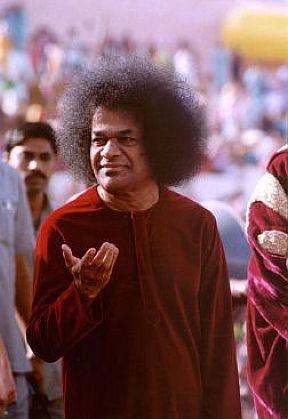
Above all, there was
Baba, fresh as a flower, beaming with a benignant smile, with no trace
on His Divine Face of the exhaustion, worry or anxiety that He had
removed from the faces of even the most busy workers around Him. The
bright morning was rendered doubly bright by the Light of Love that
shone on that face.
Dr. Gokak, Director of
the Institute of Advanced Studies, Simla, welcomed the distinguished
guests. He communicated to every one an awareness of the epochal
character of the moment. "This college and the others that Baba has
planned to establish in every state in India will inculcate Indian
culture in its essence and purity; they will develop not only knowledge
and skill, but balance and insight, and faith in the unity of all
religions, and in the Reality of Oneself." Dr. Bhagavantham, formerly
Vice-chancellor of the Andhra and Osmania Universities said, "History
has few parallels of a college that is so well equipped on the date of
its Inauguration!" Dr. Jagannath Reddy, spoke of the phenomenal growth
of the college in the short span of 3 years. The Minister for education
said, "When Baba establishes a college for women we can be certain that
it will not be just one among many. It will be a beacon, a lesson for
others, a model, a pioneer." Sri Brahmananda Reddy greeted the day as a
festival for Andhra Pradesh and for Bharathiya Culture itself. Sri
Dharma Vira felt that the college for women will be of lasting benefit
for the whole country, since educating a woman is educating a whole
family. The President declared that it was a good augury for India that
Baba is not only conferring spiritual enlightenment to millions, but
granting the proper type of education to the youth of the land.
The 8th July, 1971 was
Guru Pournima, the Full Moon Festival, dedicated to the Primal
Spiritual Preceptor, Vyâsa, and also to the adoration of Spiritual
Preceptor, by aspirants. It is the Day when millions seek to have
Darsan of Baba. It was Baba's Will that the College in which the Guru-Sishya relationship of Ancient India was to be
revived, should be inaugurated that Day itself.
Baba pointed out that,
as lava from subterranean fire, a huge upsurge of low desires is
smothering man, though his chief desire should be the visualizing of
the God in him, and the cultivation of peace, beauty, truth and love
that are the marks of that Divinity. "Man has in him a fountain of joy, peace,
love and courage. Cultivate these by precept, example and exercise.
Then, the educated men and women will have security and sweetness as
long as they live."
"India is being forged into
a Bhogabhoomi - land of luxury - a land of skyscrapers, tinned foods,
air-conditioning and television. Indians are being shaped into an
imitative, insurgent, ill-disciplined mass. They are being transplanted
on other soils and encouraged to grow, without roots. This is an insult
to our past and a dangerous defiance of history. It is a sacrilege on
the sanctity of time, on the holy purpose of the human body. That is
the reason, I have decided that this college has to be inaugurated on
Guru-Poornima Day on Guruvar - Thursday - as a Gurukula - the hermitage
school of ancient India in which the highest ideals of life were
instilled by personal example and guidance by the Guru to the pupils
eager to imbibe." [See also: Bhagavatha
Vahini, Chapter 41: The Divine Students]
Baba concluded with the
Blessing: "The
seed has been planted; it will sprout and spread, heavy with fruits,
providing shade, security and sustenance to all."
The educational
institutions started with the Blessing of Baba will not imitate nor
help to forge out of competitive or compulsive society. They look
forward with hope and envisage a society built on love and cooperation,
blossoming the human spirit, and the human community.
'The
root is education and the fruit is virtue.
Children are the crops growing in the fields to field the harvest on
which the nation has to sustain itself.
Children are like realized souls without attachment.
In children, the mind is in its native purity; for, they have no sense
of mine.'
|Previous |Next |
Bhajans

|
|