Unearthing
the Light
Early in the afternoon
on 9th May, 1970, Baba left Brindavan for Bombay. Three cars formed the
'Caravan' the last one being a carefully reconditioned one, brought by
two members of the Seva Samithi, who had come to escort Baba and his
party. I was in that car and I was a victim of the poor quality of that
reconditioning process! Baba had questioned the Samithi members, at
more then usual length, on the details of the repairs done, and the two
had assured Him that all was well.
When about 30 miles had
been traversed, something from the car fell on the road with a thud:
the vigilant chauffeur stopped the car, retrieved the part and quietly
put it under his feet, as if it was a superfluous gadget! Fifty miles
off, he heard a squeak; he stopped and lifted the bonnet to peep inside
and assured himself that all was well. A few miles off, he stopped
again and sniffed a little. He got out of the car and went around it,
and with an expression of audacious courage, hopped in again and
started off! The friends from Bombay who were with me were unconcerned.
But, my nervousness increased with every interruption.
Very near the
seventy-fourth mile, he stopped again! The bonnet was lifted for
another casual examination and I could see the man recovering a
'something' that had got loose and quietly putting it under his foot
inside the car! My fears mounted. A little distance away luckily for
me, we found Baba parked at a lonely spot by the side of the road,
awaiting us. I ran forward and pleaded with Him that I may be shifted
to another car, for, the car carrying me seemed to be fast
disintegrating. Baba replied with a chuckle of amusement. He described
an item given by the clowns in circuses where as they go round and
round the ring in a car, the parts fall off one by one until they find
themselves squatting happily on the ground!
I looked pathetically
at Him so that He might take pity on me; but, the only remedy He
proposed was: "Don't worry! If you fall out, we shall ensure that some
one picks you up and puts you in!" We reached Dharwar, 250 miles
further off, at 1 a.m. The car behaved well. We drove merrily through
the evening hours into the hours of dusk and darkness, between avenues
of trees until midnight came, when we found the trees relaxed and
rested, in profound silence.
At the bungalow of
vice-chancellor Adke, Baba asked me, "After you reported to Me, was
there any trouble?" I answered, "How could there be, Swami!" Thereafter
we proceeded in the same car to Poona and thence to Bombay, without a
squeak or a spasm! At Bombay, when it was sent to the workshop for
servicing, the mechanic asked the chauffeur, "How did those who came in
this car reach Bombay alive? The spring plates of the front wheels are
cracked!" While relating this miracle to Baba, the owner Java said,
"The driver is a devotee," and I added, "The occupants are also
devotees, Swami!" But Baba said, "Not you; the car is the devotee, a
great devotee!"
That car had a
personality and it prayed for Grace and got it! In fact, every artifact
has human feelings Baba announced so. He affirms, what Jagadish Chandra
Bose discovered, that machines get tired. He goes further and asserts
that mountains weep. And that 'Saris' weep! At Bombay, later, he asked
some one to bring for His selection and purchase, some saris to be
given as gifts to the women laborers, who helped build the Sathya Sai
College at Anantapur. He selected 96 and rejected four! He kept the
rejected ones apart, so that they could be returned!
When Baba returned an
hour later, to the table on which they were kept, he found signs of
tears. Calling our attention to this He said, "Poor things! They are
sorry I kept them aside! All right. I shall take them also to Anantapur
with Me." Months later, He repeated this incident at a meeting at
Prasanthi Nilayam, when He was describing the
Puranic story of Govardhana
Hill. When Rama decided to build a bridge over the sea towards Lanka,
[see: Ramkatha Rasavahini, Chapter 7] the Divine monkeys in His army pulled huge mountain peaks
up by their roots and passed them along the conveyor belt from shoulder
to shoulder, until they were finally dropped into the sea. After the
construction of the bridge, the mountains were not required any more.
At this, each monkey kept aside whatever peak it had with it, and
hurried to the bridge head, with the result that one mountain that had
been plucked from its native spot and brought pretty far, started
weeping!
Rama heard its wail and
consoled it, saying, "Stay! I shall use you when I incarnate next, and
hold you as an umbrella to save the Yadavas from the anger of God Indra." "The hill that wept was Govardhan," Baba
announced.
At Dharwar, Baba
expressed concern that a large number of persons were waiting until the
small hours of the next day to have His Darsan. He moved among them,
and quenched their thirst with a gentle glance, an affectionate pat, a
word scarcely heard or a look of recognition, a questioning brow, and
sometimes, a pinch of ash created on the spot for a person found ill;
or the acceptance of a bow, or letter, a flower or prayer.
That night people slept
on ground that had been consecrated by His Feet. Dawn found them at
Bhajan or with rosaries. Baba spoke to the office bearers of the Seva
Samithi Units about the immense significance of Nagara Sankirtan.
I felt that this choir movement was really more profound than the Dandi
march to the sea, for, the imperialism of the six passions (*) that rule over men is much more insidious
than the imperialism that the Salt Satyagraha was designed to destroy.
This movement where good men march into the nooks of hate and greed in
every village with the name of God on their lips, along every lane
polluted by anger and avarice, was the thin end of the wedge, destined
to put a stop to the decline of Dharma among mankind.
Baba was present at the
dais in the Shamiana for some time during the noon Bhajan, and, started
off towards Poona, soon after lunch. Passing through Belgaum and
Satara, where devotees had Darsan, the cars sped on, Baba keeping every
one fresh and happy! Baba stayed at Jamnagar House, on the outskirts of
the city of Poona, but that did not discourage those who had tasted the
sweetness of the Sai Name. The lawn of the house was dotted with
devoted groups sitting in meditation during the early hours of the next
day, and by about 7, it was no longer lawn! It was a multicolored
flower-bed of bright eyes, looking up in ardent plaint, towards a room
on the first floor, where they knew Baba was. Baba went down among them
and rewarded them for their earnestness.
Dr. Adke and his son
Manohar, an engineer at Bhadravati, accompanied Him to Poona. Baba was
conferring on the son, signs of His Grace at Bhadravati itself for,
Vibhuti was showering from
the portrait of Baba which he worshipped at home! While father and son
were taking leave of Baba, Manohar held before Him the ring He had
materialized for him, months back, at the end of the unforgettable
Karnataka tour. Its yellow gem was a little chipped in one corner. "Do
you require me to repair it? O, you want My Form on it, is that it?" He
said, taking it in His hands. "No! You are an engineer. Your hands are
ever busy handling machinery, or ought to be. If I give you My Form on
it , it will get scarred, and grated. Poor fellow, you will have no
peace then. I shall give you My Form on the ring when you go for higher
studies overseas." With that, He held the ring between the thumb and
forefinger, high for all to see and blew on it once, a little hard.
"You are lucky." Baba said.
Yes, indeed! His ring
had disappeared. In its place shining in Baba's hand was a brilliant
ring of burnished gold, with no gem, but with the letter M embossed
most charmingly, by some skilled artist. "You get more gold now." Baba
said, putting it on his finger, "And it is not Morarji gold." That is
to say, it is not 14 carat, as Morarji Desai wanted all ornaments of
gold to be, when he was Finance Minister of the Government of India! It
was 22 carat gold! Baba left Poona at about 10.30 a.m.
Dharmakshetra was called over the phone, and informed that Baba would be
arriving only at about 1 p.m. and the huge gathering there was advised
to go home, since they had been waiting for Baba from 10 in the
morning. He had stayed on at Poona, and did not want them to stay
hungry. But no one stirred! No car out of the hundreds parked in the
broiling sun budged! A Parsi gentleman, who had been waiting since 8,
seated in the front row near the dais, was asked by his wife whether he
intended to leave, for she had persuaded him to come after Herculean
efforts, to take the Darsan of Baba. He did not want to miss a chance
of witnessing this strange phenomenon that fascinated millions in the
world. So, he decided to stay, though the sun was burning the top of
his head and the ground underneath him was hot. He was thankful that he
had worn two pairs of socks for, he was warned early that shoes had to
be removed at the gate itself!
At ten minutes past
one, Baba came. His car stopped at the gate, and Baba walked slowly up
the grueling hot pathway rising sharply when it neared the dais! The
Parsi gentleman cast a look at Him, his first, and tears gushed and hid
the next look. Baba was barefooted! Yes! Baba's feet, soft and tender,
sweet, silken and small, were moving over the hot sandstrewn pathways
between the squatting thousands! He could have driven on straight to
the apartment on the first floor of Sathyadeep at Dharmakshetra! But He
demonstrated the truth that he who seeks to lead, must share the
travail with those whom he calls to follow! He blazes the trail,
goading others to aspire. The gentleman went home and came back soon,
to attend the evening Bhajan after which he hoped Baba would give His
Discourse!
The teachers of the
Sathya Sai Bala Vihars of Bombay City had arranged an exhibition of
children's art, and Baba went into the hall where it was held. The
exhibits revealed the lispings of the new age in education, which is
being inspired all over the country, the child being oriented towards
God to discover the mystery of existence. The answers discovered so far
by sages are not being understood today because those questions are not
being asked. Now Baba is offering a synthesis of those answers of the
ancient seers.
The children knew that
trees blossomed because Krishna leaned against the trunk! Cows were
happy, since Krishna patted them. A boat was worth drawing, because
Rama and Sita and Lakshmana used it to cross the Ganga [see: Ramkatha
Rasavahini, Chapter 14]. A
horse is a good subject for painting since it carried Siddhartha from
palace to forest, on his historic journey to discover the remedy for
human grief. Many tried to make models of Prasanthi Nilayam, which they
had enshrined in their hearts as the abode of God. Others took delight
in drawing Baba, as He was at Shirdi or as He is now. Reverence and
care were evident in every line; they are enough credentials for
receiving Grace. There were models and drawings of Dwarakamayi,
Dakshineswar, Govardhan, St. Peters, Juma Masjid, and other places
associated with man's undying yearning for God. That night the children
enacted a play in the Divine Presence. Toddlers of six and seven
expressed emotions of poignancy, surprise, resentment, triumph, pity
and pride so clearly and genuinely that the play gripped attention and
won appreciation. There was not a dry eye in the hall when two children
enacted the scene where Lakshmana, under orders from his elder brother
Rama, took Sita, unsuspectingly, into the thick forest and deserted her
there, leaving her to the care of the sylvan deities. [See:
Ramkatha Rasavahini, Chapter 3].
The scene where Lakshmana retraces his steps to the capital and Sita
discovers that she is left alone to the tender mercies of the forest
and his denizens pulled the heartstrings of every one in the audience
until they nearly broke. Baba, whose presence inspired the children
beyond measure, caressed them and blessed them, and appreciated the
teachers who had trained them and directed the play. He wanted that the
play be enacted during Dasara at Prasanthi Nilayam, a great occasion,
when thousands from all over the world could be thrilled by their
innocence and charm.
12th May was the day
when Baba inaugurated Dharmakshetra in 1968; it is a red letter day in
the calendar of Bombay and in the chronology of the Sai Era. No wonder
therefore that the city celebrates the day with "Thanks giving." The
multi-lingual, multi-credal, multi-state population of Bombay gathered
in massive numbers and chanted Bhajans continuously for ten hours, as
their offering of adoration. When newspapers were carrying banner
headlines on the Bhiwandi riots fanned by fanaticism and fed by fear
and falsehood, this celebration was an assurance, a promise, an oasis
of faith and strength.
Baba referred to the
surgent of communal riots and the sudden emergence of faith in violence
as a solution for the problems of life.
"Look
at a tree! The roots, the trunk, the branches, the twigs, the bark, the
timber, the pith, the sap, the leaf, the bud, blossom and fruit, the
seed - each has a distinct taste, color, feel, smell and shine; but,
you do not deny that they are all from the same seed. Each has its
separate use and function. All have been fostered by earth and sun.
'Bîjam mâm sarva-bhûtânâm', [BG -
Ch.7:10] says the Lord in the Gîtâ: I am the seed of all
Creation! It is a pity that man is indulging in the arts of slander and
faction, mudslinging and character-assassination, hatred and war so
that his ego might be satisfied. Love is the best balm to quieten
anger."
It gave the listeners
good cheer and an armour against fear.
Sri M.M. Pinge, State
President of Maharashtra for Sri Sathya Sai Seva Organizations is the
founder and administrator of a very efficient chain of institutes known
as Pinge's Classes which prepare thousands of students from offices,
factories, fields and homes for various technical and other
examinations, helping them to improve their skills and abilities. The
silver jubilee of this vast network of schools was celebrated at the
Rang Bhavan Auditorium, on the 13th May in the Divine Presence of
Bhagavan. The cream of Bombay's intellectual and artistic elite were
there, as well as a large number of students and teachers from many
colleges.
When He was led to the
dais where a special chair had been placed for Him, Baba quietly turned
towards the audience. He moved among the people, with his heart-warming
smile, and the loving look of one's dearest kinsman and friend. While
the Invocatory Verses adoring Him were being sung, He was busy with His
mission of showering Ananda (bliss) on parched eyes.
Later, He ascended the
dais and stood for a few minutes leaning forward on the back of a
chair. Then He sat on the carpet, a picture of Divine Charm, to the
delight and amazement of the spellbound gathering. When Dr. Gokak, Sri
Bharde and Sri Sawant and other distinguished guests came upon the
dais, Baba rose and occupied the special chair, and bade the
proceedings to begin. Dr. V. K. Gokak, a clear and forthright thinker
on educational and allied problems, who had been principal for many
years and who was the vice-chancellor of the Bangalore University,
addressing the gathering said, "I shall only draw upon the
educational ideals put before us by Bhagavan, for, they alone can save
us from the sad state into which the system has landed itself. Baba has
laid down the cardinal principles that should be the very basis of
education - unquestioning loyalty to truth, faith in righteous
activity, cultivation of serenity and the spontaneous upsurge of Love.
Baba has put Atma Vidya (learning of the inner reality) in the very
core of the system, for where the centre does not hold, where there is
no soul-sight, things are bound to fall apart. Baba has emphasized that
education must impart knowledge, develop skill, confer balance and
implant insight. The student must become a useful member of society,
earning not only his bread, but bread for others in the community.
Destructive attitudes are prolific in the soil of imbalance; the
vibrant energy of youth must be given constructive outlets, so that the
balance is set right. Their emotions have to be chastened, not by
reading moral texts, but by means of contact with men of mature minds,
integrated personalities, impartial but beneficent servants of mankind."
Baba in His Discourse
referred to the four cardinal principles, knowledge, skill, balance,
and insight about which Gokak had spoken, and said that knowledge is
gained through the senses, inference, and observation. At some
unfortunate periods of history this knowledge is used not for
integration but for the disintegration, not for the well-being of man
but for the skilful destruction of man. So the skill gained through
knowledge turns out to 'Kill,' consequently disturbing the balance;
hence 'insight' turns into 'outsight,' the pursuit of sensual pleasure
in the outer world.
Continuing, Baba
observed,
"Sri
Rama paying heed to flippant scandals, respecting public opinion, sent
His Queen to exile (see: Ramkatha Rasavahini,
Chapter 13).
Socialism was observed in practice considering that the peasants and
workers were honored during the age of Rama and Krishna." "Krishna
tended cattle; his elder brother, Balarama (an Incarnation in his
own right) had as his constant companion, a plough. They both declared
that agriculture and cattle-rearing were consecrated occupations."
"Although
with modern speed, the continents of the world have been knitted closer
to each other, yet mankind has not learnt the art of living as one
human family in the Universe. With the advance of science, man has
obtained higher techniques for controlling outer nature to a large
extent, but has yet to learn to control his inner nature. This he can
acquire through study and practice of the ancient way of life."
Therefore Baba exhorted
all to plan and establish a new educational system "which will instill
discipline, canalize passions, control emotions and equip youth for
mutual co-operation, compassion and comradeship, calm deliberation and
constructive service. At present, education equips youth only with a
begging bowl, entitling them to clamor for jobs!" Baba said that He
would establish a college in Bombay City if "you first prepare students
worthy of entering its portals." "Teach them spiritual truths and the
discipline that promotes their translation into daily life. Intellect
without integrity is infructuous and injurious. Politics without
principles, education without character, science without morality are
positively poisonous."
On the 14th, Baba
blessed hundreds of children, who are being prepared with devout care
to enter the portals of His Grace, through Bala Vihar classes all over
Bombay. Later during the day Baba proceeded to Jamnagar in Gujarat, by
a specially chartered plane. The scorching heat was unbearable; the
tarmac was a trail of fire. And yet, thousands greeted the plane and
rushed to have the coveted Darsan. At this, Baba willed shade and
breeze, and as He stepped out of the plane, the change in weather was
miraculously sudden and satisfying. Every one felt a thrill of joy from
head to foot at this sign of Grace. The Rajamata of Nawanagar was the
happiest of all.
At 'Amar Vilas' Palace,
Baba was received, by a guard of honor provided by the home guards (men
and women) with the Police band in attendance. In the evening more than
ten thousand people had the long-awaited chance to listen to Baba's
discourse and the enchanting Bhajans which He sings, in order to
initiate man into the path of faith. Baba said that congregational
singing of the Glory of the Lord will fill the atmosphere, internal and
external, with Love.
On the 15th Baba left
for Dwaraka, 150 miles away, with the Rajamata and members of
His party. All along the route, in the busy squares of cities on quiet
suburban roads or in the midst of flat treeless wastes, clusters of
families had gathered to catch a glimpse; they had inscribed Baba in
their hearts and taken His pictures into their shrines. As we drove
along, the pages of the Bhagavatha unfolded before our eyes: Lord Krishna was re-entering His
ancient homeland, we felt. [See also: Srîmad Bhâgavatam]
The people of Dwaraka,
and Sai devotees from other towns had filled the wide corridors of the
Krishna Temple, long before Baba arrived, while He could go
smoothly in, through the thick mass, we were pushed, jostled and
pressed; so seeing our plight, Baba came out of the temple to draw
those Gopas and Gopies into a wider space. When we were inching our way
to have a Darsan of 'Krishna,' the inhabitants of Krishna's
City were swarming around the Sai Krishna. They feasted their
eyes on Baba, and congratulated each other.
Baba left for Mithapur,
where the employees of the chemical and allied factories established by
Tatas were having a Bhajan Mandali for years. On the way to Mithapur,
Baba inquired from a devotee accompanying Him, if he would like to go
back and see the Shrine of Dwaraka and have a Darsan of the
idol of Krishna installed there; the devotee affectionately
prayed that he may not be sent back to Dwaraka, as he was very
happy to be in the presence of Sai Krishna. A continuous
stream of men, women and children flowed on to the lawns around the
Guest House. Baba moved among them showering compassion and charm.
While returning to
Jamnagar in the evening, Baba was full of sympathy with us for the
confusion and congestion inside the temple which deprived us of Darsan
of the Lord of Dwaraka, Krishna, as installed in the
temple. Suddenly He said, "O! the sea is here!" and the cars stopped.
We came upon a wide patch of sandy shore, with a temple on a heap of
rocks at one end. The place was called, we learnt later, Kuranga,
meaning 'the deer'. The sea and the wave always elicit the
playfulness inherent in Baba. For His play was first evinced when a
tiny titillating wave appeared on the deep calmness of Fullness. He
walked along the watery edge, gleefully daring the mischievous cohorts
of waves. He laughed when others were drenched with saline stuff. He
picked shells and searched for more, and sat on the sands at last, as
Krishna must have sat, some fifty centuries ago.
He heaped the soft sand
to the height of a cubit in front of Him, putting us all into a state
of extreme expectancy. He flattened the heap and drew on it with His
finger a three-slanted line. He drew a rough circle on top; he added a
small triangle over it. He drew a short line across a circle. "It is
ready," He said, wiping the sand from His palms.
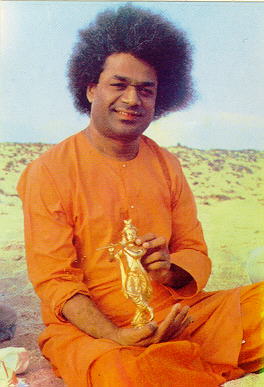 We were
unable to guess what exactly was ready, though the line must have been
for the "Thri-bhangi body," the circle the head; the small triangle,
the peacock feather and the line across, the Flute! 'It is ready,' He
said and digging His hands deep into the pile, He drew forth a bright
golden image about 15 inches high of Lord Krishna playing the
flute, the very acme of the goldsmith's art and craftsmanship. "You did
not get Darsan of Krishna in the temple; have it, now," He
invited us. It was a moment of 'supreme' ecstasy.
We were
unable to guess what exactly was ready, though the line must have been
for the "Thri-bhangi body," the circle the head; the small triangle,
the peacock feather and the line across, the Flute! 'It is ready,' He
said and digging His hands deep into the pile, He drew forth a bright
golden image about 15 inches high of Lord Krishna playing the
flute, the very acme of the goldsmith's art and craftsmanship. "You did
not get Darsan of Krishna in the temple; have it, now," He
invited us. It was a moment of 'supreme' ecstasy.
The image was
iconographically perfect; we could see a captivating smile playing
around the golden lips. We do not know how long we sat contemplating
the majestic beauty of the Krishna before us. It was Baba who
awakened us. "Come, let us go." The chauffeur of the Jamnagar Palace
was the first to rise: Baba noticed his wonder-filled eyes. He asked
him, "Which is your favorite God-form?" He replied, "Amba-Bhavani"
(Lord Shiva's consort) The divine Hand went through the circular
wave twice and a float round gold plate with the figure of Amba-Bhavani
embossed on it was ready for him.
Reaching Jamnagar at 9
a.m., Baba saw thousands still engaged in Bhajan, hoping that He would
approach them and move along the lanes they had set apart. They were
not disappointed. A few were even lucky to receive Vibhuti
created to alleviate their particular ailments.
On the 16th, Baba drove
to the Ayurvedic University, established and endowed by the
Nawanagar Royal Family, the only one in India devoted to the teaching
of that ancient science of healing. It lays great emphasis on the
hidden springs of strength in man and the vast reservoirs of well-being
which can be tapped through Yoga and mantra,
meditation and detachment.
"Ayur Veda or
the Scripture of Living." To promote research, to unravel the
intricacies of Ayurvedic texts and discover the ancient
remedies for modern illnesses, the University has a band of devoted
experts. Baba blessed each of them in his own laboratory and worktable.
He passed through the entire complex of the University, bringing cheer
with every word and look of His.
Thence, He drove to a
bungalow called Indraprastha where members of the Sathya Sai Seva Dal
were receiving advanced training in "Service as Spiritual Sadhana."
He spoke to them of faith and fidelity, obedience and surrender, love,
renunciation and service. "Remain always ready to receive the rays of the sun,
imparting illumination, health and joy." "Religion springs not from the
intellect but from the will to love."
In the evening, Baba
addressed the rotarians of Jamnagar at the town hall. He warned them
against the futility of speeches and dinners. He told them about the
fatal consequences of resorting to artificial methods of birth control.
Contraceptives will lead to mental disorders, to increased irreverence
and irresponsibility, and deterioration of the moral standards upheld
by Indian culture. "Spiritual discipline, intensification of Japa, Dhyana, Seva and Sankirtan - these can achieve the
same end, without landing the human community in the morass of
animality," Baba said.
Well! The Sea prayed
for Baba's Presence again! About 9 at night, Baba drove to Balachchdi
seashore, near the Sainik school. The staff of the Sainik school joined
the party at Bhajan. Baba sat on the soft sands by the side of
murmuring waves. In the midst of the Bhajans, Baba inquired from Dr. V.
K. Gokak the implication of the letters V and K; and when he started
telling "V for Vinayaka," Baba created out of the sand, a "silver" idol of Vinayaka
and handed it over to him.
He related the story of
the birth of Vinayaka and explained the meaning of Vinayaka,
as the great leader or as the One without a bigger leader whom he has
to follow. Then, he asked those around Him: "Ask for anything you want
from Me now." Most of us asked for Grace only, but He insisted we
should ask for some concrete article He would create. While brains were
busy formulating the needs, He created a picture of Vinayaka,
an exquisite calligraphic marvel, each line, big or small, being an Om
- the ear, the mouth, the eye, in fact, the entire picture was a
composition of a 100 OM's, drawn with skill and care, to represent Vinayaka,
the elephant-headed God. One person wanted a ring and he got it - made
of gold with Baba's portrait in enamel. Another asked for a rosary and
she got it, 108 Rudrakshi beads, encased in gold. The principal of the
Sainik school - blessed be his name - prayed for some auspicious gift
for his school! Unhesitatingly, Baba played with the sand, pouring it
through His fingers and, there was in His hand for all to see, a
beautiful five-inch 'silver' idol of Annapoorna, the Goddess of
Plenty, who confers food on all Her children. "Keep this in the dining
hall. The boys will eat with relish, and flourish amazingly," Baba
announced. "Anna, the food, which she gives. Poorna, to the full, is
not only for the Body; Anna means 'in take,' through the mouth, the
senses, the brain, the nerves. So, this Goddess will grant sustenance
for the body, the mind and the spirit, of the teachers and the taught
in your school," He blessed. Two hours of mystery, suspense and divine
delight were spent there.
The 17th was an
epoch-making day. Baba 'charged the Somanath Shrine' that day with
Divine potency. He also fulfilled the prayers of the late Jamsahed of
Nawanagar, the person primarily responsible for the renovation of that
historic temple, by visiting the place and allowing His Name to be
associated with a structure that is a limb of that complex. The
Rajamata succeeded in persuading Baba to inaugurate the imposing
architectural gem called Dig Vijaya Dwar (after Sri Digvijaya Singh,
the late Jamsaheb), the Gateway of Victory.
This temple is situated
on a spot celebrated in the Vedas and Epics. The shrine is of Shiva,
as Sauma, with Uma, as Shiva-Sakthi. Baba has come as Shiva-Sakthi
in human form to charge the ancient shrine with Divine potency. The
Shivayogis who specialized in Soma
Vidya and the followers
of the Pasupatha cult founded by sage Lakulisa about
200 AD, spread the fame of this temple from sea to sea. They
established Somanaths with Somesvara Shrines all over the land, in
Ratnagiri, E. Godavari, Purnea, Jodhpur, Mysore, and South Kanara
Districts.
Somanath was one
of the richest temples of India. When the Muslims conquered and ruled
over the Punjab and Sindh, it attracted the plunderers. Depredation,
desecration, destruction, reconstruction and rededication became
recurring chapters of its long history. The infamous raid by Mahmud of
Ghazni in 1026 AD was the third in the long list of catastrophes. The
fifth temple too met with a similar fate, at the hands of the rulers of
Delhi.
On Diwali Day,
1947, when the Indian Army entered Nawabdom of Junagadh and liberated
the pathetically dilapidated pile of stone recognized by many as
Somanath, it was rescued from those who could not appreciate the value
and validity of idols, images and symbols of the Unknown and the
Unknowable. Sardar Vallabhbhai Patel announced that day, amidst the
joyous roar of the waves of human and saline seas, "We have decided
that Somanath should be reconstructed. This is a holy task in which all
should participate."
The new temple (named
Mahameru Prasad, like the previous ones) was planned closely on the
basis of the earlier temples and now, the Gopuram, the main gateway
through which seekers would enter into the portals of Jyothirlinga, was
to be inaugurated by Someswara, come in human form: Shiva-Sakthi, come
as Sathya Sai!
Baba declared that He
would reveal, that day the genuine Somanath! This declaration filled us
with wonder and enthusiastic exuberance. So all roads converging from
Jamnagar to Somanath were shouting Jais in exhilaration. Baba was
received at the decorated Shamiana in front of the Digvijayadwar by the
trustees of the Somanath temple, as well as by the high officers of the
District and States. Amidst strains of temple music, He walked on the
red carpet laid on the steps, and opened the lock on the artistically
carved and silver-embossed door with a silver key. Then, He proceeded
along the festooned pathway, between rows of fresh banana trees, to the
main shrine of Someshwar, the focal point of the faith of millions for
millennia!
He entered the holy of
holies; Brahmin Pandits were reciting Vedic Hymns which reverberated
from the arched and conical roof, from the finial 150 feet above the
ground! He directed that a plate be brought. He spread the fingers of
His right hand and shook it over the plate, 108 silver
Bilva leaves and 108
golden flowers fell from His hand in a clinking shower. They were
reverentially touched by devotees 'for it is on their behalf and for
their sake that the process of 'charging the 3 feet high Lingam' was
being undertaken by Him. This Lingam had been recently installed, when
Babu Rajendra Prasad, President of India, inaugurated the Temple. He
poured the leaves of silver and flowers of gold on the Linga, as He had
done at Srisailam when He was set on revitalizing the Linga there. It
was like Ganga water poured into the stream of the Ganga.
Within seconds, He
waved that Divine hand! Lo and behold, a ball of brilliant light
manifested in His palm. I was at that time reciting within myself the
Dwadasa-Jyothirlinga-Stotram, the verses in praise of the twelve
"Lingas of Light" which every Hindu is exhorted to remember
reverentially. The twelve include Viswesa or Varanasi, Kedarnath in the
Himalayas, Rameswaram in the extreme south, Srisailam in Andhra
Pradesh, Mahakala at Ujjaini and Tryambaka in Nasik. But the very first
in the list is "Sowrashtra Somanatha," Somanath of Sowrashtra. The
Somanatha Linga is the only one of the twelve which is adored as
Jyothirmayam, "Imbued with the splendor of light." And, Baba had the
"Linga of Light" right now in His grasp! What a great moment was this,
I wondered.
Then I remembered
Baba's announcement: "I shall show you the genuine Somesvara Linga
today!" so, this was It, the Genuine One, installed, as legend says, by
Brahma Himself, and worshiped by the Moon-God, the God who presides
over the mind of man.
In a pamphlet issued by
the tourist department, it is said that Skanda Purana mentioned thousands of years ago that "the
Sparsa Linga of Somanath is a 'Swayam-Bhu' (self-originated)
Linga, of great prowess, as bright as the sun, of the size of an egg of
a hen, which is situated underground." It is a characteristic of Vayu,
air. These are the other Lingas representing the other four elements: Akash,
Tejas, water and earth.
So the oval ball of
light in His hand was the authentic Somesvara He had resolved to bring
up from its underground niche, kept away since many centuries from
depredation and desecration. The Sparsa (touch) Lingam was
nestling for centuries under the Linga in the Shrine. This information
was given to us by Baba, as well as by the priests and trustees. Baba
waved His hand again and created a silver stand on which it could be
placed. He gave it to the chief priest, "Let it be in the full light of day
hereafter! Let pious eyes admire its brilliance and imprint its glory
on their hearts. There is no need any more to keep it away. The avatar
has come to remove all fear,"
Baba declared.
To make the triumphant
emergence of Somesvara, Baba unfurled the flag on the towering finial
over the central shrine. Thousands acclaimed 'Jai Bhagwan' as He
gave Darsan on the temple steps. Baba left for Rajendra Bhavan
at Veeraval and at 2 p.m. He motored to Keshod aerodrome from where He
enplaned for Bombay. Over 30.000 devotees were awaiting the arrival of
Baba at Dharmakshetra, Bombay.
Dr. Gokak gave them an
intimate account of His Leelas and Mahimas, (signs of
Divinity) at Jamnagar, Dwaraka and Somanath. Baba also spoke to them of
the immanence of God in every being and the need to practice
Sadhana and Seva.
"You try to discover God,
probing and peeping into every particle of the universe. Of course, if
you have eyes to see, you can see Him there, too; for the universe is
the Body of God. You are a spark of the Divine, so are all; so is
everything!" He announced. "Before you experience the
Divine in every being, in every cell and atom, you have to experience
it as a totality of your being, that is, in your words, thoughts and
deeds," He advised. [See for
example: Srimad Bhagavatam, C2 : 1]
Baba left Bombay for
Brindavan on the 20th. While conferring His blessings on the 25th at
the Inauguration of the Bharath Engineering Workshop, He spoke of the
employer-employee bond as a loving partnership for mutual strength and
joy. On the first day of June, He visited the village of Kalkunte,
hidden away behind a belt of trees, accessible only by a tortuous
country road twelve miles long. Each hamlet on the hallowed road had
erected a Pandal, where young and old were waiting with flowers to
welcome Baba as he drove along. The villagers gathered at Kalkunte
noticed a radiance on the distant hill; as Baba's car came nearer, the
radiance around it was fringed with amber and gold.
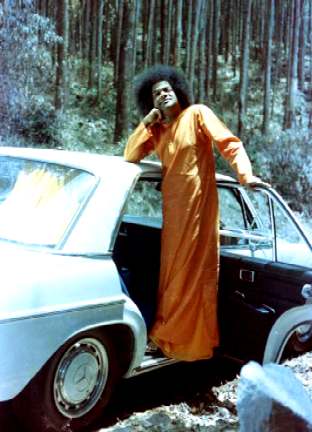 Baba alighted from the
car and was preceded by priests chanting hymns from the ancient
scriptures, followed by a band of temple musicians with pipe, drum and
cymbal, and groups of peasants singing in chorus the glory of God. He
walked about two furlongs towards the Sri Ranganatha Temple, where the
form of God installed shows the Deity reclining in ease and directing
unconcerned the Cosmic Play of Emergence, Sustenance and Mergence!
Baba alighted from the
car and was preceded by priests chanting hymns from the ancient
scriptures, followed by a band of temple musicians with pipe, drum and
cymbal, and groups of peasants singing in chorus the glory of God. He
walked about two furlongs towards the Sri Ranganatha Temple, where the
form of God installed shows the Deity reclining in ease and directing
unconcerned the Cosmic Play of Emergence, Sustenance and Mergence!
There Baba laid the
foundation stone for a building to house the village school. During His
discourse, He said, "Make yourselves moving temples. Become aware of the God
that resides in you. It is He who protects you, provides for you,
prevents you from falling prey to pernicious propensities." And referring to the school which was to
move into the new building, He said, "I have entered the field of education and
established colleges for the new era for both boys and girls in
different states, for, these are temples of Saraswathi, the Goddess of
Learning. Liberation can be achieved through the Awareness of Truth, by
learning the Unity that underlies Diversity. Now, teachers and parents,
comrades and elders tarnish the immaculate tendencies of children by
setting wrong precepts. If they grow in an atmosphere of sacrifice and
service, truth and justice, love and light, they will grow into pure,
good, brave and active citizens. Now they are a perpetual problem to
themselves and to the nation. If they are allowed to soak themselves in
godliness, they are sure to be invaluable assets to themselves and to
others."
That evening, the
Bangalore Centre of the Bharatiya Vidya Bhavan had invited Baba at its
premises and offered grateful homage, Sri R.R. Diwakar, a keen student
and interpreter of Upanishadic and Post-Upanishadic mysticism and a
Gandhian Sadhak honored by the country for his high-souled patriotism,
welcomed Baba on behalf of all those assembled there. He spoke of Baba
as the greatest and the most effective moral force in the world today.
Baba pointed out that
"It
is the responsibility of the Bharatiya Vidya Bhavan and kindred
institutions to uphold the validity Bharatiya Vidaya or Atma Vidya and
to demonstrate by precept and example, the lasting benefits it can
bestow upon the individual and society. Churn the sacred scriptures and
the text books on Yoga and other paths for self-realization and collect
the nutritious butter and share it as the sustenance of mankind which
is starving in the midst of pseudo-prosperity. Every worker at the
Bhavan must shape himself into a perfect picture of the munificence of
Bharatiya Vidya - that is to say, he must be tolerant of all faiths,
patient in the face of odds, reverent towards the old, the sacred and
the historic, and humble in spite of the insidious urge to demonstrate
and display."
On 5th June, Baba
reached
Prasanthi Nilayam.
|Previous |Next |
Bhajans
(*)
The
six passions are
those pertaining to words, the mind, anger, the tongue, the stomach and
the genitals.
The
six faults are overeating,
attachment to material things, inability to follow regulative
principles, sense gratification, useless idle talk, and impure habits.
The
six positive qualities are
enthusiasm in practicing devotional service, firm faith in devotional
processes, a strong desire to attain prema-bhakti, a favorable service
attitude, avoidance of non-devotees, and appreciation of the company of
devotees.
The
six methods of association
are to go to an assembly of devotees, to invite devotees into one's
home, to discuss and hear devotional topics, to take the
mahâ-prasada of devotees and to offer mahâ-prasada to
devotees.