The
All, In All
[SB, C1-3:3] It is imagined that the purusha, from the
excellence of His existence,
expanded into all the worlds.
Ayn Rand, Editor of the
magazine 'Objectivist', writes: "Conventional morality does not teach
or show the child what kind of man he ought to become and why. It is
only concerned with imposing a set of rules upon him - arbitrary,
bewildering, contradictory, and more often than not, incomprehensible.
The child grows up with nothing but resentment and fear, for any
concept of morality. Ethics appears to him only as a phantom scarecrow
demanding the drab performance of dry duty. The examples set by adults
are not meaningful enough to point the proper yardsticks of behavior."
No wonder the children are attracted towards Baba who bestows pure love
upon those who seek it. "The Americans come to Me since they do not know a
mother's love" said Baba one
day.
"Baba is Siva and Sakthi, Father and Mother." Velury Sivarama Sastry states thus:
"No one can understand, but everyone can benefit from Him. Science
cannot define, logic dealing with cause and effect cannot grasp. Its
pristine glory is unique. It overshadows the fleeting shadows. Only the
wise and the pure in heart can abide in it. Matter seems less material,
mind less mental, only Atma prevails.
Each one sees an aspect of its innumerable facets. Enough, if we know a
little but we never have enough. This is so near us and yet so far
away. The love that Sai manifests pales into insignificance the love of
every mother in the universe, gathered together." Sivarama Sastry is no
ordinary observer; at the age of 16, he rose to fame, as a prodigy, a
poet of dazzling merit. He was one of the few prodigies that have
blossomed. He was an outstanding scholar, critic, and teacher, versed
in the intricacies of Yoga, Tantra and Vedanta. He wrote bold and brilliant treatises on the Adhyasa
Conception of
Sankaracharya and the
Integral Yoga of Aurobindo. Universities competed with each other in
honoring themselves by including his name on the Boards of Studies in
Sanskrit. At the ripe age of 75, he came to Baba, enjoying close
contact for more than 6 years, before he dropped, like a ripe fruit
from the Tree of Life. Sastry attained renown as a writer who weighs
every word of his in the super-'selectronic' balance of Truth. So, when
he says that the Love of Baba as a Mother supersedes the love of all
mothers, he must be speaking with genuine sincerity.
Therefore, the mother
festival, or
Dasara when it is celebrated
in the immediate presence of Baba, is supremely sanctifying. During
this nine day festival of the Mother, the first three days are devoted
to worshiping the mother as Guardian, the next three days Mother is
worshiped as Provider and, during the last three days Mother is
worshiped as Teacher. Victoria Mills addressed Baba significantly.
"This is your Dream, Mother! A dream of purple flowers and blue skies;
a dream of pleasure, a dream of pain, a dream of bodies moving in the
passing hours, a dream of minds churning desires - in Thy Love, let us
live again."
Dasara [see also 'The Task'] is the occasion when the Mother as Baba, or Baba as the
Mother provides us various inducements to progress spiritually. Sanathana Dharma of course, has the entire armory required to
conquer the foes on the path, and help us march towards the final
triumph. One day is spent in celebrating the Annual Day of the
Hospital, so that the vehicle of the soul may be kept trim and
efficient, to enable it to cross the ocean of duality and merge into
the One. On another day the distressed and the destitute are given
clothes and feasted. Baba has assigned to each one of us a role to
play, designed and directed by Him, on the stage of life. On some days
the compositions of the great singers of India are sung granting to the
listeners a state of unclouded exaltation. On other days we get a
chance to witness plays based on age-old tales of gods and goddesses
full of ecstatic incidents enacted by little children, and so they can
taste innocence flowing from innocent lips. These plays are written by
Baba Himself, and so they convey to us the lessons He prescribes for
the cure of our mental ills. We are inspired to preserve, despite odds,
the moral ideals in the confusing conflicts of our lives. On the stage
and the screen away from the Nilayam, we only see crime, perversion and pollution dramatized,
whereas in the
Abode of Peace everything is
designed to elevate, sublimate and save. There are musical recitations,
and expositions of philosophical parables and mystery tales. Discourses
on Veda and Vedanta are given by pundits, who had believed that they had
comprehended what is beyond comprehension, until they met Baba! [read more about Dasara]
On the Mantap or sacrificial enclosure at one end of the
Auditorium, the adoration of Vedapurusha, [read more about Veda Purusha Jnana Yajna held in 1997] the Deity extolled in the Vedas continues for seven days
without break. The fire is adored as sacred, for it ignites and
illumines; it destroys and purifies; it burns and burnishes; it spreads
and shines. It moves fast from one victim to another. So, it is praised
and fed with hymns of praise. The Sun is the giver of life and energy;
it nips a day off from our allotted span of life, with every sunset;
so, it is worshiped by continuous prostration, repeating each time
hymns of extolment. Others can visualize God in the expansive Banyan
Tree, timeless, self-propelling through roots dropped from every
branch, providing shade and shelter for bird and beast and conferring
beauty and health to the entire region. Hymns are also uttered to the
spirit of trees.
Some of us prefer as
the symbol of God, neither Fire, nor Sun, nor the Living Laborious
Brother called Banyan Tree, but the Linga. During Dasara, a pundit can be seen on the altar at the
Auditorium shaping 1000 Lingas every day, and after worshiping them
with utmost devotion rolling the black clay back into a ball, for use
the next day! The permanent static base, pure existence, is Shiva. Its projection as dynamic energy is Sakthi. Bhagavan Ramana Maharshi used to write an
'O' at the beginning of the letter he sent to people, says Yogi
Shuddhananda Bharathi. Maharshi explained it as the Lingam, the symbol of the ultimate principle which
is beyond the triple entities of life, world and God!
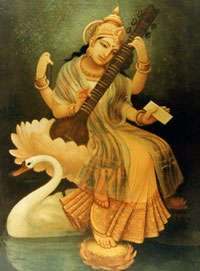 Others might be
thrilled by more elaborate representations of the might, majesty and
magnificence of God. For them Baba arranges Puja for Durga, Lakshmi and
Saraswathi with flowers, incense, camphor, sandal paste, silk and gold.
A few might be elated by the recital of the most mystic sound Om, with all its undertones and hidden
possibilities. This joy persuades us to take the first step in
spiritual endeavor (Sadhana)
facilitating our pursuit till the goal is reached. (picture: Saraswathi)
Others might be
thrilled by more elaborate representations of the might, majesty and
magnificence of God. For them Baba arranges Puja for Durga, Lakshmi and
Saraswathi with flowers, incense, camphor, sandal paste, silk and gold.
A few might be elated by the recital of the most mystic sound Om, with all its undertones and hidden
possibilities. This joy persuades us to take the first step in
spiritual endeavor (Sadhana)
facilitating our pursuit till the goal is reached. (picture: Saraswathi)
Baba Himself announced,
on the opening day of Dasara, "To celebrate Dasara at Prasanthi Nilayam is indeed a rare chance, replete with wonder
and joy, ensuring peace by the extinction of the six inner enemies."
His Mission is to put mankind again on the rails of peace and joy. So,
when the Hon'ble Minister for transport, Andhra Pradesh, announced that
he would shortly initiate steps to improve the road to Prasanthi
Nilayam and make it a tarred high way, Baba said
"The
body looks forward to a smooth drive over a tarred road, but the heart
prefers the road of tranquility and humility, so that it may reach the
goal, God, and merge in that ocean of glory. I am more interested in
that Road. I am not enthusiastic about tarring the road, for, that
would make even the little discipline of "slow and careful driving"
superfluous for people coming here! Life is not all smooth sailing. It
is full of ups and downs, sharp turns and sudden diversions. India has
always taught the first lesson in safe travel, here and hereafter:
"Start early; drive slowly; reach safely!"
Since thousands of
devotees had to sleep under the sky, piling their belongings around
their beds, the rains that poured during three nights caused a great
deal of discomfort and dislocation. Referring to these, Baba said,
"Some
people came running to Me saying, 'Swami! Stop the rains!' Well,
getting a little wet is a trivial bother, when compared to the benefits
of timely rains. The Vedapurusha Yajna is celebrated to persuade the
Gods to shower rain, that is its raison d'Ítre as the Vedas
assert. While the rite is on, the rains have come: it demonstrates that
the Pundits did the Yajna on strict Vedic lines. The rains will ensure
a good harvest and prosperity for the countryside."
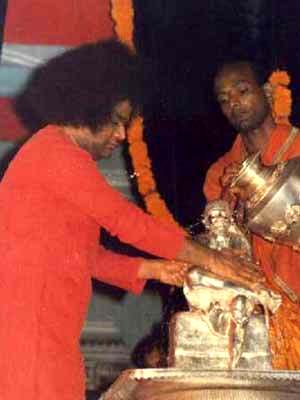 On the 20th
of October, 1969, the valedictory Rite of the Yajna was performed. Baba created a nine-gemmed
necklace for the chief priest who officiated; he was a scholar in Vedanta and Vedic grammar. During the Abhisheka or ritual bath of the image of the previous incarnation,
the Sai Baba
of Shirdi, Baba created a
sparkling eight-starred jewel of gold and placed it on the forehead of
the silver idol; it stuck! Dr. S. Bhagavantham and Mr. Tideman
Johanessen who were among the audience wondered at this: How could gold
stick on silver, without adhesive? Baba knew their thoughts. He told
them a few hours later, without their asking Him or anyone telling
Him,
On the 20th
of October, 1969, the valedictory Rite of the Yajna was performed. Baba created a nine-gemmed
necklace for the chief priest who officiated; he was a scholar in Vedanta and Vedic grammar. During the Abhisheka or ritual bath of the image of the previous incarnation,
the Sai Baba
of Shirdi, Baba created a
sparkling eight-starred jewel of gold and placed it on the forehead of
the silver idol; it stuck! Dr. S. Bhagavantham and Mr. Tideman
Johanessen who were among the audience wondered at this: How could gold
stick on silver, without adhesive? Baba knew their thoughts. He told
them a few hours later, without their asking Him or anyone telling
Him,
"If
I can create the jewel, can I not make it stick, too? When you doubt
one incident, you start doubting all. Accept Me for what I am. Then, no
doubt can interfere with your faith."
"You
complain that God is hardhearted; that He does not respond to prayer,
or give signs from His portraits, or speak from 'nowhere' to assuage or
assure; but let Me tell you, God is Love, Love is God. When there is no
response you have to infer that the cry from your heart is insincere,
it is mere play-acting. It is set to a pattern, addressed to someone
alien to you, someone accepted by you as a far away tyrant or a
taskmaster. Know that God is your nearest and dearest kin."
On the 21st, when Baba
was on the floral Jhoola, a number of poets recited the poems that He
'painted' in their hearts - Deepala Pichayya Sastry, Begum Tahira
Sayeed, the writer, Vidwan Rama Sarma, Vidwan Seshama Raju, and others.
They were in a multitude of languages, English, Urdu, Kannada,
Sanskrit. Baba advised them to see the handiwork of God, the greatest
Poet of all, in every grain of dust, every twinkle of light, every drop
of rain, every whiff of air.
"Great
poems deal with the eternal thirst of man for God; they are rich in the
ambrosia that quenches that thirst. They satisfy and build up strength
to laugh at life's fortunes. Without spiritual Sadhana, the expansion
of the consciousness, the broadening of sympathy, the sharpening of
vision, the deepening of contacts with the springs of wisdom within
oneself and within others, poetry is but a purposeless, pallid pastime."
The 7th of November
will be remembered as a landmark in the history of the Women's College
at Anantapur for on that day amidst colorful scenes of grace and glory
the Vice-president of India laid the foundation for a magnificent
building. Dr. S. Bhagavantham welcomed the Vice-president Sri G. S.
Pathak, as well as the Governor of Andhra Pradesh Sri Khandubhai Desai
who laid the Foundation Stone for the college hostel, and said, "I have
considerable experience in raising colleges, all over the country; I am
wonder struck when I consider how within a year and a half, this
college has gone ahead, with 300 students and the full complement of a
library, laboratories, ancillaries and a gas plant too!" Baba says that
no task on which He sets his Heart can fail. His will is supreme.
Dr. V.K. Gokak said, "At a time when disorder
has become the order of the day, this college will transmit, under the
guidance of the Master, the lesson of Order." The Vice-chancellor of the Venkateswara
University said, "The Sathya Sri Trust managing this college has a
symbol which reveals the core of Indian culture, the kinship and
closeness of manifold philosophies, religions and ideologies formed by
the aspiring mind of man." Sri Khandubhai Desai also appreciated
the symbol, as a sign of genuine secularism, "Secularism does not
mean irreligion; it means real religion. And real religion recognizes
all faiths as facets of the Truth."
The Vice-president said
that the Day was a Day of Devotion and Delight for him. "I am happy to
find that the Trust has taken note of the need of the nation. The next
generation has to be shaped straight and strong, so that it efficiently
bears the burden of this vast country. We want disciplined, enlightened
people to assume national and international responsibilities." Baba
spoke of His Resolve to establish such Colleges in every State of
India, "My Sankalpa, plan of action, is to provide youth with
education, which, while cultivating the intelligence, will purify the
impulses and emotions, and equip them with the physical and mental
disciplines which can awaken the springs of calmness and joy in their
hearts. Their higher nature has to be fostered and encouraged to
blossom by means of study, prayer, Sadhana, contacts with sages, saints
and spiritual heroes and heroines of their land; they have to be led
on, to the path of self-confidence, self-satisfaction, self-sacrifice
and self-knowledge." Baba blessed the College with these words, "May
this College educate generations of noble mothers who will live Dharma,
raise heroes surcharged with dedication to God and Devotion to Truth."
November 23 is the
Birthday of Baba. But, as Baba told Penn in one of His transoceanic
lessons, "It
is not My Birthday that you celebrate. It is your own." And again,
"My
mission is to raise the consciousness of man to a level at which he
neither rejoices nor mourns over anything. In that supreme state, one
is going through rebirth and re-death each moment, for these acts are
one and the same, emerging from the formless into form, merging from
the form into the formless. Then, there is no success or adversity, no
joy or pain. When the devotee attains this Oneness, his journey towards
Me ceases for he will be with Me endlessly."
The 1969 Birthday was
marked by another event, namely, the 3rd All-India conference of the
office bearers of the units of the Sri Sathya Sai Seva Organizations.
The delegates were happy that the conference was to be at the Nilayam,
in the very center of Prasanthi (Higher Peace) and the Host was no less
a Person than Bhagavan Himself. At Madras during the first conference
Baba had allowed the delegates to share His gracious presence during
most hours of the day. At Bombay, during the World Conference, Baba
moved around the hostels where the delegates were accommodated and was
present at the dining halls on most of the days. Besides Baba had
invited them to
Dharmakshetra and He took
groups of them round the building explaining to them the significance
of the numbers of steps, pillars, concrete wind-cups, etc., to the
happy edification of the uninitiated. The number was nine, multiples of
nine, adding up to nine, as was necessary in a building that symbolized
Sathya - Truth, or Brahman - the ultimate Truth, whose numerical symbol is 9. Now, the
third conference was being held in the lap of Prasanthi Nilayam, under the loving and watchful eye of Baba
Himself.
The conference began on
20th November, with more than 2.000 delegates from all the states of
India, and also representatives from Ceylon, Australia, Fiji, America,
Europe, and Africa. The presidents of the organizations of each state
gave short summaries of the various lines of activity in their area. It
was a heartening and instructive recital, for each state could
contribute some fruitful ideas of service and Sadhana to the rest.
Baba explained that the
Sai Organization is unique in more respects than one. It does not seek
donations and patrons. It works under a Master who is present
everywhere at all times, and so the Organization is only a name for a
group of people who carry on work that would win His grace, in a spirit
of worship. There is no scope here for malingering or personal rivalry
or the virus of vanity or envy. Baba said, "These are associations of
aspirants. Pay attention to your duties and responsibilities; do not
infect yourselves with caste affiliations, or personal prejudices or
political predilections. I can see you through and through, wherever
you are! Do not carry your head high and taunt people. Stoop, so that
you can lift the burden on to your shoulders; serve, so that you may be
an example and an inspiration. Follow, so that you can lead seekers
into the heart of God. Be humble, be cordial, with all. Devotion should
not be publicized. It does not end with the acquisition of a badge
which decorates that shirt. It is a secret gain, a precious boon."
While the Conference
was considering the recommendations of the four subcommittees which
dealt with Organizational matters, Spiritual activities, Publication of
Sai Literature, Mahilavibhag (Women's section) and service activities,
Baba counseled that devotees should not seek concession and exemptions
from participation in the activities set out by the Samithis, but, on
the contrary, look forward to the chance provided by the Sai
Organizations for Sathsang. It was resolved that members must attend at
least sixty percent of such meetings. It was also emphasized that there
must be unanimity in the choice of Office Bearers. The Office Bearers
should behave as Torch Bearers, reflecting in their behavior the light
of His Wisdom. "The Sai Organizations should try to reduce and remove
the hurdles and handicaps in the way of spiritual progress, its members
should be ennobled by tolerance, truth speaking and compassion, and
saturated with love for all. Whoever neglects his parents and allows
them to languish in poverty or sorrow does not deserve to be a member.
Carry the message of self-realization through the Sadhana of service,
among the women, the youth and the children. Encourage the formation of
active groups of women, who will take up the teaching of children,
develop Seva Dals."
Addressing the
Valedictory Session of the Conference on the 22nd of November, Baba
said,
"Let
Me end on this note: Do not doubt your destiny: it is to merge in the
Highest Wisdom, Power and Love. Do not waver or stay away. At every
step, inquire, discriminate, search for Truth. Be self-reliant, bold
and free. Know that you are the instruments of God in a Divine Task and
so there is no justification for weakness or vacillation. Be an example
to others in humility and devotion. Do not scatter advice, without the
authority of practical experience. Love, co-operate, serve. Your Office
is a call for spiritual exercise, a reminder of your being under My
care and direction."
The Conference was a
baptism of faith for the participants; it revealed to them the Divine
Love of which Baba is the embodiment. He was the Person on whom all
eyes rested, all ears were focused, all minds dwelt and all hearts
poured adoration. He sat among the members of the subcommittees during
their deliberations and shed light and laughter on suggestions
pompously placed and assiduously argued upon. He moved among the
delegates, scattering Grace; He met the representatives, State-wise,
for hours at a stretch, and amidst roars of laughter, and brilliant
banter, He smoothened rivalry, suppressed factionalism, softened
fanaticism, and sweetened bitterness. In spite of being concerned with
every detail of diet, agenda, seating, and discussion, He was the very
picture of freshness and light. To see Him was to learn the lesson of
selfless activity, to hear Him was to yearn for Grace and for the
chance to share His Task: to touch His Feet was to change oneself with
strength and courage to face the world and its challenges.
The delegates stayed on
for the birthday celebration on 23rd and 24th November. "The Day I am born in you
as Love, that Day is My Birthday for you." Baba announced on the 23rd. He reminded the
15.000 people who sat before the Nilayam to witness the hoisting of the
Flag, that "Here
is the Siva Sakthi, born in human form to lead mankind towards Him." When Baba declared that each individual is a
flower in the garden of God, drawing strength from the earth and beauty
from the sun, one was reminded of the poem sung by Sri Das Ganu Maharaj
while expounding the life and teachings of the 'previous body' of Baba:
"The
Bakul, Lotus, Chamelee, Dawan, Marwa, Panch - such a variety of
flowering plants bloom together in a garden and make it grand. All
flowers spring from the earth and return to the earth from which they
sprang, and after they re-enter, there is no more distinction!"
"Religion
is a perpetual encounter of the individual with the Universal, a
persistent invitation which insists on acceptance," said Baba. Those who have tasted the
sweetness of that Invitation from Baba know that He is the Lord who as
He Himself sang in the introductory verse of His birthday discourse, "commands the sun to
illumine, the stars to lend brilliance to the sky, the wind to blow and
bolster life, the rivers to meander murmuringly on, the fire to reduce
everything to irreducible ash, and the million species of living things
to populate the earth and sea, proclaiming the might and majesty of the
Lord." We have heard of gifts
being given to a person on his birthday, but, to the Lord who is amidst
us, what can we give? Therefore, Baba gives gifts to us, on the 23rd
November. We sit in long lines all over the grounds of Prasanthi
Nilayam, and he gives each one a packet of sweets, with a loving word
or a charming smile as a keepsake forever.
During these festivals,
after every discourse He sings a few Bhajan songs, with which He
activates devotion and faith among the thousands. His songs are genuine
Muraligana, that is to say, replicas of the magic music
which flowed from the Flute of Krishna on the banks of the Yamuna. The water of the Yamuna forgot to flow and halted in
ecstasy, when the Flute conveyed the breath of the Lord to them. It is
in the nature of water to flow! So, the Chithravathi at Prasanthi Nilayam has freed itself of water so that it
can listen to Baba's voice, without the bother of halting and holding
still! [MP3 - Listen to 'Murali Ghana
Lola' - Text]
A devotee writes, "In
the blissful joy of listening to His melodious voice extolling the
glory and majesty of divinity one forgets all the cares and
distractions of living; one is released from the prison of time and
space."
On 31st December, 1969,
Baba was in the midst of delegates from all the Units of the Sathya Sai
Seva Organizations in Mysore, and called them lovingly as instruments
of His Divine Mission of Dharmasthapana.
While the Presidents from each district were presenting their reports,
Baba was standing at the farther end of the Shamiana, instead of
sitting on the chair placed for Him on the Dais. In explanation He said,
"My
place is among you, with you and wherever work lies! Do not believe
that I am on a special seat, apart, distant on a pedestal. I am part of
you, partner and partaker, inspiring, instructing, when you ask Me or
need Me for inspiration and instruction." "Do not exude pride," He
advised the workers. "Spiritual pride is the most poisonous variety of
pride: it is the highest of hypocrisy. Fear too is spiritual poison,
for, when you have in your heart the Person who declares that you need
not fear, why should you fear? If you do, your lips belie your heart.
An uneasy conscience is a torment."
"If
there is righteousness in the heart, there will be beauty in the
character,"
"If there is beauty in character, there will be harmony in the home;
when there is harmony in the home, there will be order in the nation;
when there is order in the nation, there will be peace in the world... "
said Baba.
"So,
be righteous in speech, thought, and action. Avoid all prejudices on
the basis of caste, creed, color, status or degree of scholarship or
affluence." That was the directive with which the delegates returned to
their place of work."
Within a few days, Baba
inaugurated a Mahila Sathsang, under the auspices of the Organization,
and the advice He then vouchsafed to the women workers has far reaching
implications. Baba has come to clarify Dharma, mark out the bounds of behavior, prescribe laws and limits
of conduct, so that vagaries may be controlled and sublimated. He said,
"Let the Sathsang start with your homes! Let your homes be happy,
harmonious, with no friction or faction or frills, fanfare or
fanaticism. Let the different generations, living in the home with
varying levels of intelligence, experience growth and attainments,
earnings, tastes, or prejudices, learn to live together in mutual
cooperation, tolerance and loving kindness. Each one of you must do
your part in ensuring that your home has the fragrance of a Sathsang, charged with the Sai atmosphere. Learn to
put up with different opinions, different temperaments. Develop the
desire to understand others, be sympathetic towards them, be happy when
others are happy, be compassionate when others are sorrowing. Engage
yourselves in Seva - go into the slums, the hospitals and the
jails, the remand homes where delinquent children are housed. Seva is
better than even Dhyana as a Sadhana. 'Dill me Ram, hath me kam,' Perform your duty, with God installed in your heart."
Mahashivarathri, 1970!
A flood of devotees flowed into Prasanthi Nilayam. There was tremendous rush, but, absolute
silence. Baba told the young men and women of the Seva Dals, selected
by the Sathya Sai Seva Samithis from the different States of India,
"You
yearn to do some Seva in My Name, don't you? Well I have a thousand
heads, eyes and feet! The Vedas proclaim that God is 'Sahasra Seershaa
Purushah,' 'He has a thousand heads!' The thousands who have come here,
the aged, the children, the diseased, the afflicted - they are all Me.
Serve them, you serve Me!"
Baba hoisted the flag
on the Nilayam, and said that loyalty to higher truths has to be built
up from childhood, even through the lessons learnt while in the
mother's lap. At noon the creation of the huge stream of Vibhuti caused wonder and amazement, even to those
who know that it was part of the Sivarathri Festival. In the evening, Sri Nakul Sen, I.C.S., Lt.
Governor of Goa, Dr. Gokak, and Dr. D. Venkatavadhanlu, Professor of
Telugu, Osmania University, addressed the gathering.
Baba's compassion led
Him to begin His discourse with a Sanskrit verse, meaning,
"I
am not a human being nor a god or a superman. I am neither a Brahmin,
nor a Ksatriya, nor a Vaisya nor a Sudra! Then you may ask Me who I am.
Well, I am the Teacher of Truth; I am Truth, Goodness, and Beauty!"
During the discourse
the Linga that was growing in the stomach of Baba
since about a week announced itself as ready to emerge, and so Baba sat
on the chair. The huge gathering sensed the cosmic undertones of the
movement and sang with eager excitement a song in praise of Shiva, the God represented by the Linga, for whom Sivarathri was dedicated.
Fifteen minutes later,
a heavy oval Linga of a
substance akin to an opal came up and out; the enormous gathering
shouted Jai in adoration and uncontrollable bliss, when Baba held it in
His hand for all to see. Throughout the night, the Bhajan continued,
the divine offspring was placed in full view of all, so that it may
inspire them in their vigil and fast. [See also 'The Call' & 'Cities
Aflame' concerning Lingams]
The next day when the
Bhajan ended, Baba Himself gave consecrated food to the devotees. He
spoke of the Geeta and its Message. He said that the song celestial
recommended action, Karma, first;
then, in subsequent chapters, it wanted that the Karma must become untainted by any desire for
fruits. Later, it recommended righteousness, Dharma; a few chapters later, it advised that Dharma has to be given up, so that liberation, Moksha, can be attained. Finally it recommends that
the Moksha desire has to be given up, for even that is
bound. It declares that one is free, all the time, even when he
imagined he was bound. "Awake from ignorance; you know that your bondage was
unreal; it was a dream, which was denied when you woke. You are always
free, liberated. You are always the Atma that can never change or
suffer." [See also: Bhagavan on the Bhagavad Gita & Gita Vahini]
Baba left for Brindavan
after a few days, so that He could expedite from there the construction
of the college He had planned.
|Previous |Next |
Bhajans



