His
Writings
Introduction - The
Avatar's Pen
Baba speaks of Himself
as the
mother yearning to feed an unruly child who, in its
ignorance, refuses
to eat what will cure its hunger. The child has to
be coddled and
coaxed, wheeled and petted, even caught unaware
sometimes by means of a
story or a song, to induce it to accept the food it
needs. Baba's
immeasurable Love, persuades Him to pack a medicinal
dose in a sweet
smile, a panacea in a palatable parable or a
profound thought in a
syrupy joke. Let us dip into the books Baba has
given mankind in order
to draw it to the feast that He has prepared for its
hunger. His books
are an invitation to His presence, fresh and
fascinating as they are.
Baba writes in simple
and
elegant, colloquial Telugu or English prose. The
message is always
extempore, His ideas receiving expression as
mellifluous poems and
songs, showering exquisite delight. Poetry and
melody shine through
each sentence and behind each phrase and clause lays
a form that is
apparently human, but is suffused with Divine
Wisdom.
All the immortal
pieces
flowed from Baba's pen as articles for the Âs'ram
magazine 'Sanathana
Sarathi ' (The Eternal Charioteer)
during its early years.
Prof. Narayana
Kasturi,
the first editor of Sanathana Sarathi, who
used to collect material from Bhagavân every month
for the
magazine, narrates the following remarkable
experience regarding
Bhagavân's omniscience and the innate simplicity
with which
Bhagavân wrote the Vahinis.
Grandeur of the
Omniscient
Teacher
Narayana Kasturi
writes -
"Baba decided on a small book on the Upanishads,
the Upanishad
Vahini, in order to rivet the world to the
efficacy of Vedanta.
As editor of the magazine, which published serially
the chapters of
this book, I had an amazing experience, every month.
After dispatching
the magazine on the 16th of every month, I would go
to Him for the next
part of the series. Announcing the name of the
Upanishad Himself, He
would ask me to wait for a while in His room and
proceed along the
verandah with a notebook and pen, towards the room
where there stood a
table with a chair by its side and nothing else
besides.
Once, it was the turn
of the Brihadaranyaka
Upanishad, to be
summarized and simplified. It is the biggest and the
profoundest of the
ten. I am certain that Baba had never read it or
consulted others who
could talk on it. And there was no copy available
anywhere within
miles. But forty minutes after he moved out with a
pen and the notebook
as His sole possessions, I could descend the
eighteen steps from His
room with a ten-page dissertation on the truths this
Upanishad
enshrined! I peeped into the script as I walked
towards the Press and
my eyes fell on the Telugu words, which said, 'the
grandeur of the
intellect of Sage Yajñavalkya is impressively
evident in this
Upanishad'. I told myself, the grandeur of the
Omniscient teacher
that Baba is, is now impressively evident to me."
The Vahinis
It was Narayana
Kasturi
who collated all the articles that Baba had written
for the 'Sanathana
Sarathi', the Âs'ram Periodical, and brought
out in a book
form as the "Vahini Series" as Baba used to
title all His
articles as Vahinis. Vahini meaning flow
or stream.
There are 15 Vahinis
in all,
written in Telugu by Baba and translated into
English by Prof. Kasturi
(see also: 'Pathway
to Peace'
by Kasturi). The Vahinis like 'Prema
Vahini' and 'Dhyana Vahini' are little
gems, classics of the
spiritual life from the moment that Baba wrote them.
Their simplicity,
which, at the same time, contains such a depth of
meaning, is unique.
They speak of Peace, Meditation, Love and Wisdom.
They seek to acquaint
the reader with the Upanishads and the Bhagavad Gîtâ
(Geeta). In a class by itself stands 'Sandeha
Nivarini', the
doubt dispeller. It raises various metaphysical
problems and answers
them.
Prema
Vahini - The Stream of
Divine Love
Dhyana
Vahini - The Practice of
Meditation
Dharma
Vahini - The Path of
Virtue and Morality
Jnana
Vahini - The
Stream of Eternal Wisdom
Geeta
Vahini - The Divine Gospel
Prashanthi
Vahini - The Supreme
Bliss of the Divine
Sathya
Sai Vahini -
Spiritual Message of Sri Sathya Sai
Prasnothara
Vahini - Answers
to Spiritual Questions
Sandeha
Nivarini - Clearance of
Spiritual Doubts
Leela
Kaivalya Vahini - The
Cosmic Play of God
Sutra
Vahini -
Analytical Aphorism on Supreme Reality
Vidya
Vahini - Flow of
Spiritual Education
Upanishad
Vahini - Essence of Vedic
Knowledge
Bhagavatha
Vahini - The story of the
Glory of the Lord
Ramakatha
Rasa Vahini, Part - I -
The Sweet Story of Râma's Glory
Ramakatha
Rasa Vahini, Part - II -
The Sweet Story of Râma's Glory
Prema Vahini - The Stream of Divine
Love
Download
the updated epub,
pdf & mobi version of Prema Vahini
 Baba has said that if He were to be
identified by one
characteristic more than any other, He could most
aptly be called
'Prema Swaroopa', the Embodiment of Love. The very
first Vahini
(stream) that flowed forth from his pen to fertilize
the mind of man
was the book, 'Prema Vahini'. Nârada, the great
exponent of love
as a spiritual discipline, defines the path of love
as equivalent to
supreme devotion. The love is described as supreme,
because it is full
and free, with no conditions, no trace of
bargaining, no taint of fear.
Once such love is practiced and experienced all
distinctions drop,
duality ceases and only the truth remains.
Baba has said that if He were to be
identified by one
characteristic more than any other, He could most
aptly be called
'Prema Swaroopa', the Embodiment of Love. The very
first Vahini
(stream) that flowed forth from his pen to fertilize
the mind of man
was the book, 'Prema Vahini'. Nârada, the great
exponent of love
as a spiritual discipline, defines the path of love
as equivalent to
supreme devotion. The love is described as supreme,
because it is full
and free, with no conditions, no trace of
bargaining, no taint of fear.
Once such love is practiced and experienced all
distinctions drop,
duality ceases and only the truth remains.
Baba quotes the love
of the
simple milkmaids and cowherds of Vrindâvana towards
Krishna as
the best example of this parama prema
(supreme love). Krishna
Himself appreciated it thus: 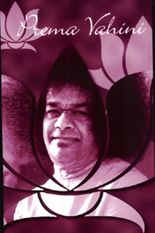 "they long for Me so deeply, their
thoughts, words and deeds
are so imbued with Me, that they have no sense of
time or space, no
consciousness of their bodies and their needs. They
are so absorbed in
Me that they are like rivers that have merged in the
ocean and lost
their individual names and distinctions".
"they long for Me so deeply, their
thoughts, words and deeds
are so imbued with Me, that they have no sense of
time or space, no
consciousness of their bodies and their needs. They
are so absorbed in
Me that they are like rivers that have merged in the
ocean and lost
their individual names and distinctions".
Baba says in Prema
Vahini:
"Only through love can faith become steady; only
through faith can
knowledge be gained; only through knowledge can parabhakti
(complete devotion, self surrender) be ensured and
only through parabhakti
can the Lord be realised."
Dhyana Vahini - The
Practice of Meditation
Download
the updated epub, pdf & mobi
version of Dhyana Vahini
 Today quacks with
new-fangled ideas lay down rules for
dhyana (meditation), says Baba. Each one has his own
special
prescription and claims that his system can confer
more benefit than
that of others. But none have themselves experienced
its sweetness of
sanctity. That is the real reason why dhyana
has drawn out upon
itself the cynical laughter of many. My intention is
to instruct such
people and guide them on the right path.
Today quacks with
new-fangled ideas lay down rules for
dhyana (meditation), says Baba. Each one has his own
special
prescription and claims that his system can confer
more benefit than
that of others. But none have themselves experienced
its sweetness of
sanctity. That is the real reason why dhyana
has drawn out upon
itself the cynical laughter of many. My intention is
to instruct such
people and guide them on the right path.
Baba goes on to reveal
in
these words the origin of His book, 'Dhyana
Vahini'. Even the
most potent drug will not cure when it is only
extolled in elaborate
phrases at the bedside of the patient. The drug must
be taken in and
allowed to walk its way into the blood stream. Your
reading what I
write on dhyana will not make it easier. The
mind is a mad
pleasure seeker, running after mirages seen through
the inefficient and
therefore, deceptive senses of perception. The
multifarious desires
that infect the mind have to be quelled and the mind
focused on ânanda
(bliss) only. Of course, it will itself turn to God.
When knowledge is
accepted as the master, when the mind is denied the
food that breeds
depravity, when the senses are tamed by firmness and
faith, dhyana
will surely lead you to that goal.
Baba distinguishes
between
concentration, contemplation and meditation.
Concentration is an
unwavering determination in one's daily life, in the
realm of the
senses, the feelings and the intellect.
Contemplation is achieved when
the senses withdraw for some time and attachment to
the objective world
slackens, when you have completely broken away from
all attachment, you
enter a state of meditation, says Baba.
Baba gives the
guidelines for
meditation and mind control in Dhyana Vahini.
He says that Dhyana
is as life sustaining as dhanya (food). Baba
explains the
choice of place, posture, time-table and the
curriculum, but lays
greater stress on the compassion of the Lord who
responds to the prayer
embodied during Dhyana.
Since God assumes, for
the
sake of the sâdhaka, the name and form that
he meditates
on, Baba assures us that dhyana need never
be a barter
endeavor; the summit can be reached by perseverance,
for He rises up to
Himself the struggling and the exhausted.
Baba warns us against
nine
enemies that waylay the earnest sâdhaka. Three
of them
are physical: adulterous urges, greed to possess
things or gain
exclusive love and the tendency to injure l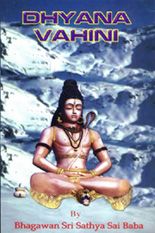 iving beings; three are
verbal: delight in causing
panic by false alarm, speaking lies and spreading
scandal; and three
are mental: craving for what belongs to
others, envy and cynicism.
iving beings; three are
verbal: delight in causing
panic by false alarm, speaking lies and spreading
scandal; and three
are mental: craving for what belongs to
others, envy and cynicism.
Baba directs that the
meditation on the form be accompanied by an unbroken
absorption of the
sweetness of the name by which that form is
identified. When the form
slips from attention, the name will soon bring it
back; when the name
drops from awareness, the form will restore it to
the mind. Thus, the
constant presence of God in the consciousness is
ensured, says Baba.
Dharma Vahini -
The Path of Virtue and Morality
Download
the updated epub, pdf & mobi
version of Dharma Vahini
 Baba says, dharma (right
conduct) is like the river
Sarasvatî, flowing unseen beneath the deeper levels
of human
consciousness, feeding the roots of activity,
filling the springs of
thought, cleansing the slushy eddies of feeling.
When the river runs
dry or is clogged by greed and hate, the avatar
comes to let in a
torrent of grace and restore its fresh, free flow.
Baba says, dharma (right
conduct) is like the river
Sarasvatî, flowing unseen beneath the deeper levels
of human
consciousness, feeding the roots of activity,
filling the springs of
thought, cleansing the slushy eddies of feeling.
When the river runs
dry or is clogged by greed and hate, the avatar
comes to let in a
torrent of grace and restore its fresh, free flow.
Baba in Dharma
Vahini
has installed dharma on an unshakable
foundation as the unity
of all life, indeed, of creation: Whoever conquers
the ego and
overcomes the natural tendency to regard the body
and its furniture as
his true self, is surely on the path of Dharma,
for he would
soon discover the truth behind all the scintillating
multiplicity. He
would realise that the objective world is like a
gem-studded wheel,
over Brahman, which is the one and only
truth. Sarvam
Khalvidam Brahman (All is verily Brahman,
God).
When man is aware of
this
truth, there will be no other; all will be you.
Since you love yourself
most, your love will flow in full measure towards
all and encompass the
living and the non-living. Dharma has to be built on
the deep
understanding of the depths of Being. Build your
life, says Baba, on
the atmic plinth, the faith that you are a wave upon
the ocean of
bliss, a spark of the cosmic intelligence.
Then He asks, when you
worship an idol, what is it that you really do?
First, a form of 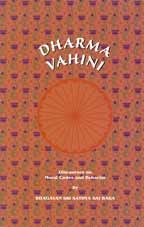 God is imprinted on your mind, after
that,
you meditate on His power, grace and omnipresence
and project these
qualities upon the idol, thus enabling your
consciousness to transcend
it and become
unaware of the
lithic substance before you.
God is imprinted on your mind, after
that,
you meditate on His power, grace and omnipresence
and project these
qualities upon the idol, thus enabling your
consciousness to transcend
it and become
unaware of the
lithic substance before you.
In the same manner,
imprint
on your consciousness that form of God which
delights you most and fills you with illumination and
project
that form on every man, beast, bird and insect, on
every tree and
plant, on every rock and hill; this sâdhana
(spiritual
practise) will make you true, good and beautiful.
This is the
fundamental norm: Atmic awareness - the unceasing
remembrance of the
One appearing to be many.
Jnana Vahini - The
Stream of Eternal Wisdom
Download
the updated epub, pdf & mobi
version of Jnana Vahini
 Whenever the gross and even
the subtle are transcended, when
the intelligence is clarified, when the self is free
from feelings,
impulses and instincts, what remains in the
consciousness is the true
self only. The person, then, is one with Eternal
Truth, the One beyond
everything. He becomes Brahman or Paramatman
says Baba.
This awareness is the acme of Ânanda (or
bliss).
Whenever the gross and even
the subtle are transcended, when
the intelligence is clarified, when the self is free
from feelings,
impulses and instincts, what remains in the
consciousness is the true
self only. The person, then, is one with Eternal
Truth, the One beyond
everything. He becomes Brahman or Paramatman
says Baba.
This awareness is the acme of Ânanda (or
bliss).
In the Taittriya
Upanishad
it is declared that, from ânanda all this is
born and
throu gh ânanda all this lives, in
ânanda
all this is merged, and in ânanda all this
rests. The
greater the awareness of Paramatman (supreme
divinity), the
more the ânanda.
gh ânanda all this lives, in
ânanda
all this is merged, and in ânanda all this
rests. The
greater the awareness of Paramatman (supreme
divinity), the
more the ânanda.
Baba summarises the
Truth in
one sentence. Awareness is Life and then goes on to
reveal that all men
are divine like Myself: the only difference is that
they are yet
unaware of their divinity. They have come into this
karmic prison
through the karmas of many lives. I have taken to
this mortal form out
of My own free will. They are bound to the body,
while I am free of
this bondage.
Gita Vahini - The
Divine Gospel
Download
the updated epub, pdf & mobi
version of Gita Vahini
 Baba's Geeta Vahini is the holy Bhagavad
Gîtâ
retold in order to save modern man from the
myopia of egoistic materialism. It is not a resume
or a commentary or
an abridgement. It is the voice of Krishna Himself,
ringing over the
clash of hate and greed and calling us into more
worthwhile victories.
He has declared that He has come to unify and
clarify, fructify and
fortify the holy aspirations of man. The doubts and
delusions, which
torment us while we are engaged in the battle with
our outer and inner
kith and kin, are treated here with love and
sympathy by Sai Krishna,
who also provides us with the answers.
Baba's Geeta Vahini is the holy Bhagavad
Gîtâ
retold in order to save modern man from the
myopia of egoistic materialism. It is not a resume
or a commentary or
an abridgement. It is the voice of Krishna Himself,
ringing over the
clash of hate and greed and calling us into more
worthwhile victories.
He has declared that He has come to unify and
clarify, fructify and
fortify the holy aspirations of man. The doubts and
delusions, which
torment us while we are engaged in the battle with
our outer and inner
kith and kin, are treated here with love and
sympathy by Sai Krishna,
who also provides us with the answers.
We are encouraged in
Geeta
Vahini to offer Baba the prayer he puts into the
heart of Arjuna
(in the great epic Mahâbhârata- 'The Great War'
)
&endash; 'as You are guiding this chariot, guide
me also and show
me the way' - for, He is in fact the charioteer
installed in everybody.
The Geeta, as expounded by Baba, is a textbook of
Yoga and a
guide for spiritual practise. It is a yoga
s'âstra and brahma
vidya (Knowledge of the Self) rolled into one.
Through smile and
story, sneer and laughter, banter and reprimand,
question and
counter-question, Baba pours into us the nectar of
wisdom in this
beautiful volume.
At Kurukshetra
(the
battleground in Mahâbhârata), Krishna said
that the
mind and its vagaries could be tamed by abhyasa
(discipline)
and vairagya (detachment). In Geeta
Vahini, Sai Krishna
adds vichara (discriminative reasoning).
Baba also analyses the
concept of kshetra (place), yajña
(sacrifice), yoga
and mâyâ (illusion) and sheds light on many
corners, which the lamps of ancient masters did not
illumine. The ideal
of nishkama karma, (selfless action), gets a
glow of heroism
when He interprets it as a conscious refusal of the
fruits of activity,
a courageous turning away from both triumph and
failure.
There are many
passages on
'Geeta Vahini' of self-revelation by Baba, where it
becomes difficult
to determine who is speaking to us so intimately Krishna
or Sai?
How can I ever forget Him who never forgets Me? is
the question, Baba
asks. Forgetting is a human frailty. Let me tell
you, there is no need
for yoga, tapas (penance) or even jñâna
(wisdom).
I only ask you to fix your mind on me, dedicate it
to me. That is all I
demand and all that you need to do, says Baba.
This is the promise of
grace,
which all devotees can hope to receive. Grace
revives us when we are in
great pain and restlessness. It revives us when we
totter through the
great alleys of our meaningless and empty lives. It
revives us when our
disgust for our own being, our own indifference, our
weakness, our
hostility and our total lack of direction and
composur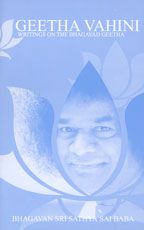 e has become intolerable.
It revives us when
year after
year, the longed-for perfection does not appear,
when the stale compulsions reign within us as they
have done
for decades, and when despair destroys all joy and
courage. Sometimes,
at that moment, a wave of light breaks into our
darkness, saying, You
are accepted.
Geeta Vahini
also
condemns fanatic, blinkered gurus and pompous
exponents of the Geeta
whose oratory sounds hollow because they do not
themselves practice
what the Geeta preaches.
(See also: Bhagavad
Gîtâ, the Divine Song; The original Sanskrit
verses and (word
for word translated) of the Mahâbhârata, with
comments
taken from the writings of Bhagavân S'rî Sathya Sai
Baba).
Prasanthi Vahini - The Supreme Bliss of
the Divine
Download
the updated epub, pdf & mobi
version of Prasanthi Vahini
 Baba's book Prasanthi
Vahini, gives us the key to
the treasure house of that peace which escapes
understanding and defies
logic, namely 'Prasanthi' (or supreme peace), which
the Geeta
calls the goal of human endeavor.
Baba's book Prasanthi
Vahini, gives us the key to
the treasure house of that peace which escapes
understanding and defies
logic, namely 'Prasanthi' (or supreme peace), which
the Geeta
calls the goal of human endeavor.
'Santhi' means
peace
unaffected by desire, greed, hatred or anger. It is
not curtailed by
adversity or multiplied by windfalls. Baba says that
we must cultivate
the three virtues of viveka (intelligence),
vairagya
(detachment) and vichakshana
(discrimination) in order to equip
ourselves with Prasanthi. He prescribes the
Viveka
Chudamani, composed by Adi Sankara, as
the text, which can
develop in us these three virtues.
Baba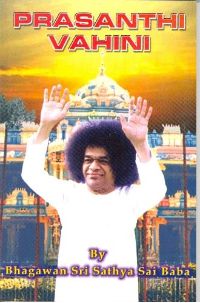 says: Like the children playing with
dolls
you, too, call some beings elephants and others
horses, some
friends and others enemies, and spend
your entire life in such make-believe. Once you realise that without the
spirit they are the
same inert substance, the notion of many and the
diversity of name and
form, both disappear, and there can be no liking and
disliking any
more. You laugh and weep, love and hate, live in
joy, sorrow, anger and
fascination, but all these varied reactions do not
make the objective
world less unreal.
says: Like the children playing with
dolls
you, too, call some beings elephants and others
horses, some
friends and others enemies, and spend
your entire life in such make-believe. Once you realise that without the
spirit they are the
same inert substance, the notion of many and the
diversity of name and
form, both disappear, and there can be no liking and
disliking any
more. You laugh and weep, love and hate, live in
joy, sorrow, anger and
fascination, but all these varied reactions do not
make the objective
world less unreal.
Vairagya
(detachment)
gets a new meaning in Prasanthi Vahini. 'Raga'
means
attachment and vairagya comes when you
realise that the stone
to which you were attached is really god. The
stoneness is like a veil
cast by your ignorance upon what is really of the
same substance as you
yourself. The vairagya that results from
this illumination is
lasting and most sublime, Baba explains.
Sathya Sai Vahini - Spiritual Message
of S'rî Sathya
Sai
Download
the updated epub, pdf & mobi
version of Sathya Sai Vahini
 Bhagavân has announced Himself as the
Divine
Teacher of Truth, Beauty and Goodness.
By precept
and example, through His writings and discourses,
letters and
conversations, He has been instilling the supreme
wisdom and
instructing all mankind to translate it into
righteous living, inner
peace and universal love.
Bhagavân has announced Himself as the
Divine
Teacher of Truth, Beauty and Goodness.
By precept
and example, through His writings and discourses,
letters and
conversations, He has been instilling the supreme
wisdom and
instructing all mankind to translate it into
righteous living, inner
peace and universal love.
When the 'Ramakatha
Rasavahini', the uniquely authentic nectarine
stream of the Râma
story, was serialised in full in the 'Sanathana
Sarathi',
Bhagavân blessed readers with a new series, which He
named 'Bharathiya
Paramartha Vahini' - The Stream of Indian
Spiritual Values.
While these precious essays on the basic truths,
that foster and feed
Indian culture since ages before history began, were
being published,
Bhagavân decided to continue the flow of
illumination and
instruction under a more comprehensive and
meaningful name, 'Sathya
Sai Vahini' - the holy stream from the Lotus
Feet of the Lord - "The
Flow of Divine Sai Grace." This book,
therefore, contains the two Vahinis
that have merged in one master stream.
Inaugurating these
series,
Bhagavân wrote, for publication in the Sanathana
Sarathi, "Moved
by the urge to cool the heat of conflict and to
quench the agonising
thirst for 'knowledge about yourself' that you are
afflicted with, see,
here it comes, the Sathya Sai Vahini, wave behind
wave, with the
Sanathana Sarathi as the medium between you and me."
With infinite
compassion,
this Sathya Sai incarnation of the Omniwill is
giving millions of
persons in all lands freedom from disease, distress
and despair,
narcotics, narcissism and nihilism. He is
encouraging those who suffer
gloom through wilful blindness to light the Lamp of
Love in order to
see the world and the Lamp of Wisdom to see
themselves. "This is a
tantalising true-false world. Its apparent diversity
is an illusion. It
is One, but is cognised by the maimed multiple
vision of humans as
Many," says Bhagavân. This book is the tw in Lamp He has devised for us.
'Sathya Sai Vahini'
reveals to us in unmistakable terms that the self in
man is "no
other than the Overself or God." We are told
that this is true not
only of mankind but of all beings, everywhere and anywhere. In
fact, "Will causes this unreal
multiplicity of Cosmos on the One that He is. He can
by the same Will
end the phenomenon." "Being (God) is behind the
Becoming and Becoming
merges in Being. This is the eternal Play," says
Bhagavân.
To sum up, the 'Sathya
Sai
Vahini' is the holy gospel given to us by the
Person who, as The
Eternal Charioteer, is eager and ready to hold
the reins of our
senses, mind, consciousness, ego and intellect, and
guide us safely to Prasanthi
Nilayam, the Abode of Supreme peace, the goal
of all mankind.
Prasnothara Vahini - Answers
to
Spiritual questions
Download
the updated epub, pdf & mobi
version of Prasnothara Vahini
 Prasna means "question",
Uttara means "answer",
and Vahini indicates "a stream". This book
is the stream of the
questions that have evoked answers from Bhagavân
S'rî
Sathya Sai Baba. Among the tasks that Bhagavân
has
assumed while incarnating, He has declared as basic,
the one which He
calls, "the clarification and purification of the
religious scriptures
of mankind." Every Vahini emanating from Him
has done this
service to some aspect or other of the spiritual
upliftment of man.
Prasna means "question",
Uttara means "answer",
and Vahini indicates "a stream". This book
is the stream of the
questions that have evoked answers from Bhagavân
S'rî
Sathya Sai Baba. Among the tasks that Bhagavân
has
assumed while incarnating, He has declared as basic,
the one which He
calls, "the clarification and purification of the
religious scriptures
of mankind." Every Vahini emanating from Him
has done this
service to some aspect or other of the spiritual
upliftment of man.
This Vahini is
one
of the earliest in the series, since it seeks to
elucidate the
fundamental concepts and precepts of religion,
especially the technical
words and expressions that seek to concretise them. For some years, this was
published as
an Appendix to a single Vahini, the Geeta Vahini,
but later it was
placed in the hands of seekers as a key publication,
helpful for
readers of all the Vahinis.
them. For some years, this was
published as
an Appendix to a single Vahini, the Geeta Vahini,
but later it was
placed in the hands of seekers as a key publication,
helpful for
readers of all the Vahinis.
The Ancient Wisdom, Sanâthana
Dharma, the Perennial Path, has been
communicated to
posterity in words that have suffered distortion,
devaluation, dilution
and denigration through the efflux of time and the
controversies among
commentators. Varna (social system based on
profession),
Âs'rama (stages of life according to ancient
religion), Yoga, Sannyasa
(renunciation), Yajña
(sacrifice), Karma (action), - these are
interpreted by
dialecticians and practitioners of varied schools
and sects, in
confusing and contradictory versions.
Bhagavân has resolved
these tangles. His exemplary love and patience
sweeten not only every
answer but every question too, for, He has, by
posturing as the
interrogator, made the clarifications full and
fruitful.
Sandeha Nivarini - Clearance of
Spiritual Doubts
Download
the updated epub, pdf & mobi
version of Sandeha Nivarini
 A series of Baba's articles published
to remove the weeds of
doubt growing wild in the hearts was collectively
entitled 'Sandeha
Nivarini'. Even in his teens and twenties,
Baba took delight in
prodding those who gathered at His feet to ask Him
questions on
spiritual matters. These became the cues for
dissertations, short and
long, with many an interspersed parable, poem or
song, to lead the
questioners from darkness to light.
A series of Baba's articles published
to remove the weeds of
doubt growing wild in the hearts was collectively
entitled 'Sandeha
Nivarini'. Even in his teens and twenties,
Baba took delight in
prodding those who gathered at His feet to ask Him
questions on
spiritual matters. These became the cues for
dissertations, short and
long, with many an interspersed parable, poem or
song, to lead the
questioners from darkness to light.
In Sandeha
Nivarini
Baba says, I am happy when anyone asks Me about the
things he has not
understood. Of course, you have every right. Then he
asks the pupil,
but are you reflecting on the answers I give and
practicing what has
been told you, with the conviction born of faith?
What am I here for?
Is it not for explaining to you the things you do
not know? Ask me
without hesitation or fear. I am always ready to
answer. Only, the
enquiry must be earnest, emerging out of a genuine
desire to know and
to practice what is good.
It can be revealed now
that
the bhakta (devotee) who visits Baba with
questions - personal,
philosophical and religious in every chapter of Sandeha
Nivarini
is a creation of the Divine pen. Baba reveals
through this character,
His infinite compassion towards the samsayatma,
the person
afflicted with doubts. He poses the problems and
provides the answers.
He writes, Bhakta!
I
converse with you about every point you place before
Me, and allow many
to take part in this conversation. The sun's light
falls upon the
mirror, the light from the mirror upon the walls of
the bungalow and
the light from the walls upon the eye. Similarly,
this Sandeha
Nivarini has been planned in order that the
illumination of My
teaching may fall upon you and thence on to the
pages of the 'Sanathana
Sarathi', so that the effulgence may
illuminate the world and bring
the light and harmony into the heart of mankind.
Leela Kaivalya
Vahini - The
Cosmic Play
of God
Download
the updated epub, pdf & mobi
version of Leela Kaivalya Vahini
 The 'Vedas' (ancient
Indian scriptures) originated
from the breath of God; each syllable is sacred.
Each word is a mantra.
It exhorts all men to pursue the same holy desire.
All hearts must be
charged with the same good urge. All thoughts must
be directed by noble
motives towards holy ends. All men must tread the
one path of truth for
all are manifestations of the One.
The 'Vedas' (ancient
Indian scriptures) originated
from the breath of God; each syllable is sacred.
Each word is a mantra.
It exhorts all men to pursue the same holy desire.
All hearts must be
charged with the same good urge. All thoughts must
be directed by noble
motives towards holy ends. All men must tread the
one path of truth for
all are manifestations of the One.
The world is
enchanting,
because it is tantalising in appearance, though it
is fundamentally
untrue. It is a phenomenon which is fading out. When
this truth is reali sed, one becomes aware of the Cosmic
Sport of
God and the Eternal Universal Being.
sed, one becomes aware of the Cosmic
Sport of
God and the Eternal Universal Being.
'Leela Kaivalya
Vahini'
is a cool crystal clear stream that flows from the
Divine pen of
Bhagavân S'rî Sathya Sai Baba to dissolve all
obstacles
like doubts and dogmas, purposeless arguments and
flimsy fancies of the sâdhaka (spiritual
aspirant).
These articles,
originally
published in the 'Sanathana Sarathi' (the
Âs'ram
periodical), were given a book form and placed at
His Lotus Feet on the
auspicious occasion of His 65th Birthday, which
eventually fell on the
50th year of proclamation of Avatârhood.
Sutra Vahini - Analytical
Aphorism on Supreme Reality
Download
the updated epub, pdf & mobi
version of Sutra Vahini
 An aphorism (sûtra) expresses
the genus of its
meaning in a few terse words. The Brahma Sûtras
systematically explain the basic principles of Vedanta,
the
science of Supreme Reality. When contemplated, they
reveal the
innermost metaphysical secrets. Today, harmony is
the need of the hour.
The ephemeral world needs spiritual awareness, and
this is what the
Vedantins (propagators of Vedanta) visualise. Vedic
scriptures offer
comforting counsel. They throw a kindly light.
An aphorism (sûtra) expresses
the genus of its
meaning in a few terse words. The Brahma Sûtras
systematically explain the basic principles of Vedanta,
the
science of Supreme Reality. When contemplated, they
reveal the
innermost metaphysical secrets. Today, harmony is
the need of the hour.
The ephemeral world needs spiritual awareness, and
this is what the
Vedantins (propagators of Vedanta) visualise. Vedic
scriptures offer
comforting counsel. They throw a kindly light.
In the words of
Bhagavân Baba, "Acquisition of the higher knowledge
alone can
fulfill the main purpose of human life. Such
knowledge makes one aware
that one is not the inert insentient body, etc., but
that one is
consciousness itself manifesting as the embodiment
of being - awareness
- bliss (sat-cit-ânanda). When this truth
dawns and is
experienced, one becomes a person liberated while
alive (jivan-mukta)".
This is the state of realization of the innate
nature of a people - the
divinity of humanity.
In this Stream of
Aphorisms (Sutra Vahini) on Brahman,
Bhagavân
S'rî Sathya Sai Baba has lighted the universal lamp
of the wisdom
(vidya) of Atma/Brahman (Divine
Self). This stream of
aphorisms first appeared in serialized form in 'Sanathana
Sarathi'.
Bhagavân, in His infinite
love, elaborated on the "Essence of Brahma Sûtras
in twelve
selected aphorisms".
Bhagavân's sublime and
profound words and spiritual wisdom are indeed
highly elevating and
illuminating. Bathing in this pellucid Stream of
Aphorisms, a
person develops correct or true vision of Reality,
bestowing supreme
delight.
Vidya Vahini - Flow
of Spiritual Education
Download
the updated epub, pdf & mobi
version of Vidya Vahini
 Baba has clarified that the
word 'Vidya' used for
this Vahini (Stream of Thought),
means (Ya) that
which (Vid) "illumines." It is this sense
that is highlighted in
expressions like âtmâ, vidya, brahma vidya,
etc.,
or even the name Vidyagiri given to the
college campus of Prasanthi
Nilayam which comprises the Institute of
Higher Learning.
Baba has clarified that the
word 'Vidya' used for
this Vahini (Stream of Thought),
means (Ya) that
which (Vid) "illumines." It is this sense
that is highlighted in
expressions like âtmâ, vidya, brahma vidya,
etc.,
or even the name Vidyagiri given to the
college campus of Prasanthi
Nilayam which comprises the Institute of
Higher Learning.
Baba makes us aware of
the
comparatively less beneficial lower learning which
deals with theories,
inferences, concepts, conjectures and constructions.
The Higher
Learning hastens and expands the universal urge to
know and become Truth,
Goodness and Beauty, Sathyam
Sivam Sundaram. Baba has come as Man among men on a
self-imposed mission to correct the wrongs inflicted
on mankind through
the fanatically blind pursuit of lower learning. The
human race has to
voyage on an even keel; it is leaning too alarmingly
towards the briny
grave; the lower learning is lowering it into the
bottomless pit. 'Vidya'
alone is the remedy.
From His childhood
days, Baba
has stood forth as an educator, a Guru as the
villagers loved to
address Him. He warned, without hesitation, elders
at Puttaparthi,
teachers in the schools, and headmen of castes against
cruelty to
animals and exploitation of labor, usury and
gambling, pedantry and
illiteracy, hypocrisy and pomp. Through gulps
and jests, parody and
satire, songs and plays, the young teenager Teacher
ridiculed and
reformed the society which honored or tolerated such
evils. Through Bhajans sung in chorus by groups
of men and women, H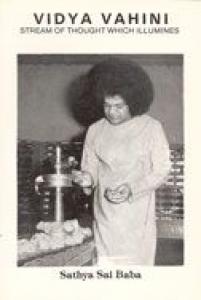 e reminded them of the universal
human values
of Truth, Morality, Peace, Love and Non-violence as
early as 1943, when
he was barely seventeen. These were the basic
acquisitions that 'Vidya',
the Higher Learning, can confer on votaries.
e reminded them of the universal
human values
of Truth, Morality, Peace, Love and Non-violence as
early as 1943, when
he was barely seventeen. These were the basic
acquisitions that 'Vidya',
the Higher Learning, can confer on votaries.
As Lord Krishna,
He
said to Arjuna (B.G. 10:32), "Adhyâtma
Vidyâ
Vidyânâm" meaning, "Among all the types of
knowledge, I am the spiritual knowledge of all
education and the
dialectic of all argumentation." The world can
be saved from
suicide only through this knowledge. The search for
Truth and Totality,
for Unity and Purity is the means; the Awareness of
the One is the
consummation of the process.
This message is the
sum and
substance of every discourse of His, from the time
He first spoke in
the early 1950s. This precious book provides us the
chance to peruse
nineteen essays He wrote in answer to appeals for
the elucidation of
the principles which must guide us while
rehabilitating education as an
effective instrument for establishing peace and
freedom in us and on
earth.
Upanishad Vahini - Essence of Vedic
Knowledge
Download
the updated epub, pdf & mobi
version of Upanishad Vahini
 Upanishad
Vahini is a synoptic review of the ten
principal Upanishads with a
prologue and an epilogue on the rare text called the
'Brahmanubhava
Upanishad'. These Upanishads are
esoteric and highly
cryptic, but they elucidate the highest truths
discernable to the
intellect of Man.
Upanishad
Vahini is a synoptic review of the ten
principal Upanishads with a
prologue and an epilogue on the rare text called the
'Brahmanubhava
Upanishad'. These Upanishads are
esoteric and highly
cryptic, but they elucidate the highest truths
discernable to the
intellect of Man.
Vedic literature is
classified as ritualistic, consecrational and
metaphysical (karma,
upasana, jñâna), and the Upanishads are
grouped under
the third category. But Baba says that each
principal Upanishad deals
with all the three and is, therefore, instructive
for all types of
spiritual aspirants. Besides special rite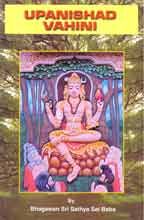 s described in most of them, the
adoration of
preceptors or deities is also recommended.
s described in most of them, the
adoration of
preceptors or deities is also recommended.
Baba says: The Upanishads
enshrine the whisperings of God to Man. About the
ten on which Adi
Sankara and other scholar saints have written
detailed expositions,
Baba says, Humanity stands to gain or fall by these
ten. They are the
synthesis of human thought, experience and aspiration at the highest.
They confirm the possibility of
human perfectibility, they declare and demonstrate
that man can secure
the awareness of God as his reality, if only he
casts off the veil of
ignorance that he now delights to wear.
Bhagavatha Vahini -
The Story of the Glory of the Lord
Download
the updated epub, pdf & mobi
version of Bhagavatha Vahini
 The Geeta is a
central gem in the crest jewel of the
great Indian epic, the Mahâbhârata. Sage
Vyâsa wove this intricate tapestry of sublime
heroism physical,
mental, moral and spiritual. He had also codified
the Vedic hymns
and rituals. He prepared a magnificent garland of
aphorisms summarizing
the basic philosophic truths. In spite of His
encyclopedic scholarship
and great creative skill in the realm of thought,
Vyâsa was
afflicted by a deep inner sadness. He had no
sweetness or peace left in
him.
The Geeta is a
central gem in the crest jewel of the
great Indian epic, the Mahâbhârata. Sage
Vyâsa wove this intricate tapestry of sublime
heroism physical,
mental, moral and spiritual. He had also codified
the Vedic hymns
and rituals. He prepared a magnificent garland of
aphorisms summarizing
the basic philosophic truths. In spite of His
encyclopedic scholarship
and great creative skill in the realm of thought,
Vyâsa was
afflicted by a deep inner sadness. He had no
sweetness or peace left in
him.
Nârada, the
sage
who propagated the validity of devotion as a means
of achieving bliss,
had advised Vyâsa to describe the glories of God,
who had
incarnated as Krishna. The exposition that
did emerge from this
advice is called the 'Bhâgavata Purâna'. Baba
has
given it to us again in a sweeter and a more concise
form as 'Bhagavata
Vahini'.
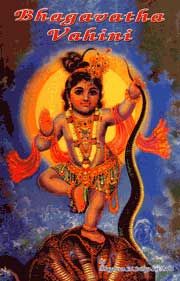 Baba's Bhagavata Vahini
flows clear
and cool, straight from the page to the heart. The
book splendidly
narrates the lîlâs
(divine sport) of Krishna and of the
dedicatory acts of those
who received His Grace. It also includes the regions
mapped by
Vyâsa under the compulsions of scholastic norms. As a result, Bhagavata
Vahini
is not just a book, it is a tonic, a balm, a
pilgrimage, a hallelujah,
a clarion call and a beacon light.
Baba's Bhagavata Vahini
flows clear
and cool, straight from the page to the heart. The
book splendidly
narrates the lîlâs
(divine sport) of Krishna and of the
dedicatory acts of those
who received His Grace. It also includes the regions
mapped by
Vyâsa under the compulsions of scholastic norms. As a result, Bhagavata
Vahini
is not just a book, it is a tonic, a balm, a
pilgrimage, a hallelujah,
a clarion call and a beacon light.
It is designed by Baba
to
loosen our bondage from the trivial and to tame the
wildness of our
minds. Vyâsa's son S'uka had recited the Bhagavata
for the benefit of King Parîkchit who had
been cursed to
die at the end of seven days. The recitation
occupied those seven days.
Since the king had filled his mind with this
narrative of the glory of
the Lord, he died with the name of the Lord on his
lips and the form of
God before his eyes.
Each one of us is
under such
a sentence of death, only we do not know when death
will confront us.
The Bhagavata Vahini can save all those who
choose to be free
from the fear of death and prepare them for passing
beyond the realm of
life, cheerfully and hopefully.
Ramakatha Rasavahini -
The Sweet Story of Rama's
Glory - Part
I & Part
II
Download
the updated epub, pdf & mobi
version of Ramakatha Rasavahini Part I &
Part II
 Ramakatha Rasa Vahini is a
lucid narrative of
Râma's life. Baba has announced that He is the same
Râma,
come again to carry out His mission through his
horde of followers.
Drawn by His Love, we have the same good fortune now
to share in his
task of remoulding man after His image.
Ramakatha Rasa Vahini is a
lucid narrative of
Râma's life. Baba has announced that He is the same
Râma,
come again to carry out His mission through his
horde of followers.
Drawn by His Love, we have the same good fortune now
to share in his
task of remoulding man after His image.
The Ramâyana
(or the Râma Story) is an intensely human drama
where God
impersonates as man and gathers around Him, on the
vast world-stage,
the perfect and the imperfect, the human and the
subhuman, the beast
and the demon, to confer on us, by precept and
example, the boon of
supreme wisdom. It is a story that plays its tender
fingers on the
heartstrings of man, evoking lithe, limpid responses
of pathos, pity,
exultation, adoration, ecstasy and surrender,
rendering us transformed
from the animal and the human, into the divine,
which is our core.
Sai has declared that
He is
the same Râma come again, and that He is
searching for
His erstwhile associates and workers in order to
allot them roles in
His present Mission of resuscitating Righteousness
and leading man into
the Haven of Peace. While recounting the incidents
in His life as
Râma, Baba has included in His narrative, certain
details of
dialogues and diversions not contemplated by Valmiki
or any
other subsequent author. He mentions many additional
events and
encounters, which fill the lacuna that, have long
disturbed admirers of
the Ramâyana.
 He has now deigned to tell
us Himself the story of this one
epic Act in that Drama, wherein He took on the Râma
role. As
Râma, Sai instructed, inspired and invigorated,
corrected,
consoled and comforted His contemporaries in the Tretâ
Age.
As Sai Râma, He is now engaged in the same
task. While
reading these pages, readers will often be
pleasantly struck by the
identity of the Râma of this story and the Sai
Râma they are witnessing.
He has now deigned to tell
us Himself the story of this one
epic Act in that Drama, wherein He took on the Râma
role. As
Râma, Sai instructed, inspired and invigorated,
corrected,
consoled and comforted His contemporaries in the Tretâ
Age.
As Sai Râma, He is now engaged in the same
task. While
reading these pages, readers will often be
pleasantly struck by the
identity of the Râma of this story and the Sai
Râma they are witnessing.
The controversy over
whether Râma
is to be reckoned as a historic prince or as God
Incarnate has been set
to rest by Baba. The 'Ramakatha Rasavahini'
is the very nectar
of the great epic, Ramâyana.
The whole volume of Râma's
story
is divided into two parts. The first part deals with
the story of
S'rî Râma from His birth till His banishment into
the
forest and the installation of Râma's sandals on the
throne of Ayodhyâ.
The second part begins with the stay of Râma in the
forest till
the installation of Lava and Kusha
on the throne of Ayodhyâ,
the end of Ramâyana.
previous
page|next page
about Sai Baba | about His Writings | code of conduct | human values |
jyoti meditation | interview1976