
|
 Chapter 5
Ceremony of Name Giving - Yajñas and
the Penance of Elders Chapter 5
Ceremony of Name Giving - Yajñas and
the Penance of Elders
Dharmaraja
(Yudhisthhira) accepted the advice of Vâsudeva,
as well as the benedictions of Vyâsa. He
sent his brothers, with the army, to bring
the gold that had been thrown aside by the
brahmins. They left after purifying
themselves by partaking consecrated
offerings. They discovered the quantities of
gold that had been given as presents to the
priests at the conclusion of the sacrifice
by Emperor Maruth in the past. They had
dropped the gold on the sides of the roads
along which they returned home. The army
collected these and conveyed them to the
capital on camels, elephants, chariots and
carts. It took them some days to reach
Hastinapura with all that load. They
unloaded the gold, amidst the acclamations
of the people.
The citizens
were amazed at the success of the
expedition; they extolled the good fortune
of the Pândavas. They welcomed into
the city the princes and the gold shouting
"Jay, Jay" until their throats were hoarse,
jumping and dancing in joy. They pictured
among themselves the grandeur and
magnificence of the sacrifice, for which
this gold was brought.
Preparations
were started that very day for the
construction of the ritual altar and the
necessary adjuncts on the bank of the
Ganga; the sacred area was many square
miles in extent. The ground was levelled and
cleaned. The dais was built; beautiful
buildings arose on the vast area. Porches
and verandas were added. Decorations like
flags and festoons embellished the
structures.
When the holy
day neared, chieftains, brahmins, scholars
and sages moved from all directions towards
the sacred place, hastening each other in
their enthusiasm to reach early. They took
residence in the quarters allotted to them,
according to their status and needs. They
spent the night counting minutes, in joyful
expectation of the extravagant but
efficacious yajña that they could
witness when the dawn brings in another day.
The morning
came. The auspicious moment approached. The
priests took up their positions and got
ready to take the vows of initiation. They
stood up facing Lord Krishna and the King
and said, "0 King! we understand that you
have resolved to perform not one but three As'vamedhas.
Is that correct? If so, do you desire us to
perform them, one after the other? Or, shall
we repeat every formula and rite, thrice and
have them all concurrently? If you make it
known, we shall arrange the participants and
performing priests accordingly."
At this, Dharmaraja
replied, "what can I say when you know best;
I shall agree to whatever advice you offer;
I seek only the consent of Vâsudeva
for whatever course we adopt" and he turned
towards Krishna with pleading eyes.
Krishna left the decision to the
brahmins. They discussed among themselves
for a while and announced at last that the
effect of "three As'vamedhas" can be
secured by repeating each mantra
thrice and presenting the brahmins presiding
over the rituals thrice the usual fees. Vâsudeva
indicated His approval of this suggestion,
and taking his cue from this, Dharmaraja
declared that he was agreeable. He desired
that the yajña might be inaugurated.
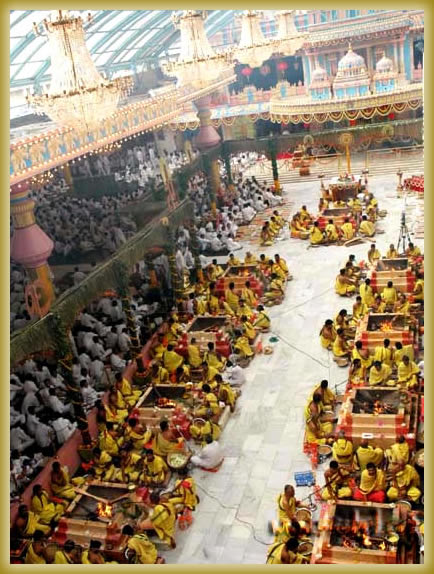 The recitation
of the mantras by the brahmins
shook both earth and sky. The preliminary
rites were gone through and the sacrificial
horses proceeded on their planned round.
They were caparisoned in great style and
they carried on their foreheads the
declaration challenging any one to take them
into custody if he dared. When He, who is
the recipient of all yajñas, (yajñaswarûpa)
has taken the role of the presiding
authority, no words can describe the fortune
of the participants and the witnesses. It
drew to a successful close with the
Valedictory Oblation (purna-âhuthi). The recitation
of the mantras by the brahmins
shook both earth and sky. The preliminary
rites were gone through and the sacrificial
horses proceeded on their planned round.
They were caparisoned in great style and
they carried on their foreheads the
declaration challenging any one to take them
into custody if he dared. When He, who is
the recipient of all yajñas, (yajñaswarûpa)
has taken the role of the presiding
authority, no words can describe the fortune
of the participants and the witnesses. It
drew to a successful close with the
Valedictory Oblation (purna-âhuthi).
The experts in
sacrificial mantras, the sages and the
brahmins were loaded with presents and fees.
Enormous numbers of cows, large areas of
land, and vast quantities of gold were
gifted away by the King. The whole nation
was filled with happiness. Every one was
praising the yajña as indescribably
superb. All who came were fed sumptuously at
all hours. Sages and ascetics who saw all
this lavishness extolled the yajña
of Dharmaraja as grander even than
the yajña performed by emperor Maruth
in the past! They were delighted they got
the chance to partake in this yajña.
People once claimed that the yajña of
Maruth was presided over by Indra, the Ruler of the Gods and they
felt that it made it incomparably superior
to any other sacrifice. But now, they
congratulated Dharmaraja on securing the yajñaswarûpa
(Vâsudeva) Himself to preside over
the yajña, a piece of good fortune
far superior to Maruth's and far
more difficult to secure.
At the end of
the yajña, those who had come from far off
places returned; others to turned home. The
kings and chieftains took respectful leave
of Dharmaraja and went back to their own
principalities. The kinsmen 0f the Kinf
stayed for a few days more and left at their
convenience to their places (see also S.B.
1.11).
However, Lord
Krishna chose to spend some more
time with the Pândavas; so, He
stayed on in Hastinapura. The Pândavas
were delighted at this signal act of
grace; they made suitable arrangements for
the residence of the Lord; they served Him
every day, they filled their eyes with His
beauty, they filled their hearts with His
gracious words of instruction; they spent
the days in supreme joy. After some time
spent thus in the Pandava capital, Krishna
returned to Dvârakâ, taking Arjuna
with Him. The inhabitants of Dvârakâ were
overjoyed when their Lord returned to His
capital. They welcomed Him in enthusiastic
reverence. They feasted on the darshan
of the Lord and were immersed in ânanda.
The Penance
of Elders
Meanwhile,
news came to Hastinapura that Vidura
his uncle was moving about on the environs
of the city in the guise of a monk; it
travelled from mouth to mouth and at last
reached the ears of Dharmaraja,
the King. The news was received with
surprise and joy. He sent a few scouts to
discover whether the news was authentic,
and soon, they brought the welcome
information that Vidura had
actually come and was present. Dharmaraja
could not contain himself with excitement.
"Ah! How happy
you have made me!", he exclaimed. "This
holy moment has made the dried trunk of
the tree of hope put forth leaves again.
Oh, I can now see and serve Vidura
who fostered us and guarded us and guided
us, I who feared I might not get the
chance at all."
The heartening
news was spread by courtiers among the
queens and princesses and women of the
royal household. Dharmaraja did
not rest; he spoke about the great event
to everyone around him; he sought out
others to share with them the joy. He
issued orders to the army that appropriate
arrangements should be made to welcome
into the capital the brother of his late
father, sage Vidura, foremost
among the votaries of the Lord. The
citizens too were alerted and asked to
prepare a grand reception.
They decorated
the streets and mansions on each side of
them; they erected arches and hung
festoons and hoisted flags. They allotted
galleries and seats on every road for
children, women, and the aged, so that
they might have a fine and clear view of
the procession and of the great Sage. It
was an inspiring sight to see many old men
and women hobbling on with their sticks,
eager to get a glimpse of Vidura,
whom they extolled as the very embodiment
of dharma, as the very god-father
of the Pândavas. Some thought at
first that the sighting of Vidura
on the outskirts of the city must have
been in someone's dream, and not in actual
fact. They had lived long enough to
swallow the rumor without personal
verification. For, they never could
believe that Vidura would ever
come back to Hastinâpura. They
grouped themselves on vantage points and
got ready for the great moment when they
could rest their eyes on the saint. All
along the route, every building was
overflowing with humanity; the trees
carried strings of adventurous youth, full
of excitement and expectation, shouting in
acclamation of the oncoming guest.
The King
decked in ceremonial robes ascended the
royal chariot and started out of the
palace with his brothers to bring home the
famous votary of the Lord.
Vidura
appeared before them walking barefoot,
slow and dignified, with matted hair and  wearing the robes of a monk. The
King and his brothers stepped down from
their vehicles, bowed reverentially to the
feet of Vidura and walked behind
him, at a respectful distance. The
citizens ran forward and fell at Vidura's
feet, in spite of the earnest entreaties
of the guards that they should desist. The
Pândavas could not express welcome in
words; their joy was immeasurable. So,
their eyes spoke it, with tears of
gratitude. They clasped Vidura in
their arms and prayed to him that he
should get into the chariot so that the
thick ranks of onlookers on all the roads
might get darshan to their hearts'
content. Vidura was persuaded to agree.
Seated in the royal chariot of the King,
Vidura gave darshan to the people
who had amassed en route. At last, the
procession reached the palace. It was a
sweet flood of song and joy that flowed
along the roads of the city that day. wearing the robes of a monk. The
King and his brothers stepped down from
their vehicles, bowed reverentially to the
feet of Vidura and walked behind
him, at a respectful distance. The
citizens ran forward and fell at Vidura's
feet, in spite of the earnest entreaties
of the guards that they should desist. The
Pândavas could not express welcome in
words; their joy was immeasurable. So,
their eyes spoke it, with tears of
gratitude. They clasped Vidura in
their arms and prayed to him that he
should get into the chariot so that the
thick ranks of onlookers on all the roads
might get darshan to their hearts'
content. Vidura was persuaded to agree.
Seated in the royal chariot of the King,
Vidura gave darshan to the people
who had amassed en route. At last, the
procession reached the palace. It was a
sweet flood of song and joy that flowed
along the roads of the city that day.
Some of the
citizens were so overcome with joy that
they were rooted to the spot. The arduous
life of tapas that Vidura had
undertaken had so transmuted his
personality that he appeared a different
person, a person glowing with divine aura,
like Indra, the king of Gods. The
people were describing their exultation in
their own words to one another. Many shed
tears remembering the trials and
tribulations which Vidura had undergone
and the peace that he had acquired. The
queens and princesses too had darshan
from inside the purdah and they
were supremely happy.

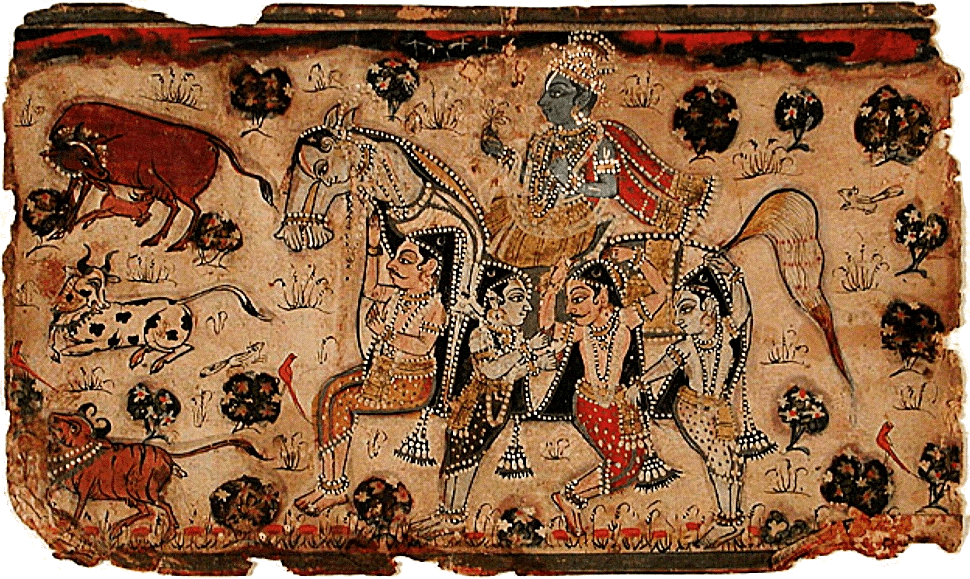
The first painting
on this page of Krishna with the
Pândavas as the legs of His horse
is titled: 'Krishna riding a
composite horse',
India, Andhra Pradesh, c.1800.
Courtesy: LACMA.
|