Chapter 7
Vidura the Counselor
 Vidura continued his admonition
of Dhritarâshthra: "You have reached
this advanced age, but still, without any shame
or hesitation, you are leading a dog's life. You
may not be ashamed of it, but, I am. Fie upon
you! Your method of spending your days is worse
than that of a crow."
Vidura continued his admonition
of Dhritarâshthra: "You have reached
this advanced age, but still, without any shame
or hesitation, you are leading a dog's life. You
may not be ashamed of it, but, I am. Fie upon
you! Your method of spending your days is worse
than that of a crow."
Dhritarâshthra
could not hear more. He cried, "O! enough,
enough. Please stop. You are torturing me to
death. These are not the words that one brother
should address another. Hearing you, I feel you
are not Vidura, my brother. He would not have
reprimanded me so cruelly. For, is Dharmaraja,
with whom I now am, a stranger? Have I taken
refuge with an alien? What is this that you are
saying? Why these harsh words! Dharmaraja is
fostering me with great love and care; how can
you declare that I am leading a dog's life or a
crow's? It is a sin, if you entertain such
ideas. This is just my fate, and nothing else."
Dhritarâshthra bent his head and moaned.
Vidura
laughed in derision. He said, "Have you not
sense of shame, that you should talk thus?
Dharmaraja might, out of his goodness, care for
you more than his own father. He might look
after you with a love greater than your own
sons. This is but the reflection of his
character. That is but the amplification of the
significance of his name. But, should you not
plan for your own future? One leg of yours is
already in the grave and you are blindly filling
your stomach in comfort and rolling in luxury.
Reflect for a moment how you tortured Dharmaraja
and his brothers, to fulfil the wicked
intentions of your vile sons, how you devised
strategems for their extinction. You put them in
a wax house and to set fire to it, you attempted
to poison them.
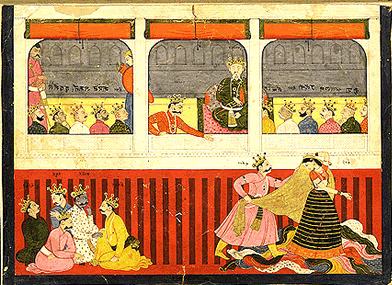
Duryodhana's
brother Dushasana forcibly attempts to disrobe
Draupadî
in the center of the assembly hall. Draupadî's
husbands, the Pândavas,
who have lost her as well as their kingdom in a
crooked game of dice,
sit helplessly to the right.
Krishna's divine grace provides her with an
unending length of material
as a sari, thus sparing her further humiliation.
You insulted their
Queen (Draupadî) in the most humiliating
manner before a vast assembly. You and your
abominable brood piled grief over grief on the
sons of Pându, your own brother. Blind,
senile, thick-skinned elephant, you sat on the
throne, perpetually asking those beside you
"What is happening now? What is happening now?"
[see
B.G. ch. 1] How can you stay in this place
enjoying Dharmaraja's hospitality, rolling over
your mind the iniquities perpetrated by you, for
his destruction? When you were devising their
end, did they cease to be your cousins? Or, did
the cousinship emerge now, when you came to them
for stay? You tell me so proudly that they are
treating you well, without a shred of shame!
Why speak so much?
The disastrous game of dice took place at your
initiative, isn't it? Do you deny it? No, I was
the witness of that game. I advised you against
it then, did you take it to heart? What happened
then to the love and sympathy which you are now
freely pouring forth? Today, like a dog you are
gulping the food the Pândavas are placing before
you and leading this despicable life."
Hearing these
words of Vidura which pained him like
hammer-strokes, Dhritarâshthra developed
a distaste for his style of living. Vidura's
intention was to prod him into the life of a
recluse and the life of sâdhana, so that
he might realise his self before it was too
late. At last, he felt that Vidura was speaking
the truth and giving him a true picture of his
low nature. He said, "brother! Yes; all that you
have said is true, I admit. I have realised it
now. But, what am I to do? I am blind and
therefore, I cannot go into the forests for sâdhana,
alone. I must have a companion. What shall I do?
For fear that I may suffer without food, Gandhâri
never leaves me even for a moment."
Vidura saw that he
had modified his attitude and had seen light. He
emphasized his original advice. He said, "You
have become blind due primarily to this
attachment to the body. How long can you be
burdened with it? It has to be dropped by the
wayside same day, some place. Know that
"you" are not this body, this package of
nauseating things. To identify yourselves with
the physical frame is the sign of extreme
foolishness. The body is being besieged
perpetually by death with his army of diseases.
But, you are unaware of it; you do not care for
the pro and the con; you snooze your fill and
snore. This drama has an end, remember. The
curtain has to come down. So hie towards some
holy place without delay and meditate on God and
save yourself. Let death come and carry away
your body there; that is the most excellent end.
Do not die like a dog or fox, somewhere,
somehow. Arise and go, develop detachment. Give
up this delusion, escape from this house."
Thus was planted
in the heart the seeds of renunciation. Dhritarâshthra
pondered long, and broke into tears. His lips
quivered. He moved his hands from side to side
to contact Vidura. At last, he held his
hands and said, "Vidura! What can I say to you
who gave this most valuable advice, advice that
is certain to promote my best interests? Though
you are younger in age, your jñâna
(religious, spiritual knowledge) makes you
senior to all of us. You have full authority to
speak as you like. Do not consider me as someone
outside your circle. Hear me with patience. I
shall certainly follow your advice." He then
began to describe his condition to his brother.
"Vidura", he
began, "How can I leave from here, without
informing Dharmaraja who is looking after
me, with more care than even a son? It won't be
proper to do so. Then, he might insist on coming
along with us, his nature is such. You must save
me from this dilemma. Take me to a place where I
can engage myself in sâdhana (spiritual
discipline)."
When he pleaded
thus, Vidura replied, "Your words sound
strange. You are not going into the forest to
eat banquets, to witness carnivals, or to enjoy
the beauty of the scenery. You are giving up
everything with a full sense of detachment. You
are taking up a life of austerity and spiritual
discipline. And, in the same breath, you are
talking of "taking leave" of kith and kin! This
is odd. You resolve to lay down the body in the
pursuit of the ideal, but, you are considering
how to get the permission of men who are related
to you through the body. These bonds cannot help
sâdhana. They can never liberate you.
Bundle them up and sink them deep. Move out of
this place with just the clothes you wear. Do
not waste a single moment of your life."
Thus, Vidura advised
him without mercy, he did not change the tune of
his song, he emphasized the importance of
immediate renunciation. Dhritarâshthra
was on his bed, listening intently and
ruminating on the next step. He said, "Vidura,
what you say is quite true. I need not describe
to you my special difficulties. This body is
decrepit, these eyes are blind. I must have some
one at least to guide my steps, isn't it? Your
sister-in-law (Gandhâri) has 'blinded' her eyes
by a bandage, in order that she can share my
handicap, and suffer similarly. How can we two
blind persons move about in the forest? We have
to be dependent on others all our lives."
Vidura saw
the tears rolling down the cheeks of the old
man, he pitied his plight, but, he never
revealed his pity. He said assuringly, "Well, I
am prepared to take you to the forest. I am
ready. What greater pleasure have I than
releasing you from here, for this sacred
purpose? Come, arise. Start." Vidura
stood up. Dhritarâshthra too rose from
his bed and stood on the floor. Gandhâri
too stood by his side, with a hand on his
shoulder. She pleaded, "Lord, I am also coming
with you, ready for anything."
But, Dhritarâshthra
said, "0, it is very hard to guard women in the
jungle. The place is infested by wild beasts and
life there is bound to be full of
privations." He spoke in this strain for a long
time. But, she argued that she could not desert
her lord, that she could stand the privations as
much as he, that it was her duty to continue
serving him until her death, that she was only
following the tradition set up by the gems of
Indian womanhood, that it is not dharma
to prevent her from observing her dharma,
that life in the zenana (place where
women stay) without him would be unbearable for
her, that she would welcome instead, life
in the jungle with her lord. She fell at the
feet of her lord and demanded permission to
accompany him.
Dhritarâshthra
was silent, he did not know what to say. It was
Vidura who spoke. "This is not the time
to discuss the niceties of dharma, how
can this lady who never stayed away from you a
single moment, suddenly leave your company and
live apart? It is not proper. Let her also come,
we shall take her. For those who march forward
to do austerities, there should be no fear or
delusion, no hunger or thirst, no grief or
suffering. It is not tapas (asceticism)
to complain of these or anticipate these. When
the body itself is being disowned, what can
privations do? Come, there is no justification
for delay." Vidura moved forward,
leading Dhritarâshthra silently followed
by Gandhâri who had her hand on his
shoulder. The saintly votary of God, Vidura,
took the pair unnoticed by the guards and the
citizens through the side streets and out beyond
the city limits. He hurried them on so that they
may reach the forest before dawn. But, the Ganga
had to be crossed in a boat and no boatman was
there to take them across before sunrise. So,
they had perforce to wait on the bank of that
holy river. Vidura made them rest for a
while in a bower and himself arranged for a
boat to take them all to the other bank in
the dark.

contents of this
Vahini |previous page |next page