Chapter
3
Ceremony of Name Giving
 [Yudhisthhira said:] "Alas! Is he to suffer at
last this tragic fate? Is this to be the reward for
all the good in store for him? Can the consequence
of years of good living suddenly turn into this
calamitous end? It is laid down that those who die
drowning, those who are killed by fall from trees,
and those who die of snake-bite have a bad
after-life. These are considered 'inauspicious
deaths'; those whose deaths are such, become ghosts
and have to suffer so, it is said. Why should this
child end up like that? O, the horror of it, o, the
injustice of the whole thing!", lamented
Yudhisthhira, biting his lips to suppress his
sorrow.
[Yudhisthhira said:] "Alas! Is he to suffer at
last this tragic fate? Is this to be the reward for
all the good in store for him? Can the consequence
of years of good living suddenly turn into this
calamitous end? It is laid down that those who die
drowning, those who are killed by fall from trees,
and those who die of snake-bite have a bad
after-life. These are considered 'inauspicious
deaths'; those whose deaths are such, become ghosts
and have to suffer so, it is said. Why should this
child end up like that? O, the horror of it, o, the
injustice of the whole thing!", lamented
Yudhisthhira, biting his lips to suppress his
sorrow.
The brahmins hastened
to console him. "Mahârâja!", they interceded. "There
is no reason to give way to grief. Such a great man
will never meet with such a tragedy. No. In the
horoscope of this child, studying the positions of
the planets, we can clearly notice two happy
conjunctions, which indicate vajra-yoga and bhakti-yoga, both powerful and
propitious. Therefore, as soon as he learns of the
curse, he will give up his kingdom as well as his
wife and children and retire to the bank of the holy
Bhagirathi river and surrender himself to the
Lord. The great sage S'uka, son of Vyâsa,
will arrive there and initiate him into âtma-jñâna
(self-knowledge) through the recital of the glories
of Lord Krishna and the singing of His praise. Thus,
he will spend his last days on the sacred bank of
the Ganga and breathe his last with the adoration of
the Lord. How can such a man meet with any tragedy
or calamity? He will not be born again, for, through
bhakti-yoga, he will attain oneness with the
Lord of All, Purushothama." Hearing these
words, Yudhisthhira gave up grief and became
happy. He said: "If so, this is no curse; it is a
unique boon!"
The Name -
Parîkchit
At this, every one
rose. The brahmins were honored as befitted their
learning and austerity. They were given gems and
silken clothes and the king arranged to send them
home. Yudhisthhira and his brothers moved into their
palaces, but, they spent many hours talking about
the happenings of the day and of the fears, luckily
removed. They were filled with joy at the turn the
predictions had taken.
The baby grew in the
lying-in-room as the moon in the bright half of the
month. Since it was born as heir to the great
empire, after a succession of dire dangers, every
one loved it and guarded it like the apple of the
eye, as the very breath of their lives. Draupadî who
was broken by the loss of her own children, (the Upapândavas),
Subhadrâ who had suffered inconsolable loss in the
death of Abhimanyu, and the Pândava brothers
who dreaded that the terrific sorrow of As'vatthâmâ
directed against the posthumous child of Abhimanyu,
still in the womb of Uttarâ, might do the worst and
destroy for ever the Pândava line - all were
relieved, nay, were overjoyed when they saw the
child. They were supremely happy; they spent the
days doting over the little lovely baby, whom they
brought from the zenana for the purpose,
whenever they felt the urge to see it and hold it in
their arms.
The child was very
bright; it seemed to watch the lineaments of every
one who fondled it or came before it. The child
stared into their faces long and longingly. All were
surprised at this strange behavior. Every person who
came to it, was subjected to this searching
examination by the child who seemed determined to
trace someone or something in the world into which
it was born.
 Some said, sadly, it is seeking its father
Abhimanyu. Others said: "No, no, the child is
searching for Lord Krishna." Some others
opined that the child appeared to be trying to
discover some divine brilliance. The fact remained
that the child was examining all for some trait or
sign which it knew already, to recognise some form
it had in mind. 'Parîkcha' was the word used by
every one for the 'quest' in which the child was
engaged and so, even before the formal naming
ceremony, every one both in the palace and outside
it, began referring to the child as the Parîkchit,
'he who is engaged in Parîkcha!' That name, Parîkchit,
stayed! From the râja to the ryot, from the scholar
to the boor, from the monarch to the
man-in-the-street, every one addressed the child as
Parîkchit or referred to him so. The fame of the
child grew from day to day. It was on every one's
lips.
Some said, sadly, it is seeking its father
Abhimanyu. Others said: "No, no, the child is
searching for Lord Krishna." Some others
opined that the child appeared to be trying to
discover some divine brilliance. The fact remained
that the child was examining all for some trait or
sign which it knew already, to recognise some form
it had in mind. 'Parîkcha' was the word used by
every one for the 'quest' in which the child was
engaged and so, even before the formal naming
ceremony, every one both in the palace and outside
it, began referring to the child as the Parîkchit,
'he who is engaged in Parîkcha!' That name, Parîkchit,
stayed! From the râja to the ryot, from the scholar
to the boor, from the monarch to the
man-in-the-street, every one addressed the child as
Parîkchit or referred to him so. The fame of the
child grew from day to day. It was on every one's
lips.
One auspicious day,
Yudhisthhira had the court priest brought before him
and he commissioned him to fix a good day for the
ceremony of naming the child-prince. The priest
called together his group of scholars and
astrologers and after consulting the conjunctions of
heavenly bodies, they discovered a day which all of
them agreed was a good one for the event. They also
settled at what hour the actual naming had to take
place. Invitations to attend the ceremony were sent
to the rulers of the land and to scholars and
pundits as well as prominent citizens. The king sent
his emissaries to invite sages, and personages full
of spiritual wealth. Arjuna went to Lord Krishna
and reverentially prayed that He should shower His
grace on the child on the occasion; Arjuna succeeded
in bringing Krishna along when he returned.
When Lord Krishna
arrived, the sages, brahmins, râjas, subordinate
rulers and citizens got ready to receive Him with
respectful homage; the Pândava brothers attired
magnificently, waited at the main gate of the palace
to offer Him welcome. When the chariot of the Lord
was sighted, drums sounded, trumpets pealed mighty
welcome, and joyful 'Jais' rose from every
throat. Yudhisthhira approached the chariot and
embraced the Lord as soon as He alighted; he held
Him by the hand and led Him into the palace, where a
high throne was specially placed for Him. After the
Lord was seated, all else occupied their seats
according to their rank and status.
 Sahadeva [the twin-brother of
Nakula] went to the inner apartments and the child
was brought on a golden plate, resplendent as the
sun and made more charming by magnificent jewels.
The priests recited mantras, invoking the
Gods to bless the child and confer on him health and
happiness.
Sahadeva [the twin-brother of
Nakula] went to the inner apartments and the child
was brought on a golden plate, resplendent as the
sun and made more charming by magnificent jewels.
The priests recited mantras, invoking the
Gods to bless the child and confer on him health and
happiness.
Sahadeva laid
the child down in the centre of the Court Hall.
Maids and chamberlains came in long lines towards
the place where the prince was, holding in their
hands plates of gold full of perfumes and flowers,
silks and brocades. Behind specially fitted
curtains, the queens Rukminî, Draupadî, Subhadrâ and
Uttarâ were rejoicing at the happy scene, watching
the gambols of the child. Sahadeva took the child
and placed it on a bed of flowers in the mantap that
was erected for the naming ceremony. But, the child
rose on all fours and started crawling bravely on,
in spite of the remonstrances of the maids.
Apparently, the child wanted to proceed somewhere!
The efforts of
Sahadeva to stop its journey proved futile.
Yudhisthhira, who was observing its movements with
interest said with a smile: "Sahadeva! Do not stand
in the way. Leave him alone. Let us see what he
does." And Sahadeva left his hold. He allowed the
child to move wherever he liked but he took care to
keep his eye always on him lest he fall or hurt
himself. He followed him vigilantly at every step.
The child, who got
freedom of movement, soon made a bee line towards
the place where Lord Krishna was seated, as
if He was a long acquaintance whom he was seeking to
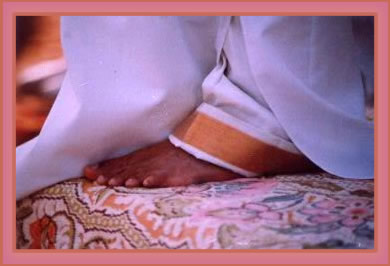
meet. The child grasped the Feet of Krishna
and pleaded, by his looks, that he may be taken onto
the lap and fondled! The Lord saw his yearning; He
laughed aloud; then, He graciously bent low to lift
the child onto His lap.
Sitting on His lap,
the prince was staring at the Lord's face without
even a wink; he did'n turn his head this way or that
or pull at anything with his hands or make any
sound. He just sat and stared. Everyone was amazed
at this behavior, so unlike that of a child. Even Krishna
shared in the feeling that pervaded the Hall.
Turning to
Yudhisthhira, Krishna said: "I did not
believe when I was told that this child stared at
everyone who came before him and examined their
lineaments. I thought it was a new explanation given
by these priests, to the usual prank and play of
children. Now, this is really a wonder. The fellow
has started examining even Me! Well, I shall test
his behavior a little Myself."
 Then,
the Lord tried to distract the attention of the
child from Himself by placing before him a variety
of toys, and Himself hiding from view. He expected
that the child will soon forget Him. But, his
attention was not drawn towards any other object. He
had fixed his eye inexorably on the Lord Himself,
and it was seeking Him and no other. He was trying
to move towards the place where he imagined Krishna
was. When His attempts to transfer the attention of
the child from Himself failed, Krishna
declared: "This is no ordinary child. He has won
through My tests. So, the name Parîkchit is the most
appropriate one for him. He already lives up to it!"
Then,
the Lord tried to distract the attention of the
child from Himself by placing before him a variety
of toys, and Himself hiding from view. He expected
that the child will soon forget Him. But, his
attention was not drawn towards any other object. He
had fixed his eye inexorably on the Lord Himself,
and it was seeking Him and no other. He was trying
to move towards the place where he imagined Krishna
was. When His attempts to transfer the attention of
the child from Himself failed, Krishna
declared: "This is no ordinary child. He has won
through My tests. So, the name Parîkchit is the most
appropriate one for him. He already lives up to it!"
At this, the pundits
recited verses indicating their blessings on the
child. The brahmins recited relevant passages from
the Vedas. The music of trumpets rent the
air. Women sang auspicious songs. The family
preceptor dipped a nine-gemmed jewel in a golden cup
of honey and wrote the name on the tongue of the
child. In the rice grains spread on a golden plate,
the name was written and the rice was then showered
on the head of the child, in token of prosperity and
happiness. The naming ceremony was thus celebrated
in grand style. Men and women who attended were
given presents as befitted their rank and they
departed. Every one was talking appreciatively of
the wonderful way in which the child sought out the
lap of the Lord. Many praised the steady faith that
the child had already attained.
Yudhisthhira who was
puzzled at the unique behavior of the child
approached Vyâsa, the great sage, to know
from him the reason for the strange search and learn
about the consequences of this attitude. Vyâsa said:
"Yudhisthhira! When this child was in the womb, the
deadly arrow that As'vatthâmâ aimed at it in
order to destroy it was about to hit its target;
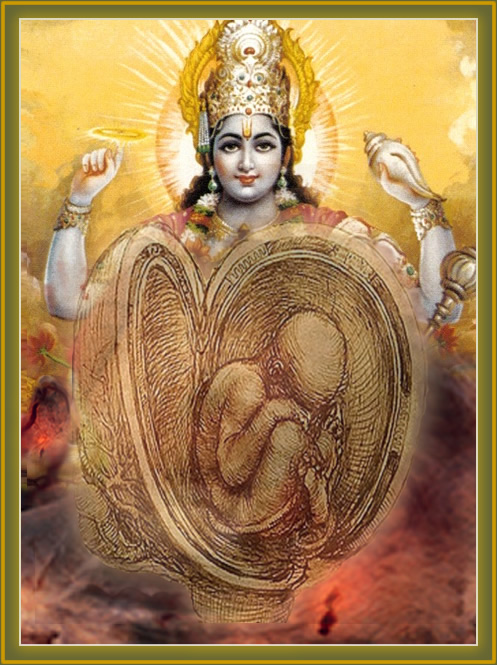
Lord Krishna entered the foetal home and
made it safe and saved it from destruction. This
child therefore has been eager to know who had saved
him from within the womb where he lay. He started
examining every one to find out whether he had the
same effluence that he saw, while a foetus in the
womb. Today, he saw that Divine Form with all its
splendor and so, he moved straight towards Him and
prayed to be taken up and seated on the lap. This is
the explanation for the strange behavior about which
you are curious to know."
Hearing these words of
Vyâsa, Yudhisthhira shed tears of joy
and thankfulness. Overjoyed at the limitless grace
of the Lord, he paid Him reverential homage.

contents of this
Vahini |previous page |next
page
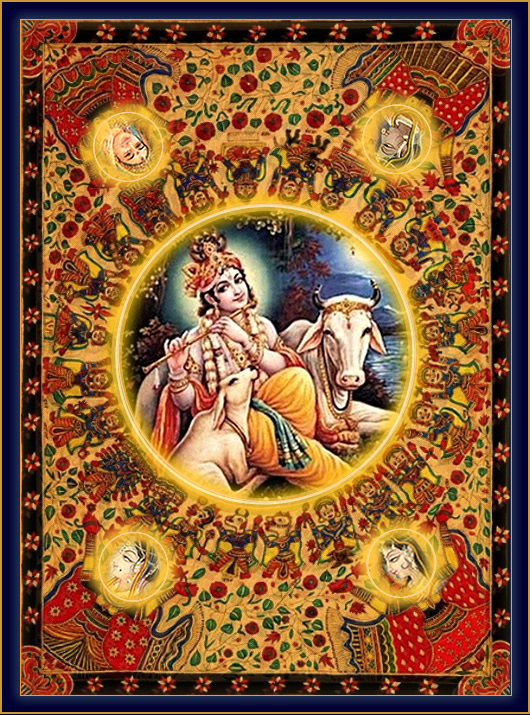
The first image on this page is a collage by
Anand Aadhar composed
of two vintage images and a picture titled:
'Yantra of Lord Vishnu with Twenty-four
Avatâras'
Source: Exoticindia.com.
Used with permission.
The third image is also a collage by Anand
Aadhar of a
vintage image of Vishnu and an
embryo study drawing by Leonardo daVinci.