Chapter
2
The Birth of a Bhagavata
 Mahârâja Parîkchit
was the very self of Abhimanyu, who had
attained the heavenly abode of heroes. When
Parîkchit was an embryo, growing in the womb of Uttarâ,
he saw the sharp arrow let off by As'vatthâmâ
flying towards him, emitting sparks of fury and
terror, bent on his destruction. But, at that very
moment, he saw also, a person of brilliant charm
armed with a terrific wheel, breaking that
death-dealing arrow into a hundred pieces. The royal
foetus was filled with wonder and gratitude. (See
also S.B. 1.12).
Mahârâja Parîkchit
was the very self of Abhimanyu, who had
attained the heavenly abode of heroes. When
Parîkchit was an embryo, growing in the womb of Uttarâ,
he saw the sharp arrow let off by As'vatthâmâ
flying towards him, emitting sparks of fury and
terror, bent on his destruction. But, at that very
moment, he saw also, a person of brilliant charm
armed with a terrific wheel, breaking that
death-dealing arrow into a hundred pieces. The royal
foetus was filled with wonder and gratitude. (See
also S.B. 1.12).
He
pondered deep on the identity of his
savior. "Who is He? He must also be dwelling in this
womb, with me, because he could see the arrow at the
very moment I saw it! But, he has such intrepidity
and skill that he could destroy it before it reached
me. Can he be a uterine brother? How could he get
hold of that wheel? If he is endowed with a wheel,
how did I miss having it? No, he is no mortal." He
argued thus for a long time within himself.
He could not forget
that face, that form. He was a boy, with the
splendor of a million suns. He was benign,
blissful, blue like the clear sky. After
saving him so dramatically and so mercifully, he had
disappeared. He had the form always before him, for,
he was seeking to see it again. Whomsoever he saw,
he examined to find out whether that form
corresponded with the form he had reverentially
fixed in his mind.
Thus he grew in the
womb, contemplating that form. That contemplation
transformed him into a splendor-filled baby. When at
the end of the period of gestation he was born into
the world, the lying-in-room was lit by a strange
light. The female attendants of Uttarâ were
dazzled by the brilliance. Their wits were overcome
by wonder.
Recovering herself, Subhadrâ
the mother of Abhimanyu sent word to Yudhisthhira,
the eldest of the Pândavas announcing the
birth. The Pândava brothers were overwhelmed with
joy, when they heard the glad tidings for which they
were waiting anxiously. They ordered that bands
play, and guns be fired, in honor of the event, for,
a scion had been born for the royal family, a
successor to the Pândava throne.
The people heard the
peal of guns and sought the reason for the joy. They
rushed towards Indraprastha in large masses
of enthusiasm. Every corner of the kingdom gushed
with joy at this event. Within minutes, the city was
transformed into a heavenly garden, fit for Gods to
give audience to men. Yudhisthhira
distributed several varieties of sweets to all who
came. He granted several cows as gifts to brahmins.
He instructed the ladies of the court to give golden
caskets full of saffron and kumkum to women.
Brahmins were awarded silk clothes and precious
gems. Citizens were transported with joy, for the
dynasty had now secured an heir. Night and day, they
reveled in hilarious exultation.
Next day, Yudhisthhira
called the family priest, Kripâcârya and
performed the rite of jatha-karma (first
cleansing) to the infant. He satisfied the brahmins
by gifts of various costly jewels. The scholars and
priests blessed the child and returned home.
On the third day, Yudhisthhira
called to his presence renowned astrologers as well
as famous palmists and soothsayers, for, he was very
eager to know whether the fair name of the kingdom
and its culture would be safe in the hands of the
prince who had come to carry the burden of the
state. Yudhisthhira received them at the
palace with traditional hospitality; they were given
appropriate seats in the hall and they were offered
scents and silks.
The king bowed before
them and joining his palms in reverential adoration,
he prostrated before them, and prayed, "0, wise men,
who know the past, present and future, examine the
horoscope of the infant that is born, calculate the
positions of stars and constellations, and the
planetary influences that will guide his life and
tell me how the future will be shaped." He noted the
exact time of birth and placed the note on a golden
plate, before them.
The pundits took that
note and drew up the plan of planetary positions,
and studied it with great care. They communicated to
one another their increasing joy as they began to
draw conclusions; they were in great joy themselves;
they could not get words to express their amazement.
The doyen of the
group, a great pundit, at last rose and addressed
King Yudhisthhira thus. "Mahârâja! I have
till this day examined well nine thousands of
horoscopes and prepared concerned plans of the
zodiacs and constellations. But, I must admit I have
never yet come across a more auspicious grouping
than is indicated in this horoscope. Here, all the
signs of good augury have assembled in one moment,
the moment of this prince's birth. The moment
indicates the state of Vishnu Himself! All
the virtues will gather in this child. Why describe
each glory separately? The great Manu has
again come into your dynasty".
Yudhisthhira
was happy that the dynasty had such good fortune. He
was indeed overpowered by joy. He folded his palms
and bent low before the scholars who had given him
such good news. "This family is lucky to claim such
a gem as its scion, through the blessings of elders
and of pundits like you as well as the blessings of
the Lord, who is our guardian. You say that the boy
will develop all virtues and will accumulate fame.
But of what use is all that, if he has not acquired
the quality of reverence towards pundits, sadhus and
brahmins? Please look into the horoscope once again
and tell me whether he will have that reverence."
The leader of the
group of astrologers replied: "You need entertain no
doubt on that score. He will revere and serve the
gods and the brahmins. He will perform many yajñas
and yagas, prescribed in the ancient texts.
He will earn the glory that your ancestor Bharatha
won. He will celebrate even the As'vamedha. He will spread the fame
of this line all over the world. He will win all
things that gods or men covet. He will outdistance
all those who have gone before him." They extolled
him thus in various ways to their hearts' content.
They stopped because they were nervous to recount
all the excellences; they feared they might be
charged with exaggeration and flattery if they
continued to detail the conclusions they had drawn
from the horoscope of the baby.
Yudhisthhira
was not satisfied; he wanted to hear more from them
of the excellences of the character of the prince.
Pundits were encouraged by this yearning. They said,
"0 King, you seem to be eager to know about some
more aspects of the child's fortune. We shall only
be too glad to answer any specific question that you
may feel inclined to put us."
Noting their
enthusiasm, Yudhisthhira came forward and asked
them, "During the regime of this prince, will there
be any great war? If war is inevitable, will he
achieve victory? 'No', said the pundits, He will not
be pestered by any foe. He knows no failure or
defeat in any undertaking of his. This is absolutely
true, an unshakable truth."
Hearing this,
Yudhisthhira and the brothers Bhîma, Arjuna,
Nakula and Sahadeva looked at each
other and shared great joy.
Meanwhile,
Yudhisthhira began to speak. He had said, "If that
is so...", but, before he could complete the
sentence, he hung his head and was plunged in
thought. The pundits noticed it; they said, "You
seem to be anxious to know something more. You have
only to ask, we shall readily answer all questions."
"Of course, I am happy at all the answers you have
given. He will be virtuous, famous, triumphant over
all, loving and kind, treating all equally; he will
perform many yajñas and yagas; he
will have no enemies; he will bring honor to the
dynasty and restore its reputation. All this gives
me great joy. But,... I would like to know also, how
he will meet his end." The brothers saw Yudhisthhira
getting rather upset at the anxiety which agitated
him over this problem. His voice had faltered a bit,
when he put the question.
The pundits consoled
him and said, "Why worry about that at this stage?
The end has to come some day, some way. It is
something that cannot be avoided. Something will
cause it; some circumstance will bring it about.
Birth involves the contingency of death. We are
afraid the extreme joy of this incident has queered
your line of thought a bit. We think this much is
enough. We shall leave the rest, in the realm of
doubt; let us not probe further. Let us leave it to
God."
But, Yudhisthhira
could not somehow give up his desire to know how
such a virtuous ideal prince would end his career on
earth. He imagined it must be a truly wondrous
finale to a glorious life. So, he wanted the
astrologers to tell him about it.
The scholars set about
the calculations again and took a pretty long time
over it. Watching this, the King became excited; he
hastened them and pressed for a quick answer. They
gave the reply, "This prince will give up his
kingdom as the result of a sage's curse."
Yudhisthhira wondered how such a paragon of virtue
can ever invoke upon himself the curse of a sage. He
was shocked at the possibility.
Meanwhile, the pundits
said, "Our calculations show that he will be bitten
by a serpent." Yudhisthhira lost heart at this news.
All his joy evaporated in a moment. He became very
sad and dispirited.

contents of this
Vahini | previous page | next
page
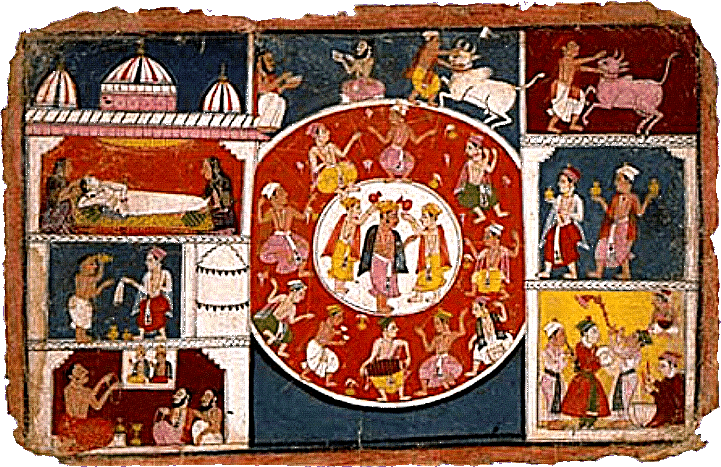
The image showing
birthday celebrations is titled:
"Scenes from the Life of Krishna: Celebrations
in Honor of Krishna's Birth"
Central India, 1680-90. Source: Virginia
Museum
of
Fine
Art.